
CUETMOCK
  • Pricing
  • Mentors
Log inStart freeStart free mocks→

First test, then trust

Try a free CUET mock test.

Join 5,00,000+ students who rehearsed exam day on the exact NTA screen before sitting CUET. On the web and on Android.

Start free mocks →Get the Android app
CUETMOCK

India's #1 CUET Mock Test Platform. Original NCERT-based questions on the exact NTA exam screen — trusted by 5,00,000+ students since CUET 2022.

Get it onGoogle PlayScan to download the CUETMOCK app

Mock tests

  • CUET mock test series
  • Browse all papers
  • Commerce mocks
  • Humanities (Arts) mocks
  • Science mocks
  • Languages & GAT mocks
  • Free practice questions
  • Pricing

Resources

  • CUET exam guide
  • CUET syllabus
  • Universities accepting CUET
  • Expert blogs
  • News & notifications
  • Webinars & counselling
  • CUET score calculator
  • How we estimate your rank
  • FAQs

Company

  • About us
  • Our leadership & team
  • Our toppers
  • Mentors
  • For schools
  • Contact us
  • Terms
  • Privacy
  • Refund policy

Talk to us

+91 7696 6630 56info@cuetmock.comWhatsApp us

Our other platforms

  • JEE Mock — For IIT-JEE aspirants
  • NEET Mock — For NEET aspirants

Newsletter

Exam updates, study material and offers — no spam.

© 2026 NYC Ventures Pvt. Ltd.

701-702, Royal Business Park, Zirakpur, Punjab - 140603

  • Terms of use
  • Privacy policy
  • Refund policy
  • Contact us

iCUETMOCK is an independent preparation platform, not affiliated with the National Testing Agency (NTA). Always check exam details on the official NTA website.

  • Home
  • Mock tests
  • CUET guide
  • Pricing
  • Log in
Home/Practice questions/General Aptitude Test
General Aptitude TestNon-Verbal ReasoningPuzzle

In the following question, find out which of the Figs. (1), (2), (3),…

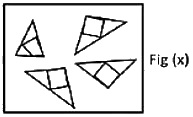
In the following question, find out which of the Figs. (1), (2), (3), and (4) can be formed from the pieces given in Fig. (X).
Question figure

Answer & explanation+

Correct answer: option 1

The correct answer is Option (1) → 

Option 1

The four triangles of Fig. (X), each with a quadrilateral running from its apex to the middle of the opposite side, meet at their apexes to form the rectangle cut by its two diagonals, and the four quadrilaterals join into the rhombus of Option (1), as shown below.
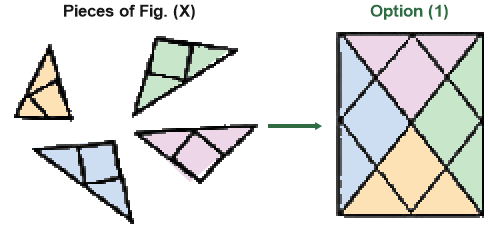
Figure for the solution

Advertisement

Practise more on Non-Verbal Reasoning

Chapter-wise mocks on the real NTA exam screen, with solutions and your rank. Your first mocks are free.

Start free mocks →

Advertisement

Next questions

  1. The term “Kutagarashala” literally means ____________.History · Ancient India: Thinkers, Beliefs and Buildings
  2. If there are Fixed assets of Rs.10,00,00 Current assets of Rs.6,00,000, Current liabilities of Rs.3,00,000 and Net profit before Interest a…Accountancy Part B · Accounting Ratios
  3. Traces of ‘canals’ have been found at which Harappan site?History · Ancient India: Bricks, Beads and Bones
  4. A swimming pool was constructed for swimmers with 18 meter wide and 24 meter long is 4 meter deep on shallow side and 8 meter deep on the d…General Aptitude Test · Quantitative Reasoning
  5. If the function f(x)=x^3-kx is increasing for all real value of x , thenMaths. Section A · Applications of Derivatives
  6. Identify the correct name of marine plant, pollinated by water.Biology · Sexual Reproduction in Flowering Plants
  7. Arrange the wavelengths of following transitions for an electron in hydrogen atom in increasing order.(A) n=2 to n=1 (B) n=3 to n=2 (C) n=4…Physics · Atoms
  8. Which of the following statements are correct for an individual with moderate intellectual disability?(A) They benefit from sheltered work…Psychology · Psychological Disorders
  9. ∫≤ft(√x-displaystyle1/(√x))^2dx = (where xgt 0 )Maths. Section A · Indefinite Integration
  10. The objective of Ford was:Business Studies · Directing