CUETMOCK
  • Pricing
  • Mentors
Log inStart freeStart free mocks→

First test, then trust

Try a free CUET mock test.

Join 5,00,000+ students who rehearsed exam day on the exact NTA screen before sitting CUET. On the web and on Android.

Start free mocks →Get the Android app
CUETMOCK

India's #1 CUET Mock Test Platform. Original NCERT-based questions on the exact NTA exam screen — trusted by 5,00,000+ students since CUET 2022.

Get it onGoogle PlayScan to download the CUETMOCK app

Mock tests

  • CUET mock test series
  • Browse all papers
  • Commerce mocks
  • Humanities (Arts) mocks
  • Science mocks
  • Languages & GAT mocks
  • Free practice questions
  • Pricing

Resources

  • CUET exam guide
  • CUET syllabus
  • Universities accepting CUET
  • Expert blogs
  • News & notifications
  • Webinars & counselling
  • CUET score calculator
  • How we estimate your rank
  • FAQs

Company

  • About us
  • Our leadership & team
  • Our toppers
  • Mentors
  • For schools
  • Contact us
  • Terms
  • Privacy
  • Refund policy

Talk to us

+91 7696 6630 56info@cuetmock.comWhatsApp us

Our other platforms

  • JEE Mock — For IIT-JEE aspirants
  • NEET Mock — For NEET aspirants

Newsletter

Exam updates, study material and offers — no spam.

© 2026 NYC Ventures Pvt. Ltd.

701-702, Royal Business Park, Zirakpur, Punjab - 140603

  • Terms of use
  • Privacy policy
  • Refund policy
  • Contact us

iCUETMOCK is an independent preparation platform, not affiliated with the National Testing Agency (NTA). Always check exam details on the official NTA website.

  • Home
  • Mock tests
  • CUET guide
  • Pricing
  • Log in
Home/Practice questions/Accountancy Part B
Accountancy Part BAccounting Ratios

If there are Fixed assets of Rs.10,00,00 Current assets of Rs.6,00,00…

If there are Fixed assets of Rs.10,00,00 Current assets of Rs.6,00,000, Current liabilities of Rs.3,00,000 and Net profit before Interest and Tax of Rs.2,60,000; then Return on Investment will be:

Answer & explanation+

Correct answer: option 3

The correct answer is Option (3) → 20%

Return on Investment (Return on Capital Employed) compares the profit before interest and tax with the capital employed. Capital employed can be taken as non-current (fixed) assets plus working capital.

  • Working capital = Current assets − Current liabilities = Rs. 6,00,000 − Rs. 3,00,000 = Rs. 3,00,000

  • Capital employed = Fixed assets + Working capital = Rs. 10,00,000 + Rs. 3,00,000 = Rs. 13,00,000

  • Return on Investment = Rs. 2,60,000 / Rs. 13,00,000 × 100 = 20%

Note: It seems that there is a mistake in the original NTA paper, which prints the fixed assets as Rs.10,00,00 when it should read Rs.10,00,000. Read as Rs. 1,00,000, the capital employed would be Rs. 4,00,000 and the return 65%, which is not among the options; with Rs. 10,00,000 the return is 20%, which is Option (3).

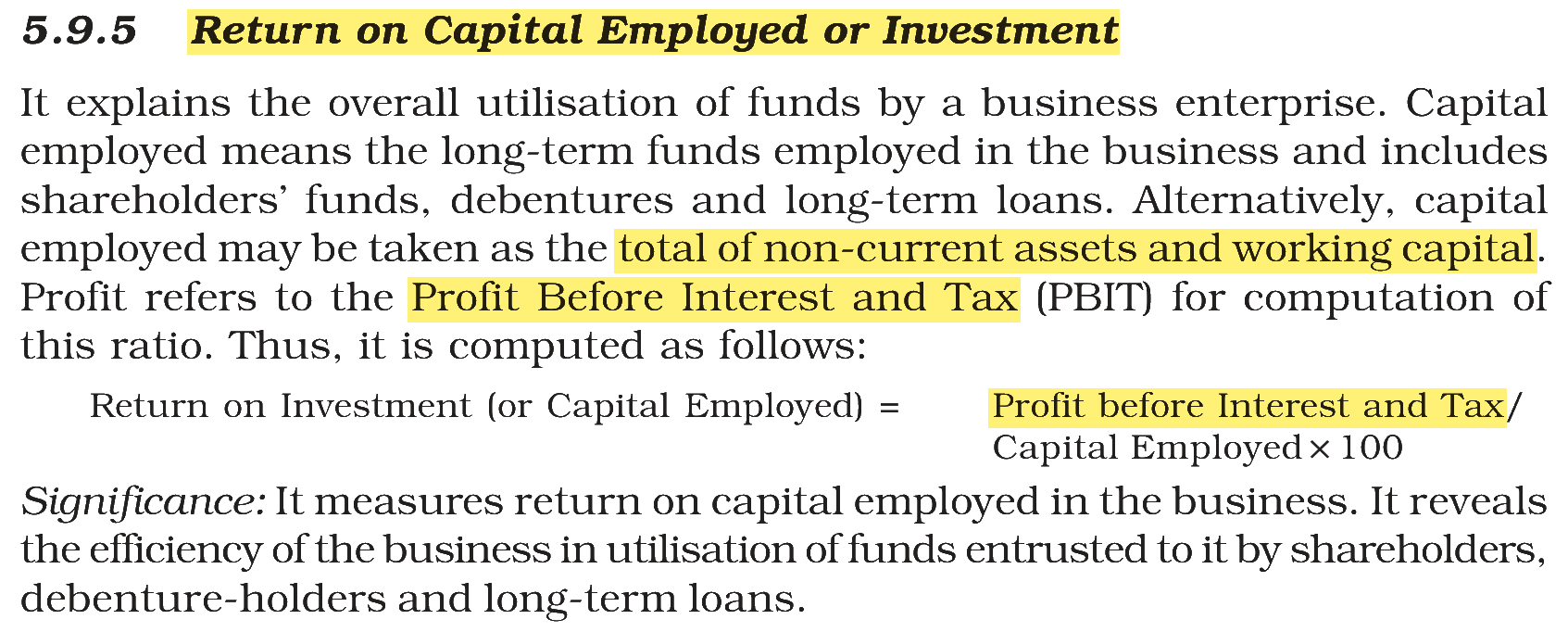
NCERT (2026-27 edition):
Return on Capital Employed or Investment

Extract from the NCERT textbook

Advertisement

Practise more on Accounting Ratios

Chapter-wise mocks on the real NTA exam screen, with solutions and your rank. Your first mocks are free.

Start free mocks →

Advertisement

Next questions

  1. Traces of ‘canals’ have been found at which Harappan site?History · Ancient India: Bricks, Beads and Bones
  2. A swimming pool was constructed for swimmers with 18 meter wide and 24 meter long is 4 meter deep on shallow side and 8 meter deep on the d…General Aptitude Test · Quantitative Reasoning
  3. If the function f(x)=x^3-kx is increasing for all real value of x , thenMaths. Section A · Applications of Derivatives
  4. Identify the correct name of marine plant, pollinated by water.Biology · Sexual Reproduction in Flowering Plants
  5. Arrange the wavelengths of following transitions for an electron in hydrogen atom in increasing order.(A) n=2 to n=1 (B) n=3 to n=2 (C) n=4…Physics · Atoms
  6. Which of the following statements are correct for an individual with moderate intellectual disability?(A) They benefit from sheltered work…Psychology · Psychological Disorders
  7. Under dirty floating system, central banks intervene to buy and sell foreign currencies in an attempt to moderate exchange rate movements w…Economics · Macro Economics: Open Economy Macro Economics
  8. The education cess levied by Government of India is earmarked for-Economics · Indian Economic Development: Human Capital Formation in India
  9. ∫≤ft(√x-displaystyle1/(√x))^2dx = (where xgt 0 )Maths. Section A · Indefinite Integration
  10. The objective of Ford was:Business Studies · Directing