Arrange the values of the following in ascending order (lowest to highest).
A. Thus, it causes AD and output to increase by an amount larger than initial increment
B. Consequently, AD line shift parallel upward
C. Suppose, the autonomous investment increases in the economy
D. There is an emergence of excess demand in the economy
Choose the correct sequence from the options given below:
Answer & explanation
Correct answer: option 1
The correct answer is Option (1) → C, B, D, A.
The economy is in equilibrium when aggregate demand equals output. If something lifts demand — say, firms decide to invest more — output must rise, and as it rises incomes rise and spending rises again. The four statements trace this chain from its cause to its final result.
(C) Suppose, the autonomous investment increases in the economy — the first step, and the cause of all that follows. Autonomous investment does not depend on income; it changes with things such as the rate of interest and the availability of credit.
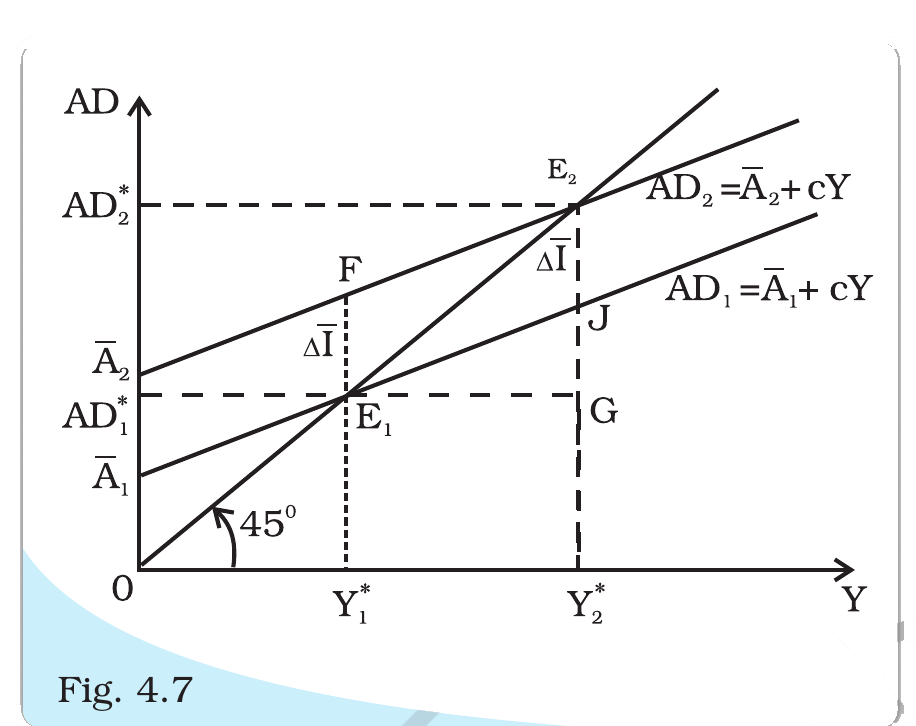
(B) Consequently, AD line shift parallel upward — aggregate demand is AD = A + cY, so a rise in the autonomous part A raises the intercept by the amount of the extra investment and leaves the slope c unchanged. The AD line therefore shifts upward in parallel.
(D) There is an emergence of excess demand in the economy — at the old level of output, aggregate demand now exceeds output, and this excess demand is what makes firms produce more. The old equilibrium no longer holds.
(A) Thus, it causes AD and output to increase by an amount larger than initial increment — the result. The extra output is paid out as wages, interest, rent and profit, so income rises. People spend the fraction c (the MPC) of this extra income, so demand rises again, firms raise output once more, and the process goes on round after round in smaller and smaller amounts. This is the multiplier mechanism. In the new equilibrium, output and aggregate demand have risen by more than the initial increase: the total rise is the investment multiplier, 1/(1 − c), times the increase in investment.
Note: It seems that there is a mistake in the original NTA paper, which asks to ‘Arrange the values of the following in ascending order (lowest to highest)’ when it should ask for the four statements to be arranged in the order in which they occur. They are steps of the multiplier process, not values, so they can only be put in sequence; read that way, the question can still be answered.
NCERT (2025-26): “4.3.2 Effect of an Autonomous Change in Aggregate Demand on Income and Output … When autonomous investment increases, the AD1 line shifts in parallel upwards and assumes the position AD2. The value of aggregate demand at output Y1* is Y1*F, which is greater than the value of output 0Y1* = Y1*E1 by an amount E1F. E1F measures the amount of excess demand that emerges in the economy as a result of the increase in autonomous expenditure. Thus, E1 no longer represents the equilibrium.… That occurs at point E2, which is, therefore, the new equilibrium point. The new equilibrium values of output and aggregate demand are Y2* and AD2*, respectively. Note that in the new equilibrium, output and aggregate demand have increased by an amount E1G = E2G, which is greater than the initial increment in autonomous expenditure… Thus an initial increment in the autonomous expenditure seems to have a multiplier on the equilibrium values of aggregate demand and output. What causes aggregate demand and output to increase by an amount larger than the size of the initial increment in autonomous expenditure? We discuss it in section 4.3.3.…”
|