
CUETMOCK
  • Pricing
  • Mentors
Log inStart freeStart free mocks→

First test, then trust

Try a free CUET mock test.

Join 5,00,000+ students who rehearsed exam day on the exact NTA screen before sitting CUET. On the web and on Android.

Start free mocks →Get the Android app
CUETMOCK

India's #1 CUET Mock Test Platform. Original NCERT-based questions on the exact NTA exam screen — trusted by 5,00,000+ students since CUET 2022.

Get it onGoogle PlayScan to download the CUETMOCK app

Mock tests

  • CUET mock test series
  • Commerce mocks
  • Humanities (Arts) mocks
  • Science mocks
  • Languages & GAT mocks
  • Free practice questions
  • Pricing

Resources

  • CUET exam guide
  • CUET syllabus
  • Universities accepting CUET
  • Expert blogs
  • News & notifications
  • Webinars & counselling
  • CUET score calculator
  • How we estimate your rank
  • FAQs

Company

  • About us
  • Our leadership & team
  • Our toppers
  • Mentors
  • For schools
  • Contact us
  • Terms
  • Privacy
  • Refund policy

Talk to us

+91 7696 6630 56info@cuetmock.comWhatsApp us

Our other platforms

  • JEE Mock — For IIT-JEE aspirants
  • NEET Mock — For NEET aspirants

Newsletter

Exam updates, study material and offers — no spam.

© 2026 NYC Ventures Pvt. Ltd.

701-702, Royal Business Park, Zirakpur, Punjab - 140603

  • Terms of use
  • Privacy policy
  • Refund policy
  • Contact us

iCUETMOCK is an independent preparation platform, not affiliated with the National Testing Agency (NTA). Always check exam details on the official NTA website.

  • Home
  • Mock tests
  • CUET guide
  • Pricing
  • Log in
Home/Practice questions/Physics
PhysicsRay Optics

The figure below shows an equiconvex lens (n = 1.5) placed in contact…

The figure below shows an equiconvex lens (n = 1.5) placed in contact with a thin liquid layer resting on a plane mirror. A small needle, with its tip positioned on the principal axis of the lens, is moved along the axis until its inverted image coincides with the needle tip itself.

When the liquid is present, the distance between the needle and the lens is found to be 50 cm. The experiment is then repeated after removing the liquid, and the distance is observed to be 35 cm. The refractive index of the liquid is-
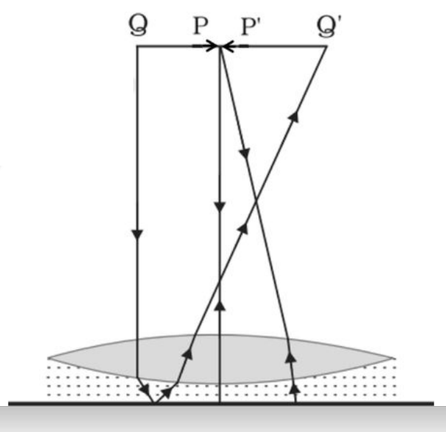
Figure for the question

Answer & explanation+

Correct answer: option 2

The correct answer is Option (2) → 1.30

The needle’s image coincides with the needle when rays from its tip leave the lens parallel to the axis, strike the plane mirror normally and retrace their path. So the needle is at the focus of the lens system placed above the mirror.

Without the liquid, the system is the glass lens alone, so its focal length is \( f_1 = 35 \) cm. Using the lens maker’s formula for the equiconvex lens (\( R_1 = +R,\ R_2 = -R \)):

    \( \displaystyle \frac{1}{f_1} = (n - 1)\left(\frac{1}{R} + \frac{1}{R}\right) = \frac{2(1.5 - 1)}{R} = \frac{1}{R} \)

    \( \displaystyle R = f_1 = 35\,\mathrm{cm} \)

With the liquid, the glass lens and the liquid layer act as two thin lenses in contact, with combined focal length F = 50 cm.

    \( \displaystyle \frac{1}{F} = \frac{1}{f_1} + \frac{1}{f_2} \)

    \( \displaystyle \frac{1}{f_2} = \frac{1}{50} - \frac{1}{35} = \frac{7 - 10}{350} = -\frac{3}{350}\,\mathrm{cm^{-1}} \)

The liquid forms a plano-concave lens: its upper surface follows the lower face of the glass lens (\( R_1 = -35 \) cm) and its lower surface is plane (\( R_2 = \infty \)). Let its refractive index be \( \mu \).

    \( \displaystyle \frac{1}{f_2} = (\mu - 1)\left(\frac{1}{R_1} - \frac{1}{R_2}\right) = (\mu - 1)\left(-\frac{1}{35} - 0\right) \)

    \( \displaystyle -\frac{\mu - 1}{35} = -\frac{3}{350} \)

    \( \displaystyle \mu - 1 = 0.30 \)

    \( \displaystyle \mu = 1.30 \)

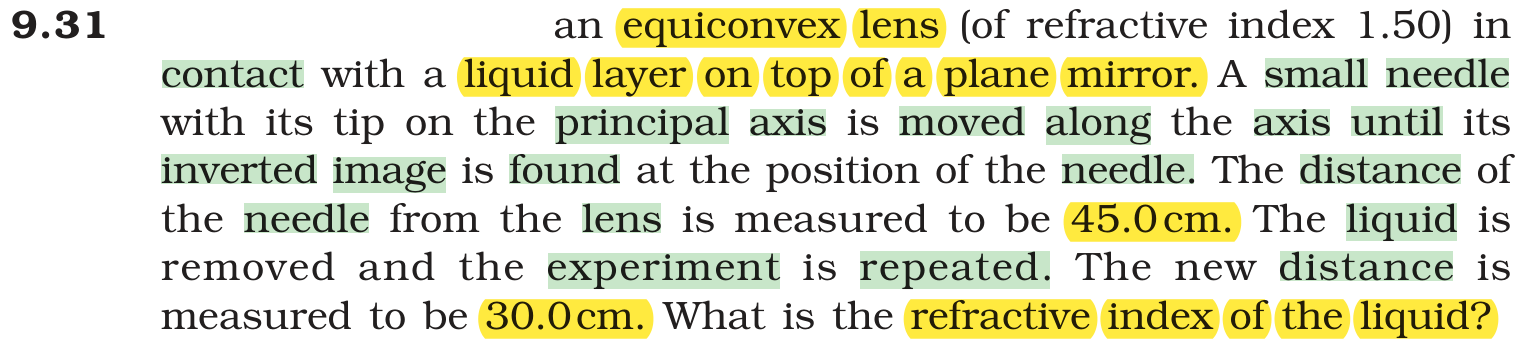
Note: NTA picked this question from an NCERT (2026-27) exercise and changed the figures. Do not ignore NCERT while practising numericals.

NCERT (2026-27):
Exercises – …
Textbook extract

Advertisement

Practise more on Ray Optics

Chapter-wise mocks on the real NTA exam screen, with solutions and your rank. Your first mocks are free.

Start free mocks →

Advertisement

Next questions

  1. The following reaction is catalysed by2I− + S2O82− → I2 + 2SO42−Chemistry · Inorganic: D and F Block Elements
  2. Which of the following has a negative value for temperature coefficient of resistivity?Physics · Current Electricity
  3. Arrange the following major religious teachers in a chronological order:(A) Basavanna in Karnataka(B) Sri Chaitanya in Bengal(C) Miyan Mir…History · Medieval India: Bhakti Sufi Traditions
  4. If y=log_x(x^2+1)·log_(x^2+1)x , then displaystyledy/dx isMaths. Section A · Continuity and Differentiability
  5. As a result of global warming, by what rate atmospheric temperature rises?Economics · Indian Economic Development: Environment and Sustainable Development
  6. If ∫displaystyle1/(tan x+cot x) dx=kcos 2x+C , where C is an arbitrary constant, then the value of k isMaths. Section B1 · Indefinite Integration
  7. Which organisation deals with the global trade regulations?Geography · Fundamentals of Human Geography: International Trade
  8. Revenue receipts are those receipts which__________________.Economics · Macro Economics: Government Budget and Economy
  9. Fill in the blanks with the appropriate Phrasal Verbs from the options given below:-The negotiations between the neighbouring states will s…English · Grammar: Phrasal Verb
  10. The supply function of a producer is given by p=displaystyle3/5e^3x , where x denotes a thousand units. If sales are 4000 units, then the p…Applied Maths. Section B2 · Calculus