
CUETMOCK
  • Pricing
  • Mentors
Log inStart freeStart free mocks→

First test, then trust

Try a free CUET mock test.

Join 5,00,000+ students who rehearsed exam day on the exact NTA screen before sitting CUET. On the web and on Android.

Start free mocks →Get the Android app
CUETMOCK

India's #1 CUET Mock Test Platform. Original NCERT-based questions on the exact NTA exam screen — trusted by 5,00,000+ students since CUET 2022.

Get it onGoogle PlayScan to download the CUETMOCK app

Mock tests

  • CUET mock test series
  • Commerce mocks
  • Humanities (Arts) mocks
  • Science mocks
  • Languages & GAT mocks
  • Free practice questions
  • Pricing

Resources

  • CUET exam guide
  • CUET syllabus
  • Universities accepting CUET
  • Expert blogs
  • News & notifications
  • Webinars & counselling
  • CUET score calculator
  • How we estimate your rank
  • FAQs

Company

  • About us
  • Our leadership & team
  • Our toppers
  • Mentors
  • For schools
  • Contact us
  • Terms
  • Privacy
  • Refund policy

Talk to us

+91 7696 6630 56info@cuetmock.comWhatsApp us

Our other platforms

  • JEE Mock — For IIT-JEE aspirants
  • NEET Mock — For NEET aspirants

Newsletter

Exam updates, study material and offers — no spam.

© 2026 NYC Ventures Pvt. Ltd.

701-702, Royal Business Park, Zirakpur, Punjab - 140603

  • Terms of use
  • Privacy policy
  • Refund policy
  • Contact us

iCUETMOCK is an independent preparation platform, not affiliated with the National Testing Agency (NTA). Always check exam details on the official NTA website.

  • Home
  • Mock tests
  • CUET guide
  • Pricing
  • Log in
Home/Practice questions/Chemistry
ChemistryPhysical: Solutions

The elevation of boiling point of a solvent depends upon

Comprehension:

Solutions

The solution which obeys Raoult's law over the entire range of concentration are known as ideal solutions and which does not obey are known as non-ideal solution. The vapour pressure of a non ideal solution is either higher or lower than that predicted by Raoult's law equation. The colligative properties, which depend on the number of solute particles irrespective of their nature, are relative lowering of vapour pressure, depression of freezing point, elevation of boiling point and osmotic pressure. All these properties can be utilised for the determination of molar mass of the solute.

The elevation of boiling point of a solvent depends upon

Answer & explanation+

Correct answer: option 3

The correct answer is Option (3) → the number of solute molecules.

Note: The given answer is as per the official NTA Answer Key. However, there is more than one correct option for this question, as explained below.

  • Option (3) the number of solute molecules is correct because elevation of boiling point is a colligative property: for a given solvent it depends on the number of solute particles, not on their nature.

  • Option (2) the nature of the solvent is also correct because the constant Kb in ΔTb = Kbm is a property of the solvent: the same molality of solute raises the boiling point of water by 0.52 K per mol kg−1, but that of benzene by 2.53 K.

  • m counts the moles (number) of solute particles per kilogram of solvent; the identity of the solute does not appear.

  • Kb, the molal elevation constant (ebullioscopic constant), depends only on the solvent:

        \( \displaystyle K_b=\frac{R\times M_1\times T_b^2}{1000\times\Delta_{vap}H} \)

So, for a given solvent, the elevation of boiling point depends on the number of solute molecules.

Why the other options are incorrect

  • Option (1) the nature of the solute — Incorrect. 1 mol of glucose and 1 mol of urea in 1 kg of water raise the boiling point by the same amount, so the nature of the solute does not matter (as long as it does not dissociate or associate).

  • Option (4) the number of solvent molecules — Incorrect. The solvent enters only as a fixed quantity (1 kg) in the definition of molality; the elevation is decided by how many solute particles that amount of solvent contains.

NCERT (2026-27 edition):
Elevation of Boiling Point – …
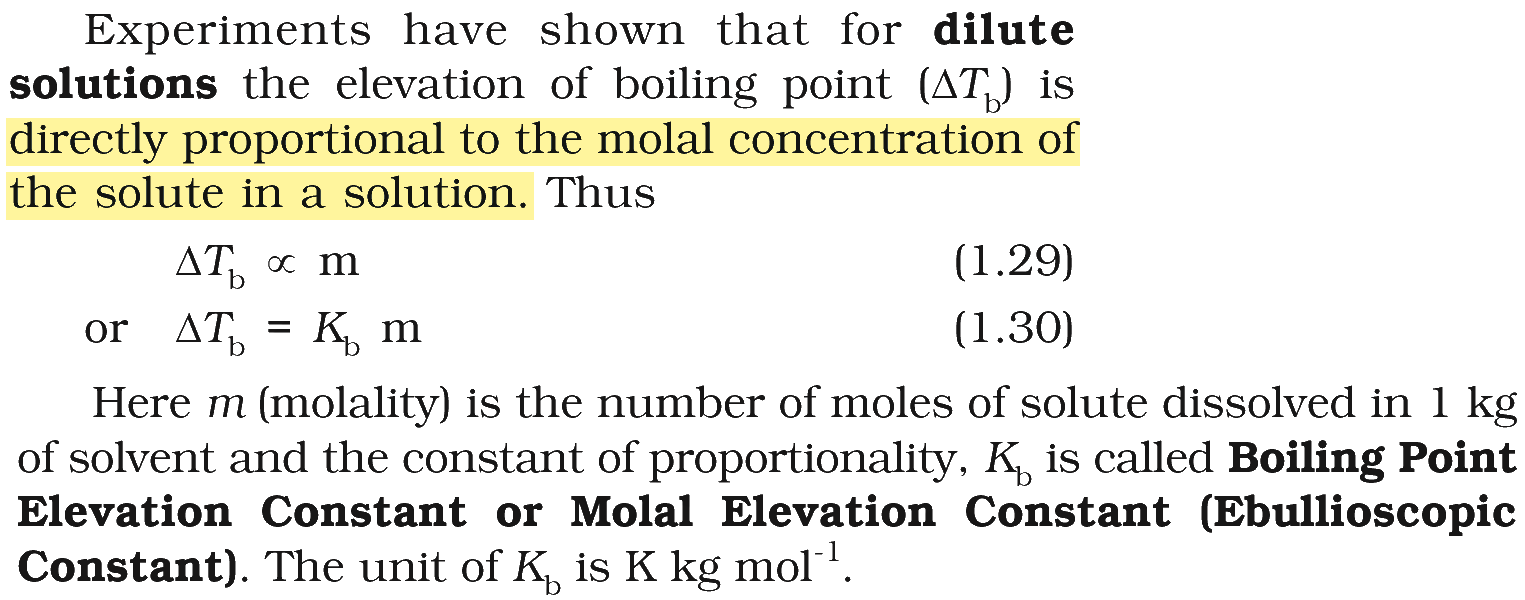
Textbook extract

Advertisement

Practise more on Physical: Solutions

Chapter-wise mocks on the real NTA exam screen, with solutions and your rank. Your first mocks are free.

Start free mocks →

Advertisement

Next questions

  1. Match List-I with List-IIList-IList-II(A)Column matrix(I) […] (B)Row matrix(II) […] (C)Diagonal matrix(III) […] (D)Scalar matrix(IV) […] Ch…Applied Maths. Section B2 · Algebra
  2. Match List-I with List-IIList-IList-IIDifferential equationOrder and Degree(A) (d^2y)/(dx^2)=1+√(displaystyledy/dx) (I) Order = 2, Degree =…Maths. Section A · Differential Equations
  3. A catalystChemistry · Physical: Chemical Kinetics
  4. Choose the incorrect statement.Environmental Studies
  5. In a hydrogen atom, a transition of an electron takes place from n = 3 to n = 2 orbit. The energy of the emitted photon will be:Physics · Atoms
  6. The matrix […] is not invertible forMaths. Section B1 · Determinants
  7. From the Point of view of Tenure, Debentures can be:Accountancy Part A · Issue and Redemption of Debentures
  8. A current passes through a wire of non-uniform cross-section. Which of the following quantities are independent of cross-section?A. Drift s…Physics · Current Electricity
  9. The inability to stop thinking about a particular idea or topic is known as:Psychology · Psychological Disorders
  10. Match List-I with List-IIList-IList-II(A)Capital Account(I)Difference between the value of exports and imports of goods(B)Balance of Trade…Economics · Macro Economics: Open Economy Macro Economics