A catalyst
Answer & explanation
Correct answer: option 4
The correct answer is Option (4) → alters the activation energy of the reaction.
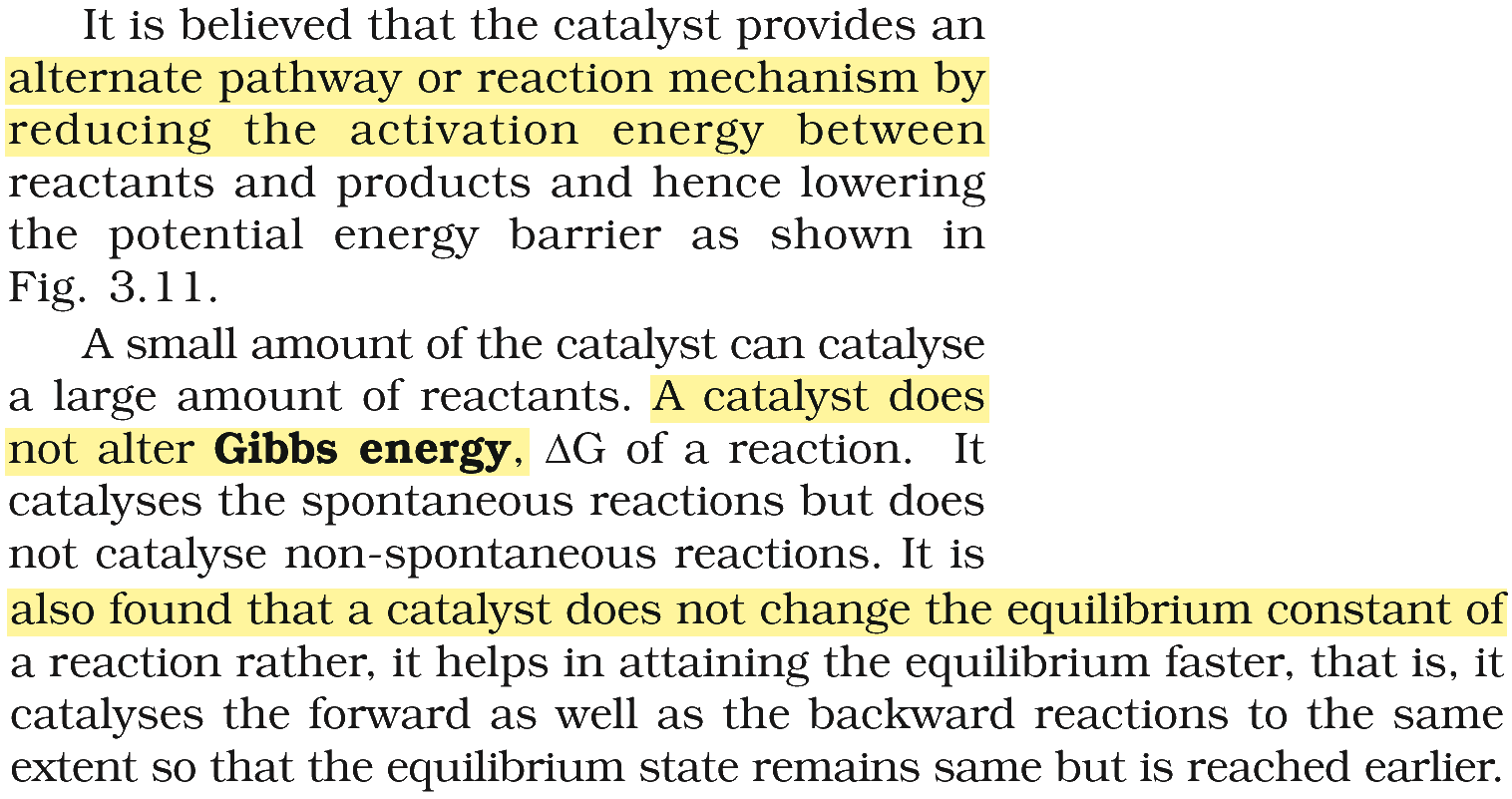
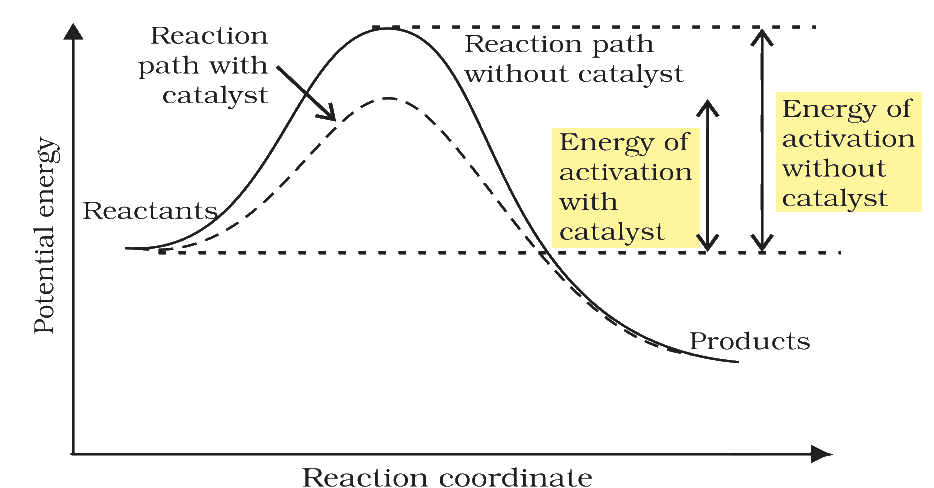
A catalyst increases the rate of a reaction without itself undergoing any permanent chemical change. It works by forming temporary bonds with the reactants and providing an alternative pathway (reaction mechanism) that has a lower activation energy. More molecules then have enough energy to react, so the rate increases.
Why the other options are incorrect
Option (1) is required in equal quantity as reactants — Incorrect. A catalyst is regenerated after each cycle, so a small quantity is enough.
Option (2) alters the Gibbs energy of a reaction — Incorrect. ΔG depends only on the initial and final states, which a catalyst does not change; it cannot make a non-spontaneous reaction spontaneous.
Option (3) alters the equilibrium constant of a reaction — Incorrect. The forward and backward rates are increased by the same factor, so K stays the same.
NCERT (2026-27 edition):
Effect of Catalyst – …