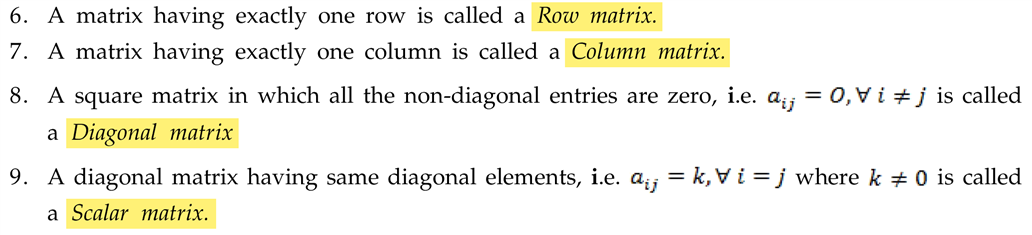
Match List-I with List-II
| List-I | List-II | ||
| (A) | Column matrix | (I) | \( \begin{bmatrix}1 & 2 & 3\end{bmatrix} \) |
| (B) | Row matrix | (II) | \( \begin{bmatrix}1 & 0 & 0\\0 & 2 & 0\\0 & 0 & 3\end{bmatrix} \) |
| (C) | Diagonal matrix | (III) | \( \begin{bmatrix}1\\2\\3\end{bmatrix} \) |
| (D) | Scalar matrix | (IV) | \( \begin{bmatrix}2 & 0 & 0\\0 & 2 & 0\\0 & 0 & 2\end{bmatrix} \) |
Choose the correct answer from the options given below:
Answer & explanation
Correct answer: option 3
The correct answer is Option (3) → (A) - (III), (B) - (I), (C) - (II), (D) - (IV)
(A) Column matrix
This matches (III), the 3 × 1 matrix with a single column.
(B) Row matrix
This matches (I), the 1 × 3 matrix [1 2 3] with a single row.
(C) Diagonal matrix
This matches (II). It is a square matrix whose entries off the leading diagonal are all 0; its diagonal entries 1, 2, 3 are not all equal, so it is diagonal but not scalar.
(D) Scalar matrix
This matches (IV), a diagonal matrix whose diagonal entries are all equal (here all 2).
So the matching is (A)-(III), (B)-(I), (C)-(II), (D)-(IV).
Note: Some List-I items fit more than one List-II entry. Item (C), Diagonal matrix, fits both (II) and (IV), because every scalar matrix is also a diagonal matrix and (IV) is a scalar matrix. The question can still be solved because (A), (B) and (D) have only one possible match each, and Option (3) is the only option with (A)-(III), (B)-(I) and (D)-(IV).
CBSE Applied Mathematics (Class XII):
Algebra