In the discontinuous synthesis of DNA replication, the two fragments of DNA are joined by:
Answer & explanation
Correct answer: option 3
The correct answer is Option (3) → DNA ligase
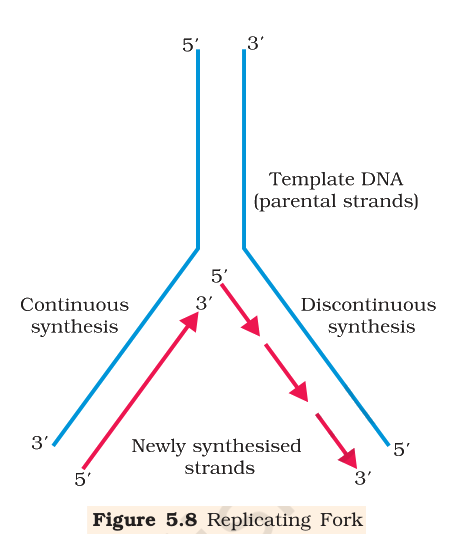
DNA polymerase can add nucleotides only in the 5′ to 3′ direction. So on one template strand the new strand is made continuously, and on the other it is made as short pieces, which is discontinuous synthesis. These short pieces are the Okazaki fragments, and they are joined by the enzyme DNA ligase.
(1) DNA polymerase — Incorrect. It makes each piece by adding nucleotides. It does not join two separate fragments.
(2) RNA polymerase — Incorrect. It makes RNA from a DNA template during transcription.
(3) DNA ligase — Correct. It seals the fragments into one continuous strand.
(4) Endonuclease — Incorrect. It cuts DNA inside the strand. It does not join pieces.
NCERT Extract:
The Machinery and the Enzymes – “… The DNA-dependent DNA polymerases catalyse polymerisation only in one direction, that is 5’ 3’. This creates some additional complications at the replicating fork. Consequently, on one strand (the template with polarity 3’ 5’ ), the replication is continuous, while on the other (the template with polarity 5’ 3’ ), it is discontinuous. The discontinuously synthesised fragments are later joined by the enzyme DNA ligase (Figure 5.8).”