
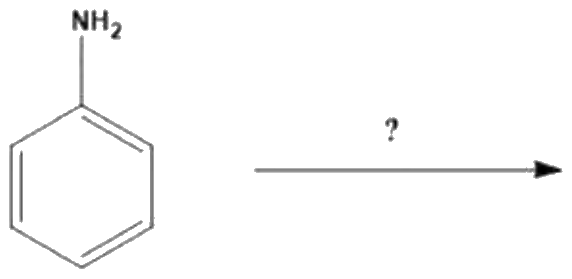
The first step in conversion of aniline to 4-bromoaniline involves
Answer & explanation
Correct answer: option 1
The correct answer is Option (1) → Acetylation of amino group
The –\( \ce{NH2} \) group is a very strong activating group. Its lone pair pushes electrons into the ring, so aniline reacts with bromine water at room temperature and gives 2,4,6-tribromoaniline at once. The reaction cannot be stopped at the monobromo stage.
To get only the para product, the activating effect is first reduced by acetylation. In acetanilide the lone pair on nitrogen is also delocalised onto the neighbouring C=O group, so it activates the ring less. The bulky –\( \ce{NHCOCH3} \) group also hinders the ortho positions, so bromine enters mainly at the para position. Hydrolysis then gives back the amino group:
\( \displaystyle \ce{C6H5NH2 + (CH3CO)2O} \xrightarrow{\text{pyridine}} \ce{C6H5NHCOCH3 + CH3COOH} \)
\( \displaystyle \ce{C6H5NHCOCH3 + Br2} \xrightarrow{\ce{CH3COOH}} \text{4-bromoacetanilide} + \ce{HBr} \)
\( \displaystyle \text{4-bromoacetanilide} + \ce{H2O} \xrightarrow{\ce{H^+}\text{ or }\ce{OH^-}} \text{4-bromoaniline} + \ce{CH3COOH} \)
So the first step is the acetylation of the amino group.
Why the other options are incorrect
Option (2) Formation of diazonium salt in the presence of NaNO2 and HCl — Incorrect. Diazotisation converts –\( \ce{NH2} \) into –\( \ce{N2^{+}} \), which is later replaced, so the amino group would be lost.
Option (3) Reaction with Bromine water at room temperature — Incorrect. This gives 2,4,6-tribromoaniline, not the monobromo product.
Option (4) Reaction with Bromine in the presence of NaOH — Incorrect. \( \ce{Br2} \)/NaOH is the reagent of the Hofmann bromamide reaction of amides; it does not brominate the ring of aniline selectively.
NCERT (2026-27 edition):
Bromination – “Aniline reacts with bromine water at room temperature to give a white precipitate of 2,4,6-tribromoaniline. The main problem encountered during electrophilic substitution reactions of aromatic amines is that of their very high reactivity. Substitution tends to occur at ortho- and para-positions. … This can be done by protecting the –NH2 group by acetylation with acetic anhydride, then carrying out the desired substitution followed by hydrolysis of the substituted amide to the substituted amine.”