Arrange the following statements in correct order in the context of flexible exchange rate system.
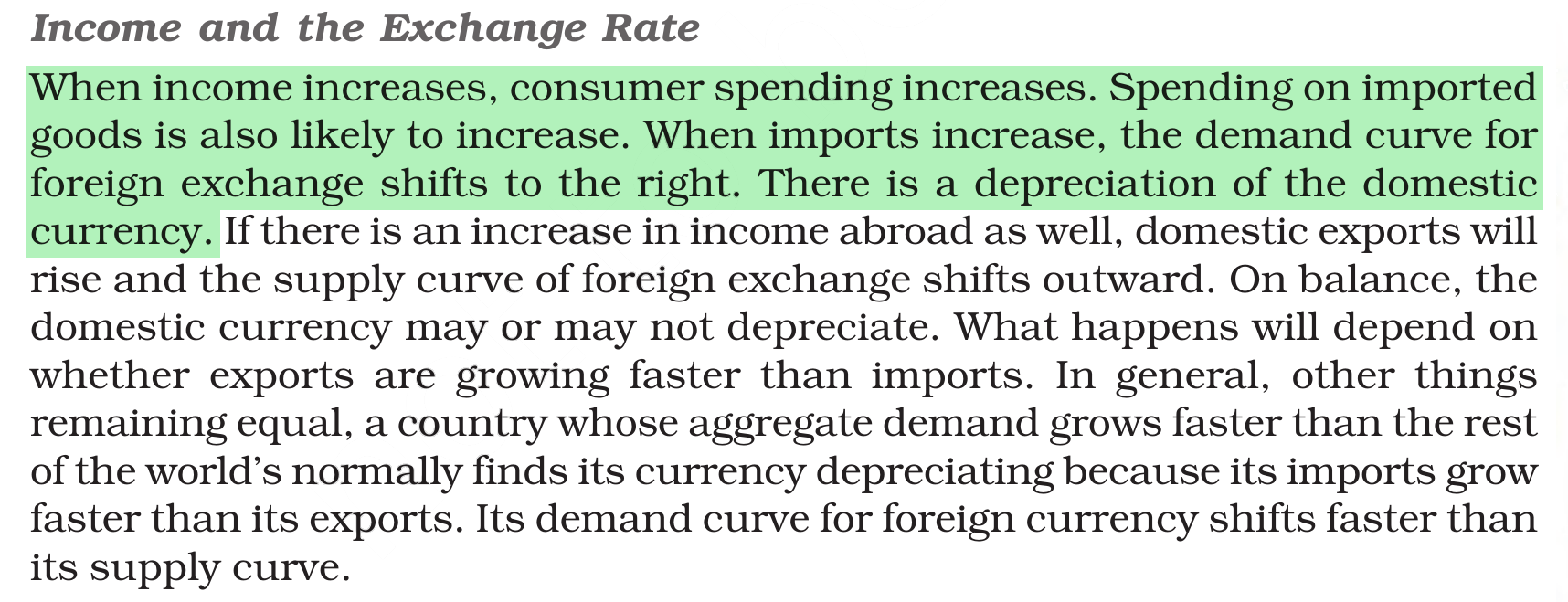
(A) When income increases, consumer spending increases.
(B) Shift in demand curve for foreign exchange towards right.
(C) Spending on imported goods increases.
(D) Depreciation of domestic currency with respect to foreign currency.
Choose the correct answer from the options given below:
Answer & explanation
Correct answer: option 2
The correct answer is Option (2) → (A), (C), (B), (D)
The exchange rate is the price of foreign currency in rupees, and under a flexible system it is set by the demand for and supply of foreign exchange. Imports have to be paid for in foreign currency, so anything that makes people buy more from abroad raises the demand for it. A rise in national income does this, and its effect reaches the rupee step by step.
(A) When income increases, consumer spending increases. This is the starting point. When income rises, consumers have more to spend, and consumer spending rises with it.
(C) Spending on imported goods increases. Part of the extra spending falls on goods produced abroad, so the value of imports goes up along with income.
(B) Shift in demand curve for foreign exchange towards right. Foreign sellers have to be paid in their own currency. To pay for the larger imports, importers must buy more foreign currency, so the demand for foreign exchange rises at every exchange rate and the demand curve shifts to the right.
(D) Depreciation of domestic currency with respect to foreign currency. With the supply of foreign exchange unchanged and the demand higher, foreign currency becomes dearer: more units of the domestic currency are needed to buy one unit of it. That is a depreciation of the domestic currency, and it comes last, as the result of the steps before it.
Note: A same/similar question was asked in CUET (UG) in the papers below.
| 2026 | 2025 | 2024 | 2023 | 2022 |
| 11-05 S2* 13-05 S2 | – | – | – | – |
* A similar question.
NCERT: Introductory Macroeconomics — Chapter 6: Open Economy Macroeconomics (2025-26)
|