Which of the following condition is satisfied for a firm to maximise it's profit in the short run under perfect competition?
Where, P = Price, AC = Average cost, MC = Marginal Cost.
Answer & explanation
Correct answer: option 2
The correct answer is Option (2) → P = SMC
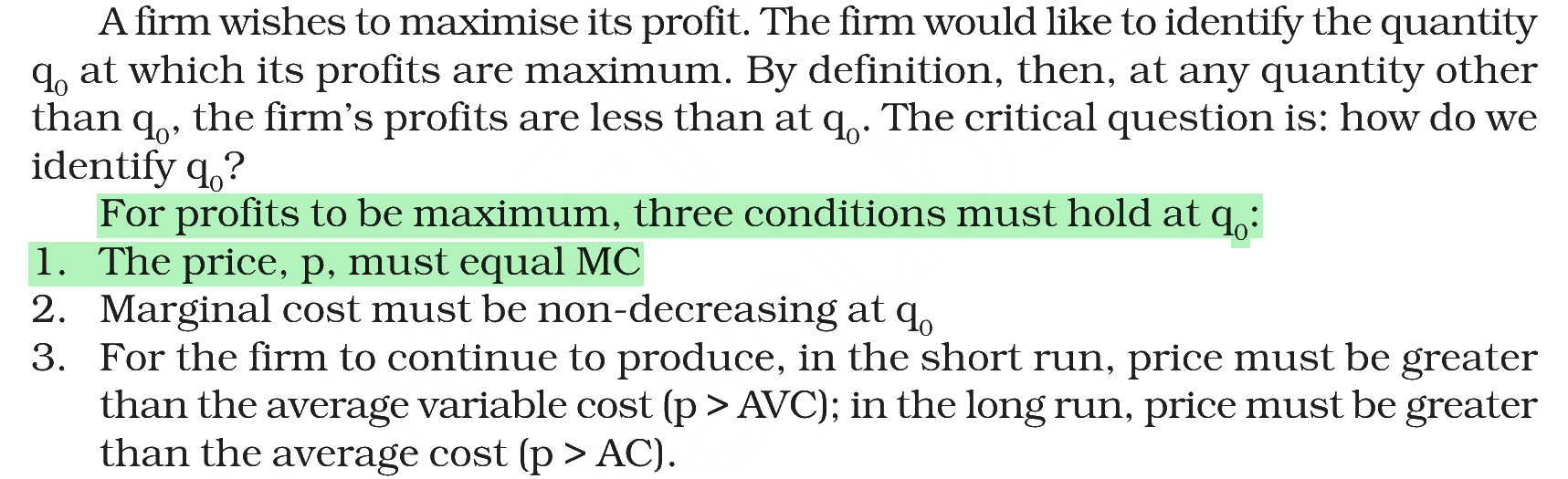
A firm’s profit is its total revenue minus its total cost. Under perfect competition the firm is a price taker: it can sell any quantity at the market price, so each extra unit adds the price, P, to its revenue. Each extra unit also adds to its cost, and that addition is the short run marginal cost (SMC). The firm compares the two unit by unit:
If P > SMC, one more unit adds more to revenue than to cost, so raising output raises profit.
If P < SMC, the last unit costs more than it brings in, so cutting output raises profit.
Profit is therefore highest where neither change helps, at the output where P = SMC, with SMC rising there and the price at least covering average variable cost.
Why the other options are incorrect
Option (1) P < SMC — Incorrect. This is the case where the firm is producing too much; it has gone past the profit-maximising output.
Option (3) P > SAC — Incorrect. Price above short run average cost means the firm earns supernormal profit, not that its profit is at a maximum; that can hold at many outputs, and profit is highest at only one.
Option (4) P/SMC — Incorrect. A ratio, not a condition; it states no equality or inequality and so says nothing about output.
NCERT: Introductory Microeconomics — Chapter 4: The Theory of the Firm under Perfect Competition (2025-26)
|