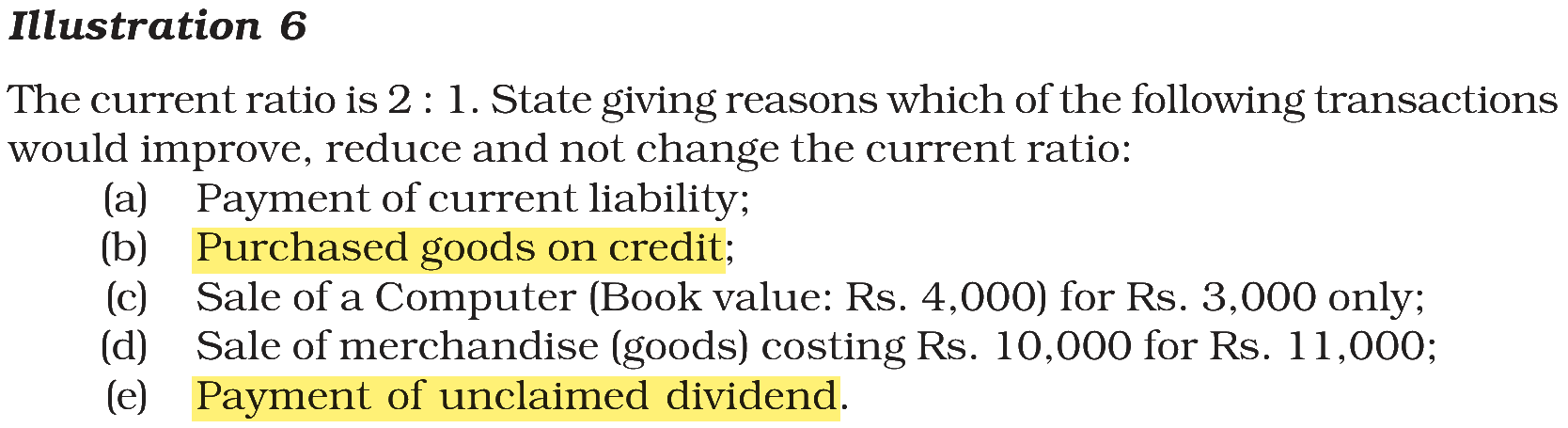
The current ratio is 2 : 1. Which of the following transactions would improve, reduce or not change the current ratio? Match List-I with List-II
| List-I | List-II | ||
|---|---|---|---|
| (A) | Payment of unclaimed dividend | (I) | Improve |
| (B) | Purchase of Machinery against Issue of Shares | (II) | Reduce |
| (C) | Sale of goods on credit | (III) | Will not be recorded |
| (D) | Purchased goods on credit | (IV) | Does not Change |
Choose the correct answer from the options given below:
Answer & explanation
Correct answer: option 2
The correct answer is Option (2) → (A) - (I), (B) - (III), (C) - (IV), (D) - (II)
Current ratio = current assets ÷ current liabilities. At 2 : 1, a transaction that changes both by the same amount moves the ratio: taking the same amount off both raises it, adding the same amount to both lowers it.
(A) Payment of unclaimed dividend — this matches (I) Improve. Unclaimed dividend is a current liability, so cash and the liability fall together.
Before = Rs. 2,00,000 : Rs. 1,00,000 = 2 : 1
After paying Rs. 10,000 = Rs. 1,90,000 : Rs. 90,000 = 2.11 : 1
(B) Purchase of Machinery against Issue of Shares — this matches (III) Will not be recorded, by elimination. The printed entry does not actually match: the transaction is recorded, but it involves only a fixed asset and share capital, so the current ratio does not change.
(C) Sale of goods on credit — this matches (IV) Does not Change. If the goods are sold at cost, stock is replaced by debtors of the same amount and current assets stay as they were. The question does not say the goods are sold at cost; sold at a profit, current assets rise and the ratio improves.
(D) Purchased goods on credit — this matches (II) Reduce. Stock and creditors rise by the same amount.
After buying Rs. 10,000 = Rs. 2,10,000 : Rs. 1,10,000 = 1.91 : 1
Note: It seems that there is a mistake in the original NTA paper, which prints (III) “Will not be recorded” in List-II when it should read “Does not Change”: no transaction fits (III), while (B) and (C), as worked above, both fit (IV). The question can still be solved: only Option (2) pairs (A) with (I) and (D) with (II), the two certain matches. Match the items that have only one possible match first; the options then settle the rest.
NCERT (2026-27 edition):
|