CUETMOCK
  • Pricing
  • Mentors
Log inStart freeStart free mocks→

First test, then trust

Try a free CUET mock test.

Join 5,00,000+ students who rehearsed exam day on the exact NTA screen before sitting CUET. On the web and on Android.

Start free mocks →Get the Android app
CUETMOCK

India's #1 CUET Mock Test Platform. Original NCERT-based questions on the exact NTA exam screen — trusted by 5,00,000+ students since CUET 2022.

Get it onGoogle PlayScan to download the CUETMOCK app

Mock tests

  • CUET mock test series
  • Browse all papers
  • Commerce mocks
  • Humanities (Arts) mocks
  • Science mocks
  • Languages & GAT mocks
  • Free practice questions
  • Pricing

Resources

  • CUET exam guide
  • CUET syllabus
  • Universities accepting CUET
  • Expert blogs
  • News & notifications
  • Webinars & counselling
  • CUET score calculator
  • How we estimate your rank
  • FAQs

Company

  • About us
  • Our leadership & team
  • Our toppers
  • Mentors
  • For schools
  • Contact us
  • Terms
  • Privacy
  • Refund policy

Talk to us

+91 7696 6630 56info@cuetmock.comWhatsApp us

Our other platforms

  • JEE Mock — For IIT-JEE aspirants
  • NEET Mock — For NEET aspirants

Newsletter

Exam updates, study material and offers — no spam.

© 2026 NYC Ventures Pvt. Ltd.

701-702, Royal Business Park, Zirakpur, Punjab - 140603

  • Terms of use
  • Privacy policy
  • Refund policy
  • Contact us

iCUETMOCK is an independent preparation platform, not affiliated with the National Testing Agency (NTA). Always check exam details on the official NTA website.

  • Home
  • Mock tests
  • CUET guide
  • Pricing
  • Log in
Home/Practice questions/Psychology
PsychologyAttitudes and Social Cognition

Which mode of spreading the message about benefits of ORS will be mor…

Read the passage and answer the questions:

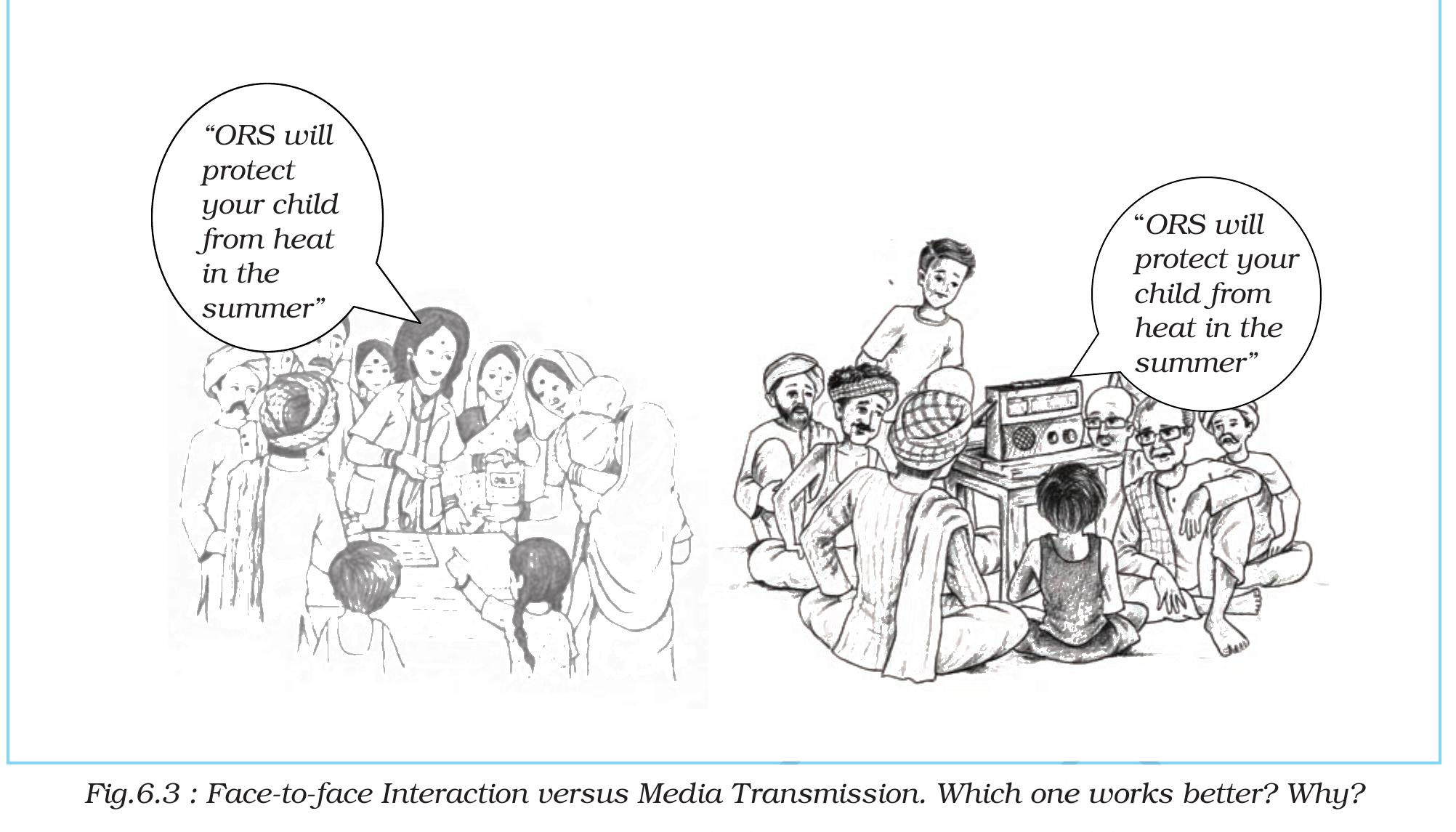
A non-profit organisation wanted to promote and teach people of a village about the benefits of Oral Rehydration Salts (ORS). They made colorful posters with graphics and pasted them near the Panchayat and Health Centre of the village. However, despite the posters displayed at multiple points in the entire village, they were unable to communicate or bring positive change in the attitude of the villagers. They changed their strategy and started using radio to educate the villagers. When one of the volunteers started to interact face-to-face with the villagers, she was surprised to see that most of the villagers were unaware of the benefits of ORS despite the efforts of the organisation. During the interaction, she found that disseminating information regarding ORS by meeting in person was more persuading. She reported this to her seniors and requested to change in the strategy to bring positive changes in the attitude of the villagers regarding the uses of ORS.

Which mode of spreading the message about benefits of ORS will be more effective for villagers?

Answer & explanation+

Correct answer: option 1

The correct answer is Option (1) → Face-to-face interaction

Option (1) Face-to-face interaction — Correct. The mode of spreading the message plays a significant role in attitude change. Face-to-face transmission is usually more effective than indirect transmission. The volunteer found the same: meeting the villagers in person was more persuading than all the posters.

Option (2) Letters and Pamphlets — Incorrect. Letters and pamphlets are indirect transmission. Like the organisation’s posters, they carry the message without anyone to explain it or answer doubts.

Option (3) Indirect Transmission — Incorrect. This is the general name for the less effective mode: letters, pamphlets or mass media, set against face-to-face talk.

Option (4) Television and radio — Incorrect. These are mass media. A positive attitude towards ORS is created more effectively when workers and doctors talk to people directly than by describing its benefits on the radio, which the organisation had already tried.

Note: This case is built on the ORS example NCERT uses for the mode of spreading a message in attitude change, with its picture of face-to-face talk set against a radio broadcast (Fig. 6.3). Even a one-line example beside a figure can come back as a full case study; give the pictures and their examples the same attention as the main text.


NCERT (2025-26): “Message characteristics : … Finally, the mode of spreading the message plays a significant role. Face-to-face transmission of the message is usually more effective than indirect transmission, as for instance, through letters and pamphlets, or even through mass media. For example, a positive attitude towards Oral Rehydration Salts (ORS) for young children is more effectively created if community social workers and doctors spread the message by talking to people directly, than by only describing the benefits of ORS on the radio …. These days transmission through visual media such as television and the Internet are similar to face-to-face interaction, but not a substitute for the latter.”

NCERT extract

Advertisement

Practise more on Attitudes and Social Cognition

Chapter-wise mocks on the real NTA exam screen, with solutions and your rank. Your first mocks are free.

Start free mocks →

Advertisement

Next questions

  1. Process of moving from self-employment and regular salaried employment to casual wage work is referred as:Economics · Indian Economic Development: Employment - Growth, Informalisation and Other Issues
  2. Which of the following is NOT an interstitial compound?Chemistry · Inorganic: D and F Block Elements
  3. Satyajit Ray’s film ‘Jalshaghar’, on the decline of the aristocratic zamindari style of living, was shot at which place?History · Modern India: Colonialism and the Countryside
  4. The Indian Constitution provides for the office of the Comptroller and Auditor General of India (CAG). On Nov 21, 2024, the name of the app…General Aptitude Test · Current Affairs
  5. If A exceeds B by 40%, B is less than C by 20%, then A : C is :General Aptitude Test · Numerical Ability
  6. The maximum value of z=5x+3y subjected to the constraints 2x+3y≥ 60,2x+y≤ 40;x,y≥ 0 is:Maths. Section A · Linear Programming
  7. Match the LIST-I with LIST-IILIST-ILIST-IITrophic levelsExamplesA. FirstI. Man, lionB. SecondII. Phytoplankton, treesC. ThirdIII. Zooplankt…Biology · Ecosystem
  8. Identify the source of the excerpt titled, ‘Why the Salt Satyagraha’?History · Modern India: Mahatma Gandhi and the Nationalist movement
  9. If X is the brother of the son of Y's son, how is X related to Y?General Aptitude Test · Verbal Reasoning
  10. The term “switch cost” in the passage implies that-English · Comprehension - (Narrative / Factual)