Process of moving from self-employment and regular salaried employment to casual wage work is referred as:
Answer & explanation
Correct answer: option 3
The correct answer is Option (3) → Casualisation of workforce.
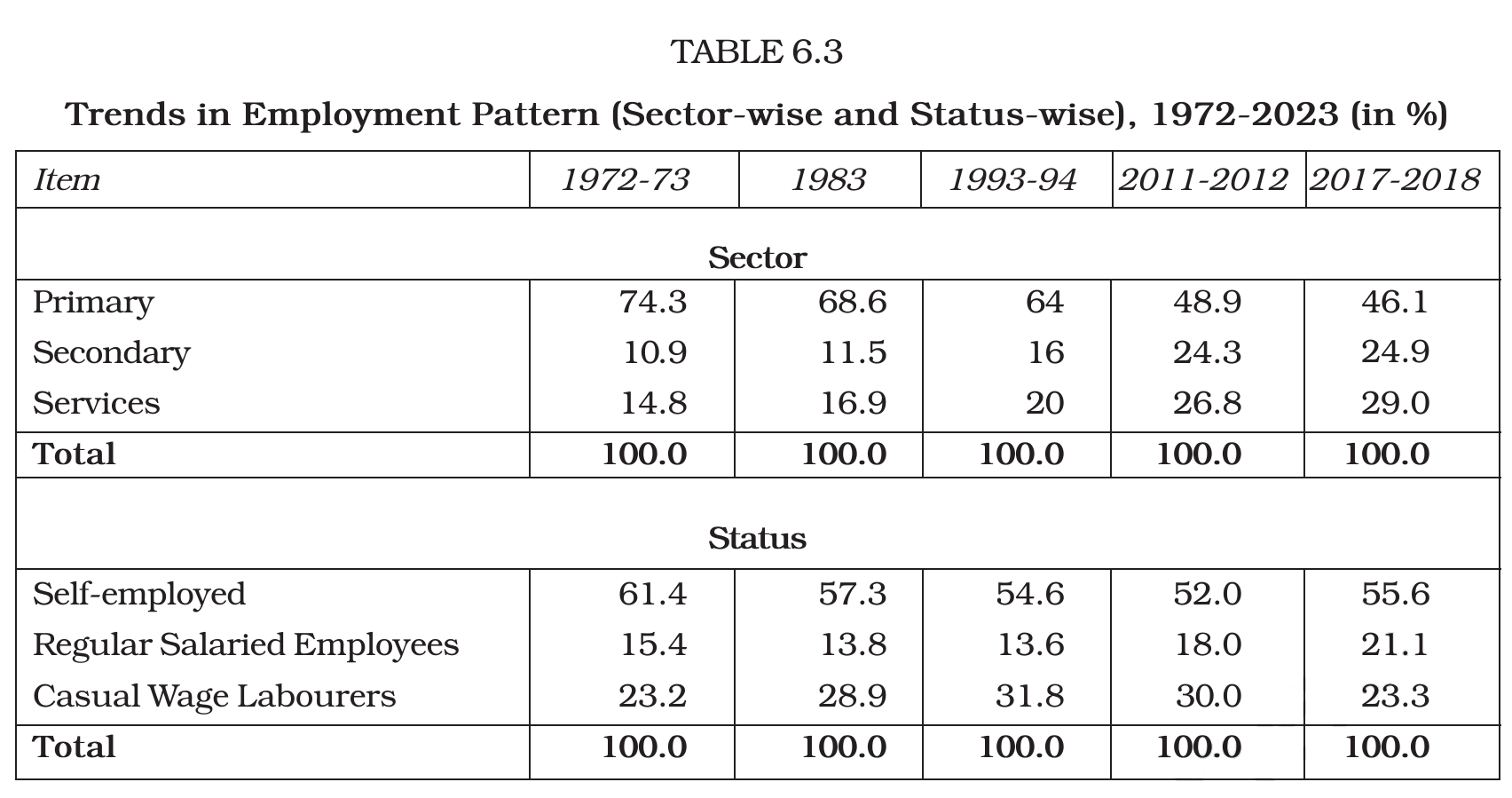
Over the last five decades many Indian workers who once worked for themselves or held regular salaried jobs have had to take up casual wage work, hired by the day. This shift is called the casualisation of the workforce. It leaves workers highly vulnerable, because casual workers have no regular income and no job security.
Why the other options are incorrect
Option (1) Worker-population ratio. — Incorrect. This is the share of the population that is working; it measures how many work, not the kind of work they do.
Option (2) Formalisation of workforce. — Incorrect. Formalisation would be a move into the formal sector, with regular pay and protection, the opposite of a move to casual work.
Option (4) Direct way of employment generation. — Incorrect. This refers to jobs the government creates by employing people itself, not to a change in the status of workers.
Note: A same/similar question was asked in CUET (UG) in the papers below.
| 2026 | 2025 | 2024 | 2023 | 2022 |
| 19-05 S2 | – | – | 29-05 S3* | – |
* A similar question.
NCERT (2025-26): “6.6 Growth and Changing Structure of Employment … The distribution of workforce in different status indicates that over the last five decades (1972-2023), people have moved from self-employment and regular salaried employment to casual wage work. Yet self-employment continues to be the major employment provider.… …Scholars call the process of moving from self-employment and regular salaried employment to casual wage work as casualisation of workforce. This makes the workers highly vulnerable.…”
|