Which of the following is NOT an interstitial compound?
Answer & explanation
Correct answer: option 3
The correct answer is Option (3) → Fe3O4
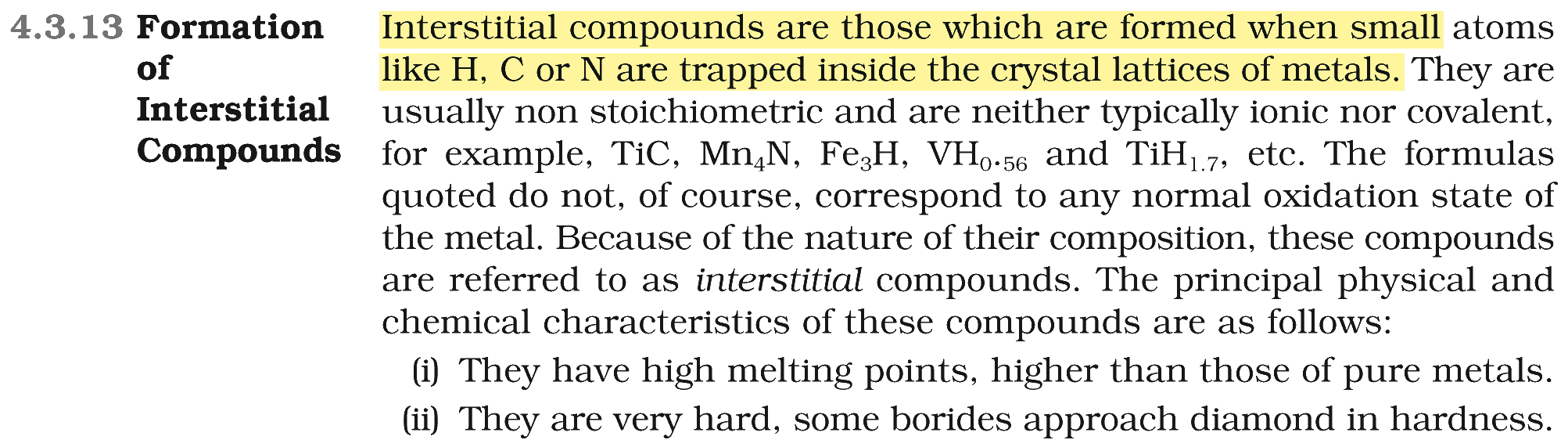
Interstitial compounds are formed when small atoms such as H, C or N are trapped in the empty spaces (interstitial sites) of the crystal lattice of a transition metal.
Option (1) TiC — An interstitial compound. Small carbon atoms occupy the voids of the titanium lattice.
Option (2) Mn4N — An interstitial compound. Small nitrogen atoms occupy the voids of the manganese lattice.
Option (3) Fe3O4 — Not an interstitial compound. Magnetite is a true ionic mixed oxide, FeO·\( \ce{Fe2O3} \), with \( \ce{Fe^{2+}} \), \( \ce{Fe^{3+}} \) and \( \ce{O^{2-}} \) ions in a fixed ratio; the large oxide ion does not fit into the voids of an iron lattice.
Option (4) Fe3H — An interstitial compound. Tiny hydrogen atoms occupy the voids of the iron lattice.
NCERT (2026-27 edition):
Formation of Interstitial Compounds