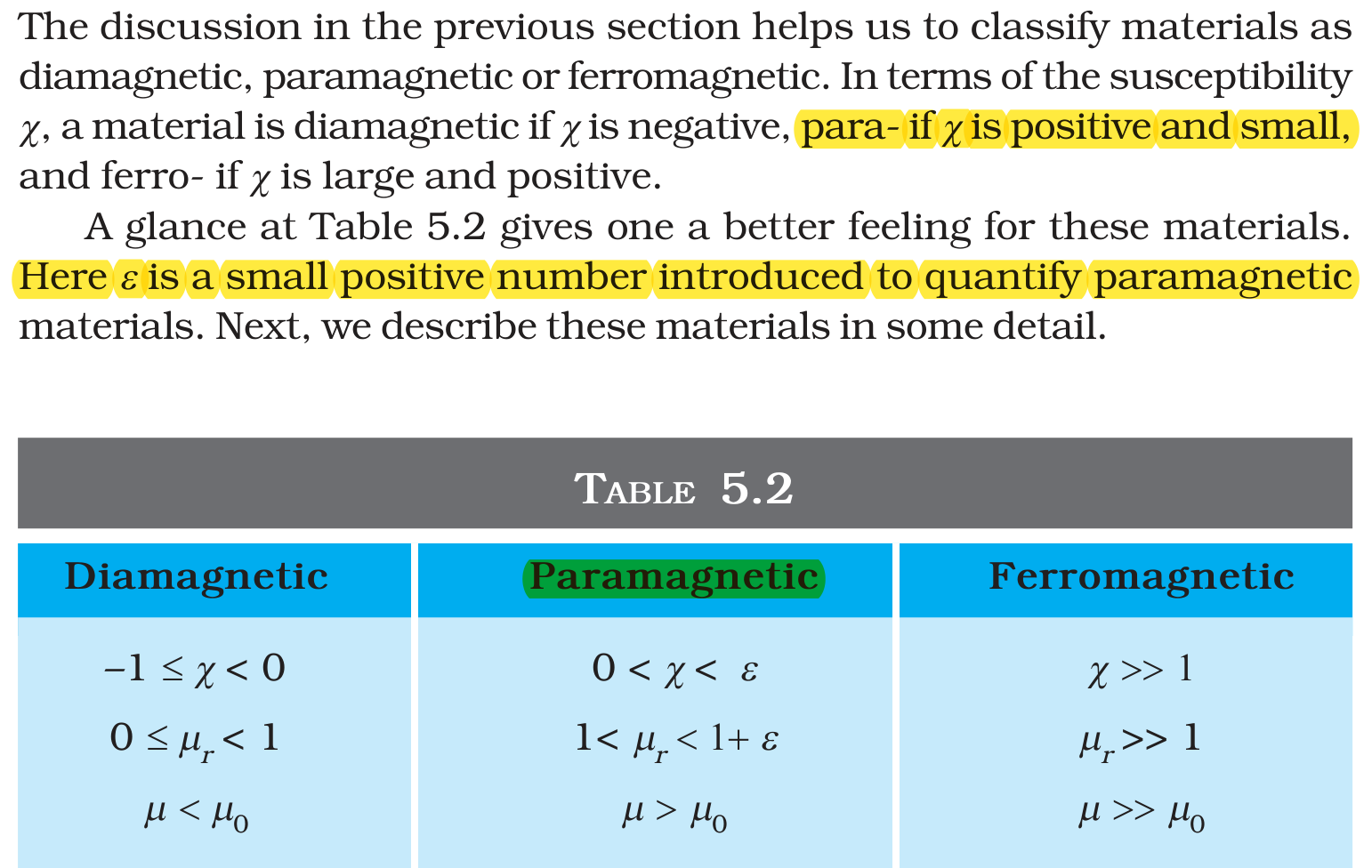
Identify the correct relations regarding the permeability and susceptibility of a paramagnetic material.
(Here, the symbols have their usual meaning)
(A) \( 0 \lt \chi \lt \varepsilon \)
(B) \( \chi \propto T \)
(C) \( \mu \gt \mu_{0} \)
(D) \( 1 \lt \mu_{r} \lt 1 + \varepsilon \)
Choose the correct answer from the options given below:
Answer & explanation
Correct answer: option 1
The correct answer is Option (1) → (A), (C) and (D) only
A paramagnetic material is weakly magnetised along the applied field, so its susceptibility is small and positive, and by Curie’s law it falls as temperature rises. Here \( \varepsilon \) stands for a small positive number.
\( \mu_{r} = 1 + \chi, \quad \mu = \mu_{r}\mu_{0} \)
(A) \( 0 \lt \chi \lt \varepsilon \) — Correct. \( \chi \) is positive but small.
(B) \( \chi \propto T \) — Incorrect. Curie’s law gives \( \chi = C\mu_{0}/T \), so \( \chi \propto 1/T \); thermal agitation disturbs the alignment of the atomic dipoles.
(C) \( \mu \gt \mu_{0} \) — Correct. Since \( \chi \gt 0 \), \( \mu_{r} \gt 1 \) and \( \mu = \mu_{r}\mu_{0} \gt \mu_{0} \).
(D) \( 1 \lt \mu_{r} \lt 1 + \varepsilon \) — Correct. This follows from \( \mu_{r} = 1 + \chi \) with \( 0 \lt \chi \lt \varepsilon \).
NCERT (2026-27):
Magnetic Properties of Materials –