
Which of the following disorders is an autosomal dominant trait?
Answer & explanation
Correct answer: option 3
The correct answer is Option (3) → Myotonic dystrophy
An autosomal dominant trait is carried on an autosome (not on X or Y). One copy of the faulty allele is enough to show the disorder. So it appears in every generation, and males and females are affected equally. Myotonic dystrophy is the example of such a trait.
(1) Haemophilia — Incorrect. Haemophilia is sex-linked recessive. Its gene lies on the X chromosome, so it is not autosomal.
(2) Colour blindness — Incorrect. Colour blindness is also a sex-linked recessive disorder carried on the X chromosome. It is more common in males.
(3) Myotonic dystrophy — Correct. It is an autosomal dominant trait.
(4) Sickle-cell anaemia — Incorrect. Sickle-cell anaemia is autosomal, but recessive. It shows only when both alleles are faulty (HbSHbS).
Note: A similar question was also asked in CUET (UG) 2026 on 06-06-2026 (Slot 1), on 21-05-2026 (Slot 1) and on 20-05-2026 (Slot 1).
NCERT Extract:
Mendelian Disorders – “… Mendelian disorders are mainly determined by alteration or mutation in the single gene. These disorders are transmitted to the offspring on the same lines as we have studied in the principle of inheritance. The pattern of inheritance of such Mendelian disorders can be traced in a family by the pedigree analysis. Most common and prevalent Mendelian disorders are Haemophilia, Cystic fibrosis, Sicklecell anaemia, Colour blindness, Phenylketonuria, Thalassemia, etc. It is important to mention here that such Mendelian disorders may be dominant or recessive.”
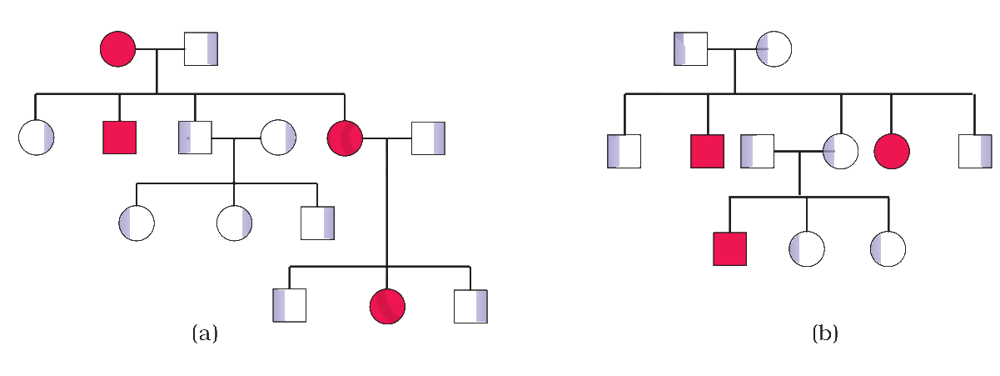
Figure 4.14 Representative pedigree analysis of (a) Autosomal dominant trait (for example: Myotonic dystrophy) (b) Autosomal recessive trait (for example: Sickle-cell anaemia)