
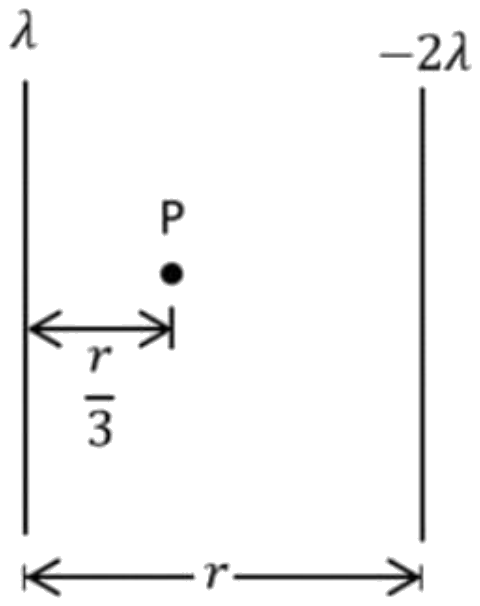
Two infinitely long straight uniformly charged wires of linear charge density \( \lambda \) and \( (-2\lambda) \) are placed parallel to each other, \( r \) distance apart in air as shown in the figure. The electric field at point P at distance \( \left(\displaystyle\frac{r}{3}\right) \) from the first wire will be
Answer & explanation
Correct answer: option 4
The correct answer is Option (4) → \( \displaystyle\frac{3\lambda}{\pi\varepsilon_{0}r}(\hat{\imath}) \)
An infinitely long line charge produces a field \( E = \lambda/(2\pi\varepsilon_{0}d) \) at distance \( d \), directed away from a positive line and towards a negative line.
Take \( \hat{\imath} \) along the line from the first wire \( (\lambda) \) towards the second wire \( (-2\lambda) \). P is \( r/3 \) from the first wire and \( 2r/3 \) from the second.
Field of the first wire at P, pointing away from it, along \( +\hat{\imath} \):
\( \displaystyle E_{1} = \frac{\lambda}{2\pi\varepsilon_{0}(r/3)} = \frac{3\lambda}{2\pi\varepsilon_{0}r} \)
Field of the second wire at P, pointing towards it, also along \( +\hat{\imath} \):
\( \displaystyle E_{2} = \frac{2\lambda}{2\pi\varepsilon_{0}(2r/3)} = \frac{3\lambda}{2\pi\varepsilon_{0}r} \)
Between two oppositely charged wires the two fields point the same way, so they add:
\( \displaystyle \vec{E} = (E_{1}+E_{2})\,\hat{\imath} \)
\( \displaystyle \vec{E} = \frac{3\lambda}{\pi\varepsilon_{0}r}(\hat{\imath}) \)