Match the LIST-I with LIST-II
| LIST-I (Coalition governments) | LIST-II (Led By) | ||
| A. | National Front Government led by Samajwadi Janata Party | I. | I. K. Gujral |
| B. | United Front Government with the Congress support | II. | Chandra Shekhar |
| C. | United Progressive Alliance Government led by the Congress | III. | Manmohan Singh |
| D. | National Democratic Alliance Government I and II led by the BJP | IV. | A. B. Vajpayee |
Choose the correct answer from the options given below:
Answer & explanation
Correct answer: option 4
The correct answer is Option (4) → A – II, B – I, C – III, D – IV
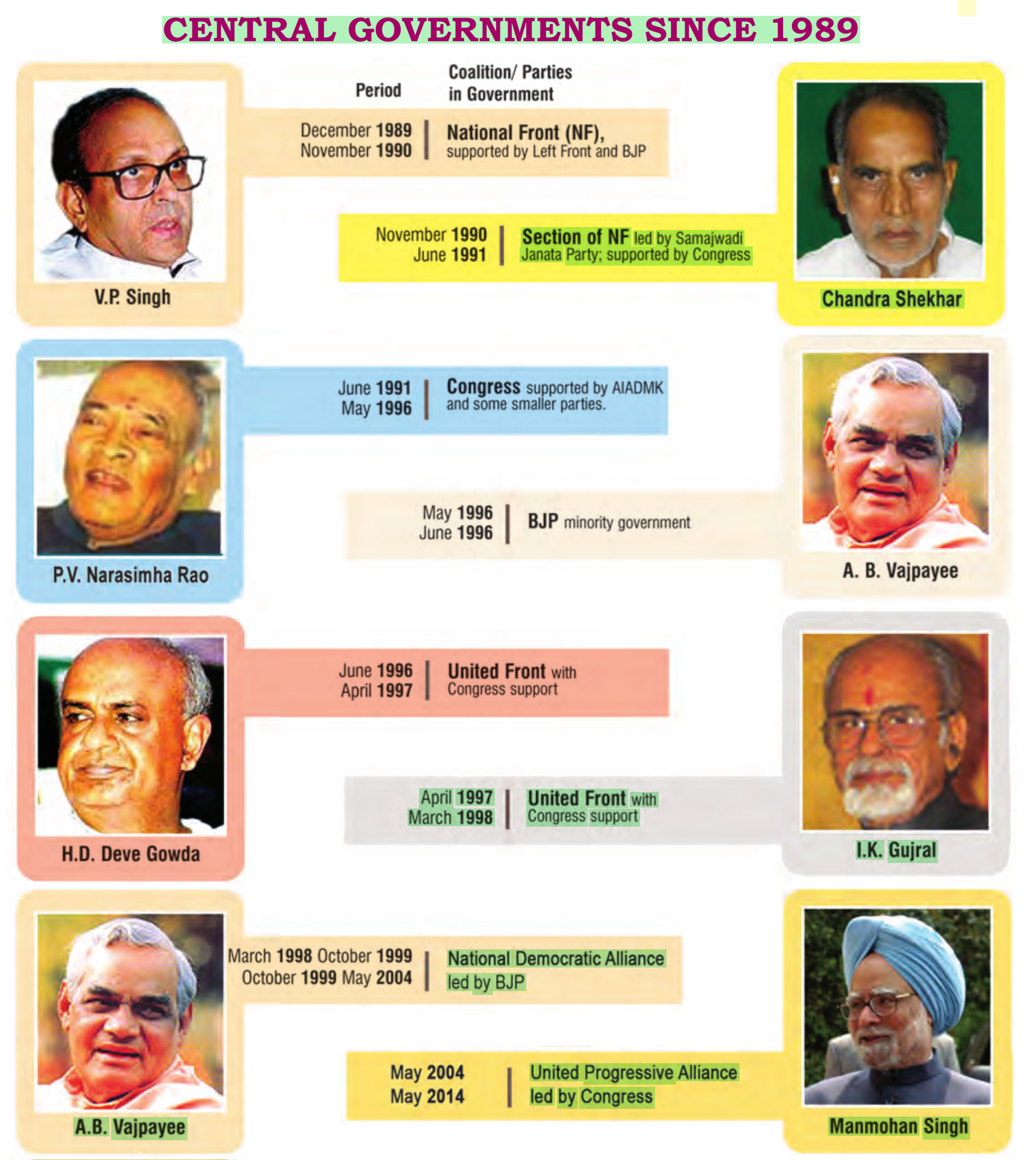
(A) National Front Government led by Samajwadi Janata Party — this matches (II) Chandra Shekhar. His government (November 1990 to June 1991) was a section of the National Front led by the Samajwadi Janata Party and supported by the Congress.
(B) United Front Government with the Congress support — this matches (I) I. K. Gujral. He headed the United Front government with Congress support from April 1997 to March 1998, after H. D. Deve Gowda.
(C) United Progressive Alliance Government led by the Congress — this matches (III) Manmohan Singh. He led the UPA government from May 2004 to May 2014.
(D) National Democratic Alliance Government I and II led by the BJP — this matches (IV) A. B. Vajpayee. He was the Prime Minister of the NDA governments from March 1998 to May 2004.
NCERT (2025-26): “Alliance politics … The nineties also saw the emergence of powerful parties and movements that represented the Dalit and backward castes (Other Backward Classes or OBCs). Many of these parties represented powerful regional assertion as well. These parties played an important role in the United Front government that came to power in 1996. The United Front was similar to the National Front of 1989 for it included Janata Dal and several regional parties. This time the BJP did not support the government. The United Front government was supported by the Congress. This shows how unstable the political equations were. In 1989, both the Left and the BJP supported the National Front Government because they wanted to keep the Congress out of power. In 1996, the Left continued to support the non-Congress government but this time the Congress, supported it, as both the Congress and the Left wanted to keep the BJP out of power. They did not succeed for long, as the BJP continued to consolidate its position in the elections of 1991 and 1996. It emerged as the largest party in the 1996 election and was invited to form the government. But most other parties were opposed to its policies and therefore, the BJP government could not secure a majority in the Lok Sabha.… … a coalition government from May 1998 to June 1999 and was re-elected in October 1999. Atal Behari Vajpayee was the Prime Minister during both these NDA governments and his government formed in 1999 completed its full term. Lok Sabha Elections (2004-2019) … The Congress led UPA government completed its term despite Left parties withdrawing the support in July 2008 on the issue of Indo-US nuclear deal. Elections for 15th Lok Sabha were held in 2009. Results witnessed a rise in the number of seats (from 145 in 2004 to 206 in 2009) of the Indian National Congress (INC) and Congress led UPA Government. Dr. Manmohan Singh was sworn as Prime Minister for the second term, heading the coalition government of UPA again.… …Congress leader Sitaram Kesri withdrew the crutches of support from Deve Gowda’s United Front Government.”
|