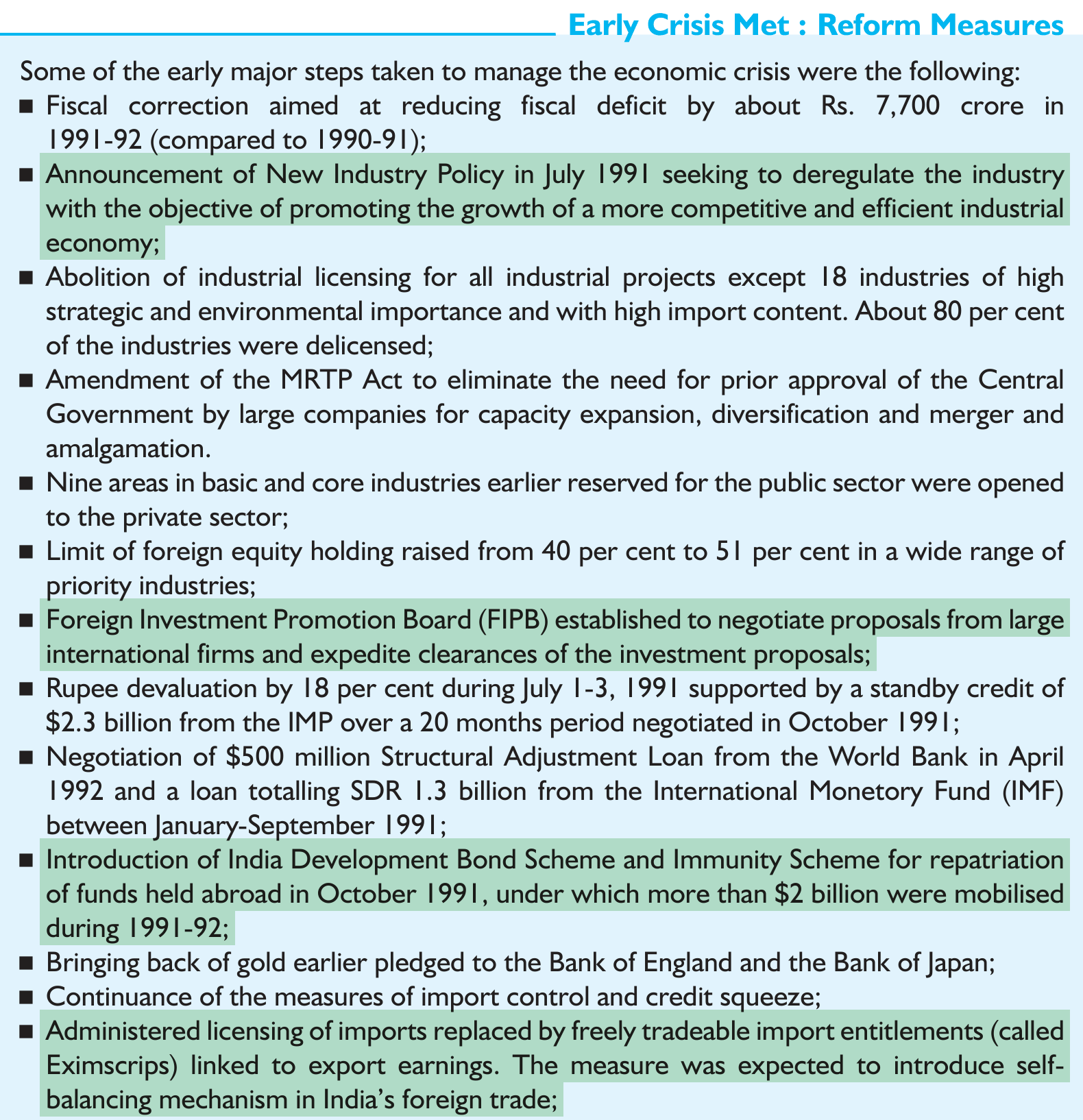
Match List-I (early steps taken to manage the economic crisis of 1991) with List-II (their purpose):
| List-I | List-II | ||
|---|---|---|---|
| (A) | New Industry Policy of July 1991 | (I) | Bringing back money that Indians held overseas |
| (B) | Foreign Investment Promotion Board (FIPB) | (II) | Removing controls to build a more competitive and efficient economy |
| (C) | India Development Bond Scheme | (III) | Introducing a self-balancing mechanism |
| (D) | Eximscrips (freely tradeable import entitlements) | (IV) | Dealing with proposals of large firms and speeding up clearances |
Choose the correct answer from the options given below:
Answer & explanation
Correct answer: option 4
The correct answer is Option (4) → (A)-(II), (B)-(IV), (C)-(I), (D)-(III)
| List-I | List-II | Reason |
|---|---|---|
| (A) New Industry Policy of July 1991 | (II) Removing controls to build a more competitive and efficient economy | The policy set out to deregulate industry, that is, to remove controls. Its objective was a more competitive and efficient industrial economy. |
| (B) Foreign Investment Promotion Board (FIPB) | (IV) Dealing with proposals of large firms and speeding up clearances | FIPB was set up to negotiate proposals from large international firms and to expedite, or speed up, the clearance of their investment proposals. |
| (C) India Development Bond Scheme | (I) Bringing back money that Indians held overseas | The scheme was for the repatriation of funds held abroad, which means bringing that money back to India. |
| (D) Eximscrips (freely tradeable import entitlements) | (III) Introducing a self-balancing mechanism | Eximscrips were import rights linked to export earnings, so imports would move with exports. This was expected to bring a self-balancing mechanism into foreign trade. |
NCERT (2026-27 Edition):
|