
The figure shows a set-up used to obtain fresh water from salt (sea) water. At present, the piston applies a pressure larger than the osmotic pressure (Π) of the salt water.
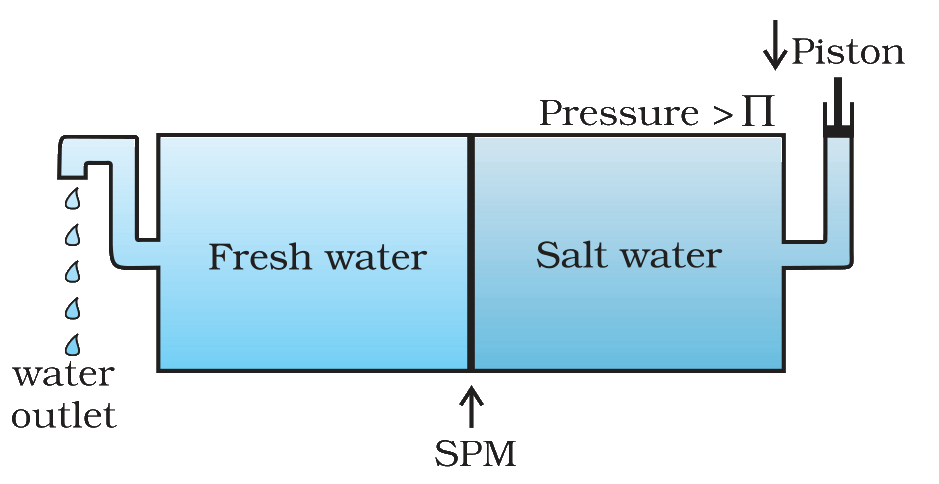
If the pressure applied by the piston is reduced to a value LESS than the osmotic pressure of the salt water, what will happen in the set-up?
Answer & explanation
Correct answer: option 3
The correct answer is Option (3) → Water will pass through the SPM from the fresh-water side into the salt water, so no water will come out of the outlet.
On its own, water flows through a semipermeable membrane from the pure solvent into the solution (osmosis). The osmotic pressure is the extra pressure on the solution that just stops this flow. Only a pressure larger than the osmotic pressure reverses the flow (reverse osmosis).
Pressure less than Π — Osmosis takes place. The pressure is not enough to stop osmosis. Water passes from the fresh-water side into the salt water, the normal direction of osmosis.
The outlet — No water comes out. The outlet is fed only by the fresh-water side. That side now loses water to the salt water, so no water comes out of the outlet.
Why the other options are incorrect
Option (1) Pure water will still be squeezed out of the salt water through the SPM, but more slowly, so the outlet drips more slowly. — Incorrect. Pure water is squeezed out of the sea water only when the pressure is more than the osmotic pressure. Below Π the flow is the other way.
Option (2) Water will stop passing through the SPM in either direction, and the liquid levels on both sides will stay unchanged. — Incorrect. The flow stops completely only when the applied pressure is equal to the osmotic pressure, not less than it.
Option (4) Salt ions will pass through the SPM from the salt water into the fresh water, so water from the outlet will turn salty. — Incorrect. The membrane (cellulose acetate) is permeable to water but impermeable to the ions present in sea water, whatever the pressure.
NCERT (2026-27 edition):
1.6.4 Osmosis and Osmotic Pressure – “If this membrane is placed between the solvent and solution as shown in Fig. 1.9, the solvent molecules will flow through the membrane from pure solvent to the solution. This process of flow of the solvent is called osmosis. The flow will continue till the equilibrium is attained. The flow of the solvent from its side to solution side across a semipermeable membrane can be stopped if some extra pressure is applied on the solution. This pressure that just stops the flow of solvent is called osmotic pressure of the solution.”
1.6.5 Reverse Osmosis and Water Purification – “The direction of osmosis can be reversed if a pressure larger than the osmotic pressure is applied to the solution side. That is, now the pure solvent flows out of the solution through the semi permeable membrane. … When pressure more than osmotic pressure is applied, pure water is squeezed out of the sea water through the membrane. … Cellulose acetate is permeable to water but impermeable to impurities and ions present in sea water.”
Fig. 1.11: Reverse osmosis occurs when a pressure larger than the osmotic pressure is applied to the solution.