Chemical Kinetics
Kinetic studies not only help us to determine the speed or rate of a chemical reaction but also describe the conditions under which the reaction rates can be altered. Some reactions such as ionic reactions are very fast while some others like rusting of iron are very slow. Also, there are reactions like inversion of cane sugar and hydrolysis of starch, which proceed at a moderate speed. The rate of a reaction can be defined as the change in concentration of a reactant or product per unit time. The unit used to express the rate of a reaction is concentration time−1. The rate of a reaction can be determined in terms of the average rate of reaction or can be determined at a particular instant of time called the instantaneous rate of reaction. The rate of a chemical reaction at a given temperature depends on the concentration of one or more reactants. The representation of the rate of reaction in terms of concentration of the reactants is known as rate law. Rate law for any reaction cannot be predicted by merely looking at the balanced chemical equation, i.e., theoretically, but must be determined experimentally.
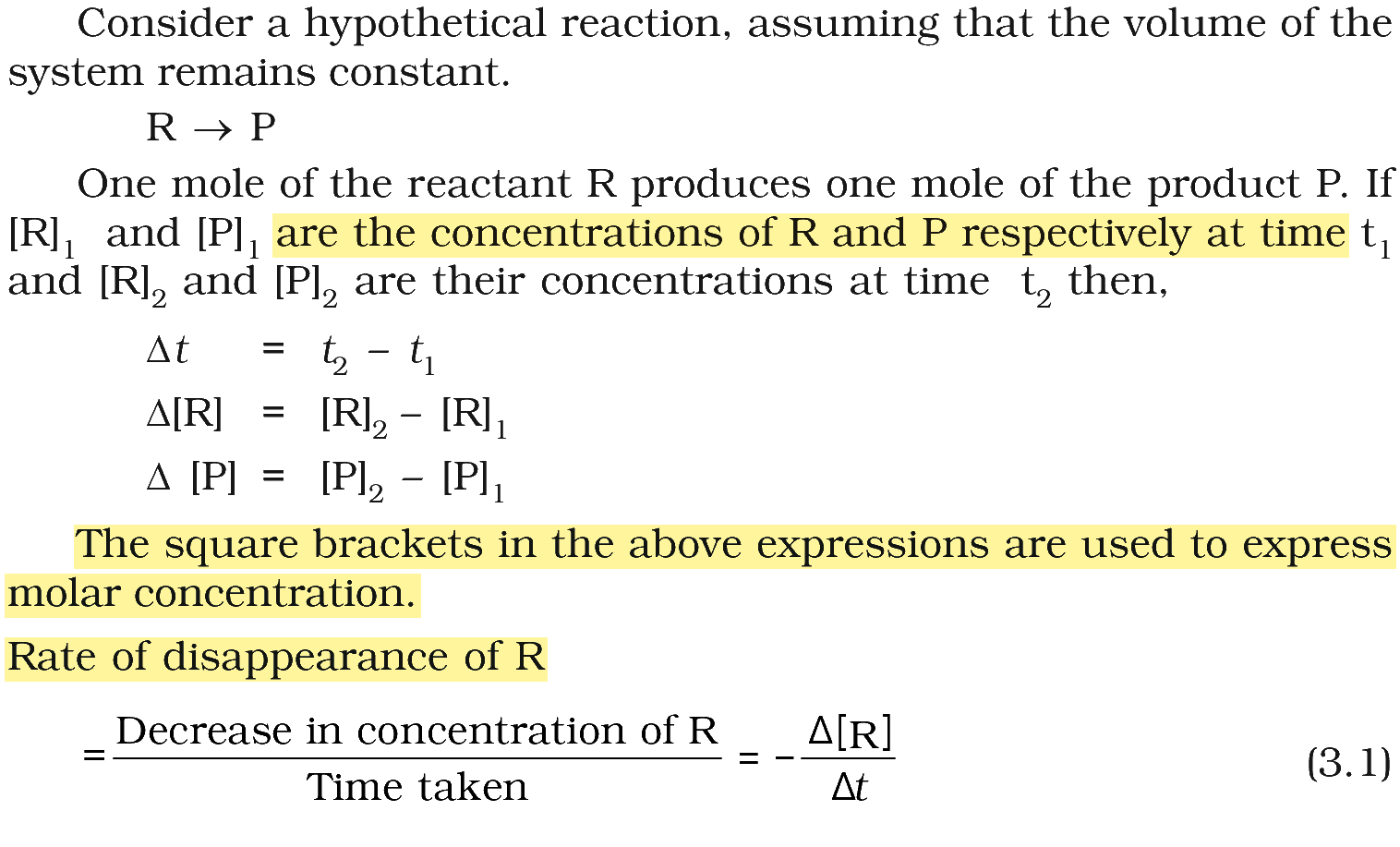
For a hypothetical reaction, R → P,
If [R]1 and [P]1 are the concentrations of reactant R and product P respectively at time t1 and [R]2 and [P]2 are their respective concentrations at time t2 then the rate of disappearance of reactant can be expressed as:
Answer & explanation
Correct answer: option 3
The correct answer is Option (3) → \( \displaystyle -\left(\frac{[\mathrm{R}]_2-[\mathrm{R}]_1}{[\mathrm{t}]_2-[\mathrm{t}]_1}\right) \)
The average rate of a reaction is the change in concentration of a reactant or product divided by the time taken for that change:
\( \displaystyle \text{Rate of appearance of P}=+\frac{\Delta[\mathrm{P}]}{\Delta t}=\frac{[\mathrm{P}]_2-[\mathrm{P}]_1}{t_2-t_1} \)
As the reaction proceeds, the reactant is used up, so \( \ce{[R]2} \) is less than \( \ce{[R]1} \) and Δ[R] is negative. The minus sign makes the rate a positive quantity. The unit of rate is concentration time−1, e.g. mol L−1 s−1.
So the rate of disappearance of R is given by the expression with the minus sign, Option (3).
Why the other options are incorrect
Option (1) \( \displaystyle \left(\frac{[\mathrm{R}]_2-[\mathrm{R}]_1}{[\mathrm{t}]_2-[\mathrm{t}]_1}\right) \) — Incorrect. Since \( \ce{[R]2} \) < \( \ce{[R]1} \), it gives a negative value, but a rate is always positive.
Option (2) [R]2 - [R]1 — Incorrect. This is only the change in concentration (a negative number); it is not divided by the time, so it is not a rate.
Option (4) [R]1 - [R]2 — Incorrect. This is the decrease in concentration, but it too is not divided by the time interval; its unit is mol L−1, not mol L−1 s−1.
Note: It seems that there is a mistake in the original NTA paper, which prints [t]2 − [t]1 in Options (1) and (3) when it should read t2 − t1.
NCERT (2026-27 edition):
Rate of a Chemical Reaction – …