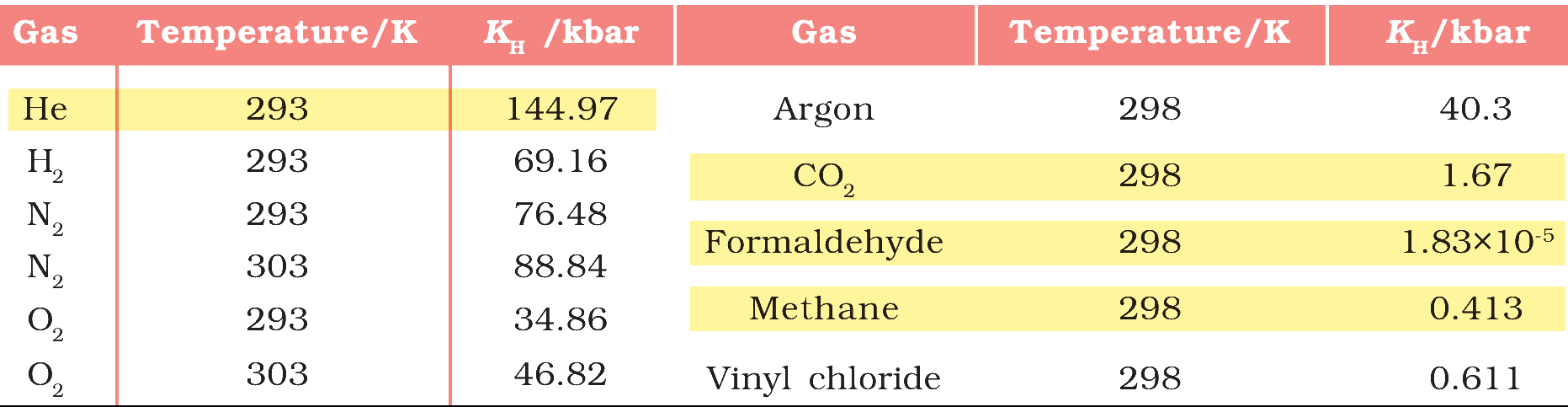
Arrange the following gases in the increasing order of their solubility in water at 298 K and atmospheric pressure.
(A) \( CH_4 (K_H = 0.413\, kbar) \)
(B) \( HCHO (K_H = 1.83 × 10^{-5}\, kbar) \)
(C) \( He (K_H = 144.97\, kbar) \)
(D) \( CO_2 (K_H = 1.67\, kbar) \)
Choose the correct answer from the options given below:
Answer & explanation
Correct answer: option 2
The correct answer is Option (2) → (C), (D), (A), (B)
By Henry’s law, the partial pressure of a gas over a solution is proportional to its mole fraction in the solution:
\( \displaystyle p = K_\mathrm{H}\,x \qquad \Rightarrow \qquad x = \frac{p}{K_\mathrm{H}} \)
At the same pressure and temperature, the solubility (x) is inversely proportional to \( K_\mathrm{H} \): the higher the value of KH, the lower the solubility.
The given values, from the largest to the smallest \( K_\mathrm{H} \):
\( \displaystyle \ce{He}\,(144.97) \gt \ce{CO2}\,(1.67) \gt \ce{CH4}\,(0.413) \gt \ce{HCHO}\,(1.83 \times 10^{-5})\ \mathrm{kbar} \)
Solubility increases in the reverse order:
\( \displaystyle \ce{He} \lt \ce{CO2} \lt \ce{CH4} \lt \ce{HCHO} \)
Formaldehyde, a polar molecule that forms hydrogen bonds with water, is by far the most soluble.
Shortcut: Helium has the largest \( K_\mathrm{H} \) (least soluble) and formaldehyde the smallest (most soluble); only Option (2) starts with (C) and ends with (B).
NCERT (2026-27 edition):
Solubility of a Gas in a Liquid – …