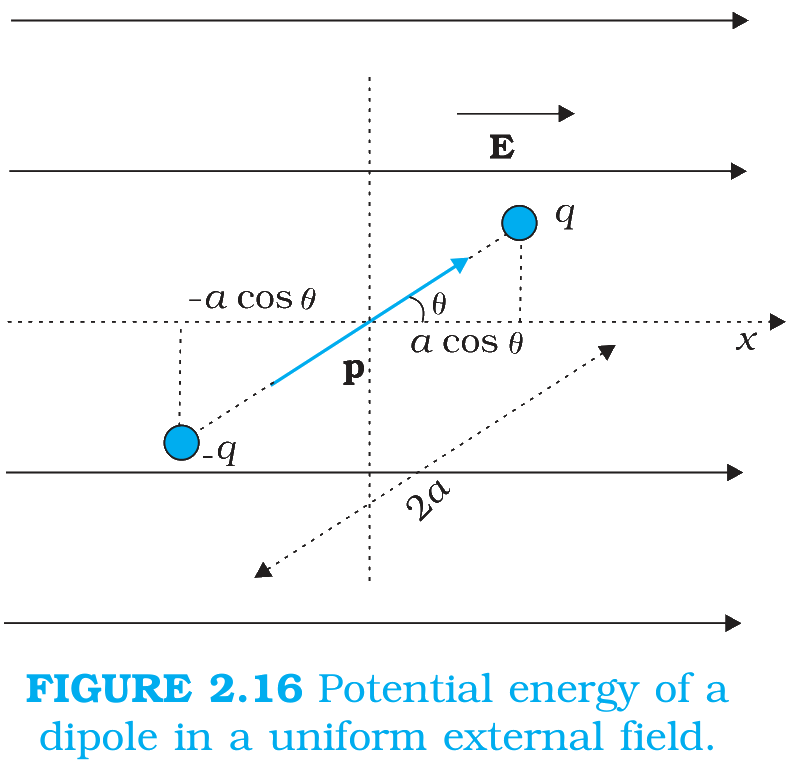
The figure shows an electric dipole, with charges \(q\) and \(-q\), in a uniform electric field \(\mathbf{E}\).
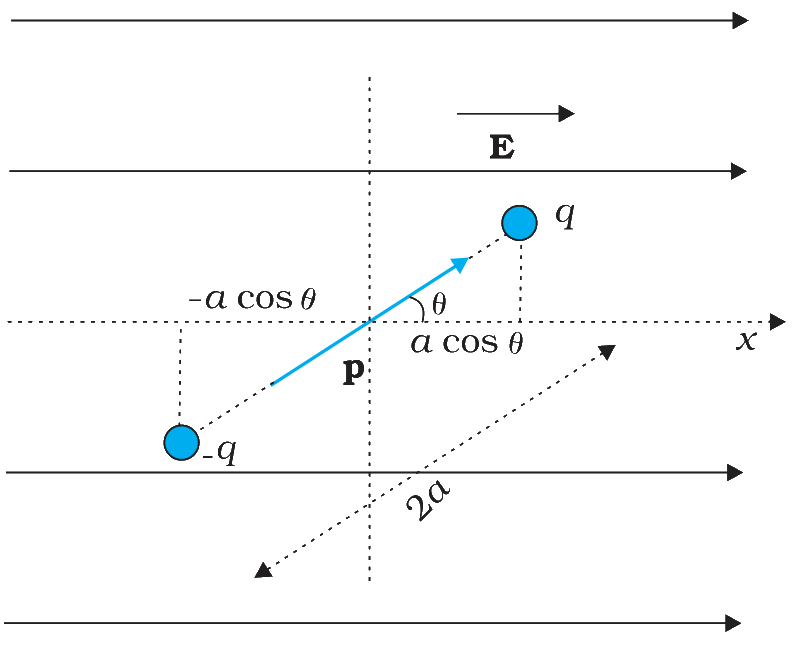
The dipole is held at rest in this position and then released. Which of the following is correct just after it is released?
Answer & explanation
Correct answer: option 4
The correct answer is Option (4) → It turns so that \(\theta\) decreases, and its potential energy decreases.
In a uniform field, the forces \( q\mathbf{E} \) and \( -q\mathbf{E} \) on the two charges are equal and opposite. So there is no net force, but there is a torque \( \mathbf{p}\times\mathbf{E} \). This torque turns \( \mathbf{p} \) towards \( \mathbf{E} \).
In the figure, \( q \) is at \( x=a\cos\theta \) and \( -q \) is at \( x=-a\cos\theta \). So \( q \) is ahead of \( -q \) by \( 2a\cos\theta \) along the field. The potential falls along the field, so
\( \begin{aligned} q(V_1-V_2) &= q(-E\times2a\cos\theta) \\ &= -pE\cos\theta \end{aligned} \)
This is the potential energy of the dipole, taking it as zero at \( \theta=90^\circ \). When \( \theta \) gets smaller, \( \cos\theta \) gets larger. So the potential energy becomes more negative, and the energy lost goes into the turning motion.
Option (1) It turns until \(\theta=90^\circ\), because its potential energy is least there. — Incorrect. At \( \theta=90^\circ \) the potential energy is zero. In the position shown it is \( -pE\cos\theta \), which is already lower. The torque turns the dipole towards \( \mathbf{E} \), so \( \theta \) gets smaller.
Option (2) It turns so that \(\theta\) increases, and its potential energy decreases. — Incorrect. The torque turns \( \mathbf{p} \) towards \( \mathbf{E} \), so \( \theta \) gets smaller. A larger \( \theta \) would also raise the potential energy.
Option (3) It moves along \(\mathbf{E}\) without turning, and its potential energy decreases. — Incorrect. The net force on the dipole is zero, so it does not move along the field. The torque is not zero in this position, so the dipole turns.
Option (4) It turns so that \(\theta\) decreases, and its potential energy decreases. — Correct. The torque turns \( \mathbf{p} \) towards \( \mathbf{E} \), so \( \theta \) decreases. Then \( -pE\cos\theta \) becomes more negative.
NCERT (2026-27):
Dipole in a Uniform External Field – “… This torque will tend to align the dipole with the field E.”
Potential energy of a dipole in an external field – “… The displacement parallel to the force is 2a cosθ. Thus, [V(r1)–V (r2)] = –E × 2a cosθ .”
Example 2.6 – “So, there is loss in potential energy. This must be the energy released by the substance in the form of heat in aligning its dipoles.”