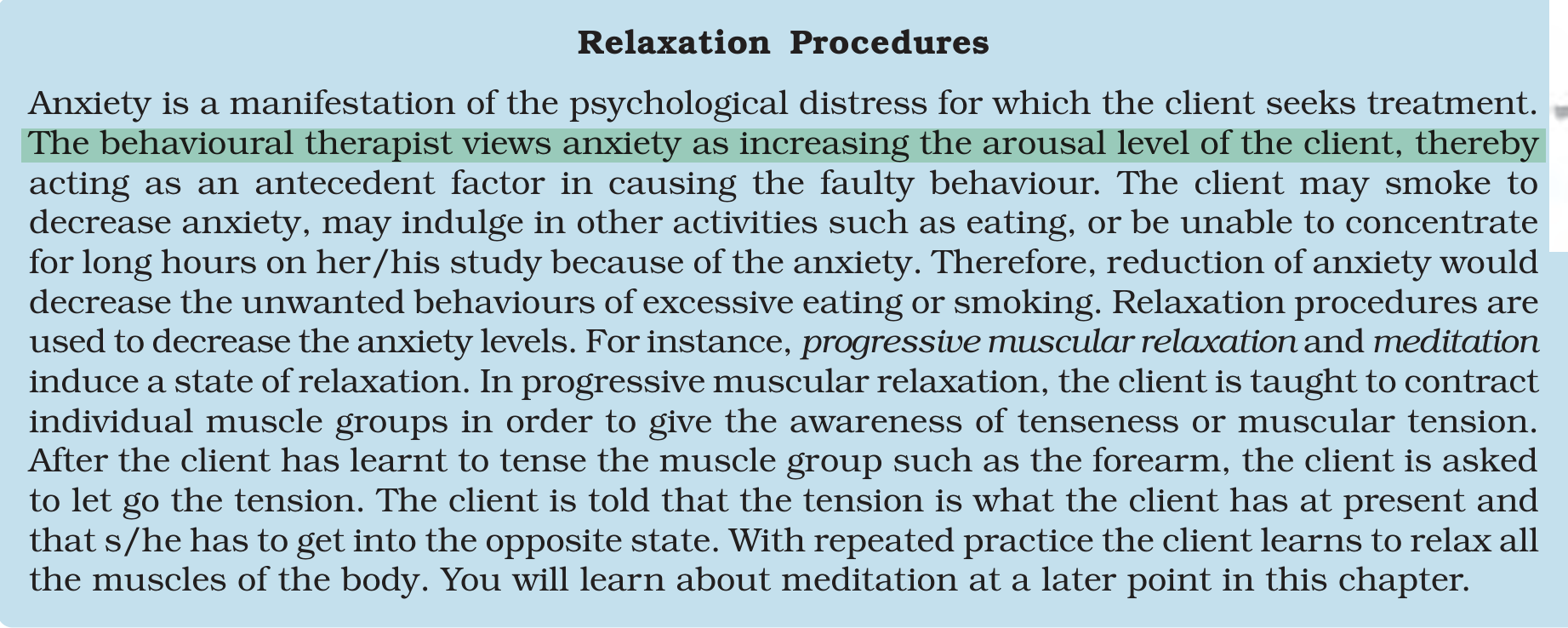
How does a behavioural therapist view the part played by anxiety in causing faulty behaviour?
Answer & explanation
Correct answer: option 1
The correct answer is Option (1) → It raises the client's arousal level and acts as an antecedent factor
| Option | Reason |
|---|---|
| Option (1): It raises the client's arousal level and acts as an antecedent factor. Correct. | Anxiety increases the arousal level of the client and so acts as an antecedent factor in causing the faulty behaviour, which is why relaxation procedures are used to bring it down. |
| Option (2): It follows the faulty behaviour and acts as a maintaining factor. Incorrect. | A maintaining factor is what leads to the persistence of a faulty behaviour, such as the relief from anxiety that keeps a person smoking. |
| Option (3): It is a consequent operation that rewards the faulty behaviour. Incorrect. | A consequent operation is what the therapist arranges after the behaviour, such as praising a child for eating dinner properly. |
| Option (4): It is an establishing operation that lowers the value of a reward. Incorrect. | An establishing operation changes the reinforcing value of a consequence beforehand, such as serving less food at tea time so that food at dinner is worth more. |
NCERT (2026-27):
|