
Some dens are rooms. All rooms are walls. Some walls are bricks. All bricks are plates.
(a) Some plates are walls
(b) Some walls are dens
(c) Some bricks are rooms
(d) Some plates are rooms
Answer & explanation
Correct answer: option 3
The correct answer is Option (3) → (a) and (b) only
A conclusion follows only if it is true in every diagram the statements allow. A “some” statement joined to an “all” statement carries the overlap forward: if some X are Y and all Y are Z, then some X are Z.
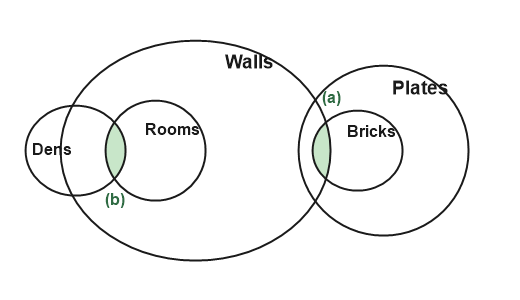
(a) Some plates are walls Correct. Some walls are bricks and all bricks are plates, so those walls are plates too.
(b) Some walls are dens Correct. Some dens are rooms and all rooms are walls, so those dens are walls, and some walls are dens.
(c) Some bricks are rooms Incorrect. Rooms and bricks are linked only through walls, and the bricks may lie in a part of the walls that has no rooms, as in the diagram.
(d) Some plates are rooms Incorrect. Plates meet the walls only through bricks, and no statement places a brick or a plate inside the rooms.