
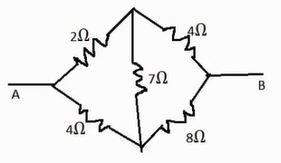
A bridge circuit is shown in the diagram. The equivalent resistance between A and B is
Answer & explanation
Correct answer: option 1
The correct answer is Option (1) → \( 4\,\Omega \)
The circuit is a Wheatstone bridge with the \( 7\,\Omega \) resistor in the middle arm. Readings from the figure:
\( \text{upper path: } 2\,\Omega \text{ and } 4\,\Omega \)
\( \text{lower path: } 4\,\Omega \text{ and } 8\,\Omega \)
The bridge is balanced when the ratios of the arms are equal:
\( \displaystyle \frac{2}{4} = \frac{4}{8} = \frac{1}{2} \)
So the two ends of the \( 7\,\Omega \) resistor are at the same potential, no current flows through it, and it can be removed. The rest is two series paths in parallel between A and B.
\( R_{\text{upper}} = 2 + 4 = 6\,\Omega \)
\( R_{\text{lower}} = 4 + 8 = 12\,\Omega \)
\( \displaystyle R_{AB} = \frac{6 \times 12}{6 + 12} = \frac{72}{18} = 4\,\Omega \)