
How does pollination take place in Vallisneria?
Answer & explanation
Correct answer: option 2
The correct answer is Option (2) → Female flowers reach the water surface on long stalks and pollen grains released on the surface are carried by water currents.
Water-pollinated plants use water in two ways. In Vallisneria, the female flower reaches the surface of water on a long stalk, and the male flowers or pollen grains are released onto the surface. Water currents carry them passively, and some reach the female flowers and the stigma. In sea-grasses, by contrast, the female flowers stay submerged and the pollen is carried inside the water.
Option (1) Female flowers remain submerged and long, ribbon-like pollen grains are carried inside the water. — Incorrect. This describes sea-grasses, whose female flowers remain submerged and whose long, ribbon-like pollen grains are carried inside the water.
Option (2) Female flowers reach the water surface on long stalks and pollen grains released on the surface are carried by water currents. — Correct. In Vallisneria the female flowers reach the surface on long stalks, and pollen released on the surface is carried by water currents.
Option (3) Flowers emerge above the level of water and are pollinated by insects, as in water lily. — Incorrect. Flowers that emerge above water and are pollinated by insects are seen in most aquatic plants such as water lily. Vallisneria is water-pollinated.
Option (4) Flowers emerge above the level of water and pollen grains are carried by wind currents. — Incorrect. Some aquatic plants with flowers above the water are wind-pollinated, but Vallisneria uses water.
NCERT Extract:
Pollination – “… Not all aquatic plants use water for pollination. In a majority of aquatic plants such as water hyacinth and water lily, the flowers emerge above the level of water and are pollinated by insects or wind as in most of the land plants. In Vallisneria, the female flower reach the surface of water by the long stalk and the male flowers or pollen grains are released on to the surface of water. They are carried passively by water currents (Figure 1.11a); some of them eventually reach the female flowers and the stigma.”
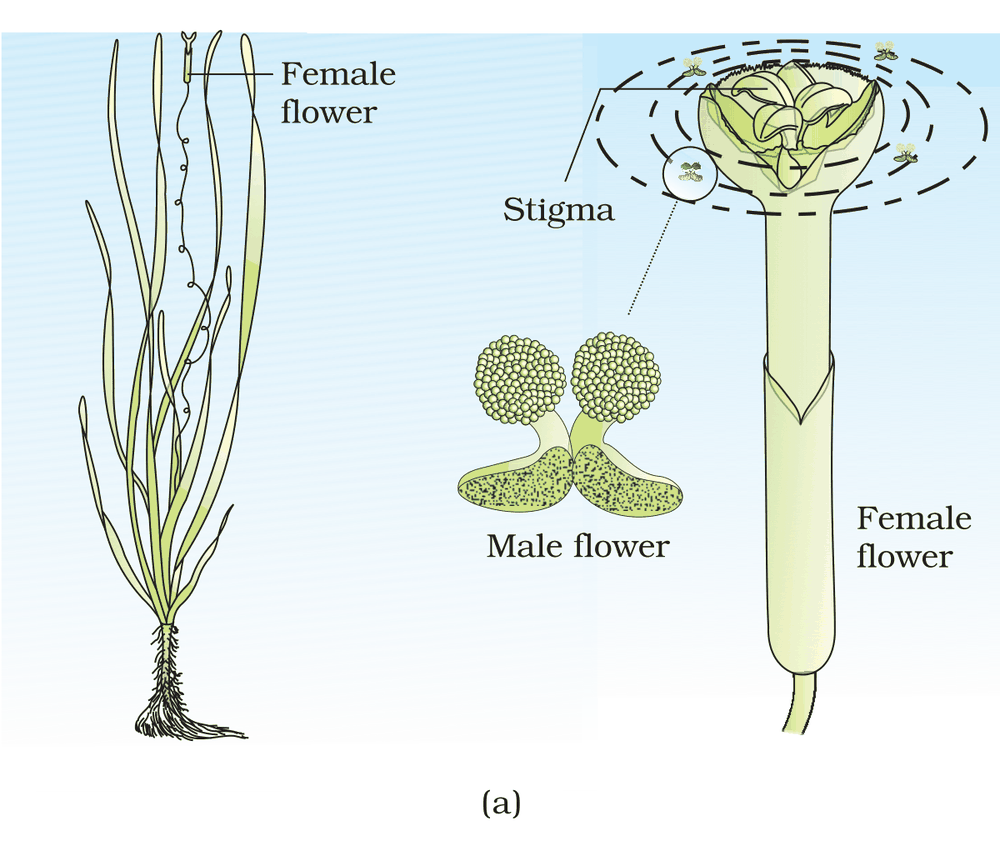
Figure 1.11 (a) Pollination by water in Vallisneria