High molecular mass macromolecules are called polymers which consist of repeating structural units derived from corresponding monomers. These polymers can be classified in a number of ways, such as based on their source, method of preparation intermolecular forces of attraction etc.
Natural rubber is a polymer of cis-1, 4-isoprene and can be made tough with vulcanisation process. Polymers are useful in manufacturing of various materials such as toys, fibres, pipes, television cabinets etc.
In view of potential environmental hazards of waste disposal certain biodegradable polymers are synthesised such as PHBV.
Based on the paragraph given above answer the questions
Some statements about polymers are given below. Identify the correct statement.
A. The order of intermolecular forces is terylene > polythene > neoprene
B. High density polythene is a linear polymer
C. Novolac on heating with formaldehyde gives Bakelite.
D. natural rubber is a linear polymer called as trans-1-4-polyisoprene.
E. Aliphatic polyesters are important classes of biodegradable polymers
Choose the most appropriate answer from the options given below :
Answer & explanation
Correct answer: option 2
The correct answer is Option (2) → A, B, C & E only
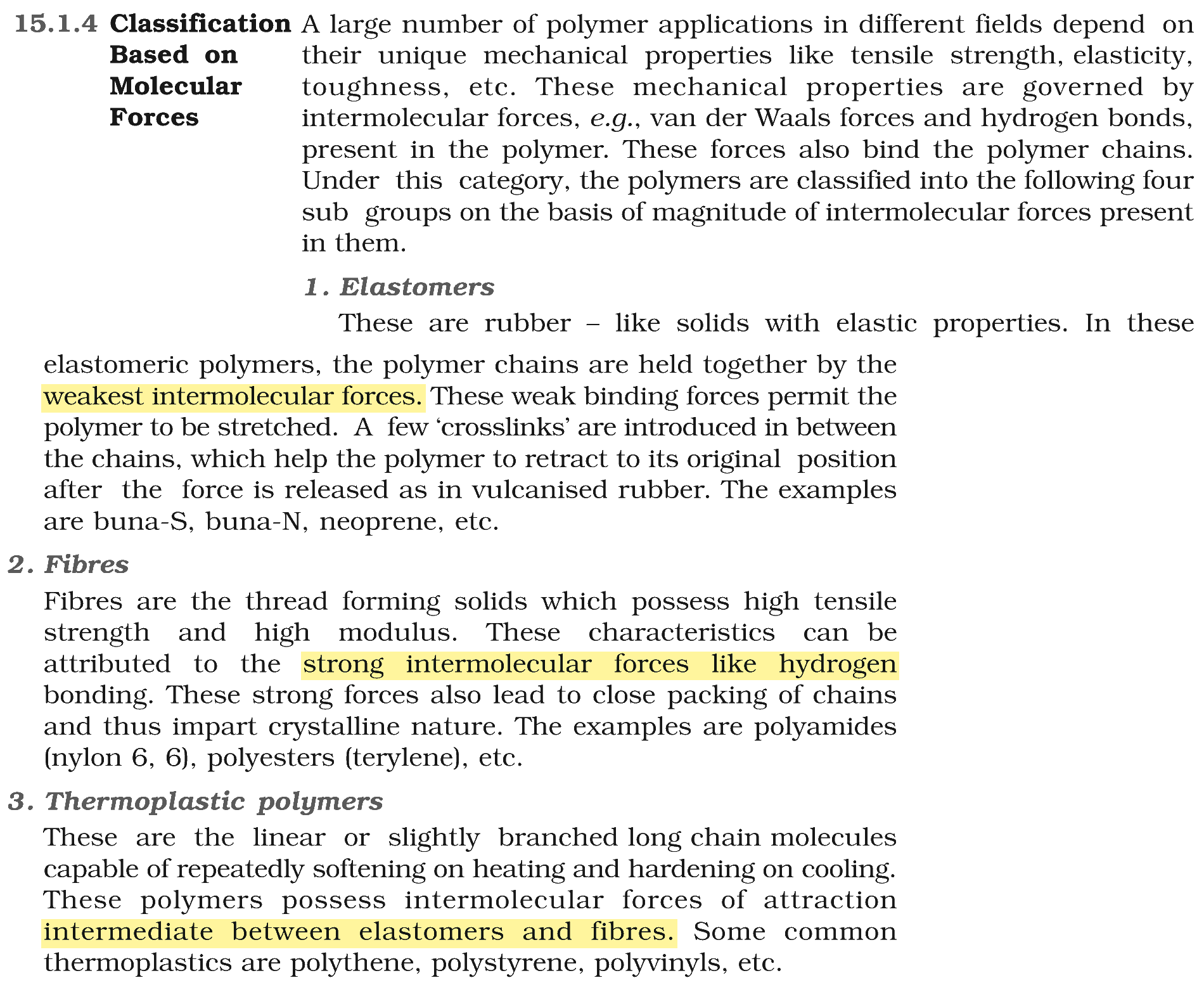
(A) The order of intermolecular forces is terylene > polythene > neoprene — True. Fibres such as terylene have the strongest forces (hydrogen bonding), thermoplastics such as polythene have intermediate forces, and elastomers such as neoprene the weakest.
(B) High density polythene is a linear polymer — True. It consists of linear molecules, which pack closely and give it its high density.
(C) Novolac on heating with formaldehyde gives Bakelite — True. Novolac undergoes cross linking to form the infusible solid bakelite.
(D) Natural rubber is a linear polymer called trans-1,4-polyisoprene — False. Natural rubber is cis-1,4-polyisoprene.
(E) Aliphatic polyesters are important classes of biodegradable polymers — True. PHBV and nylon-2-nylon-6 are examples.
Note: This question is from the pre-rationalised NCERT book (2022-23). The topic is not there in the latest NCERT book (2026-27), and it is also out of the CUET 2026 syllabus.
NCERT (Pre-rationalised edition, 2022-23):
Classification Based on Molecular Forces