Read the following passage and answer the questions.
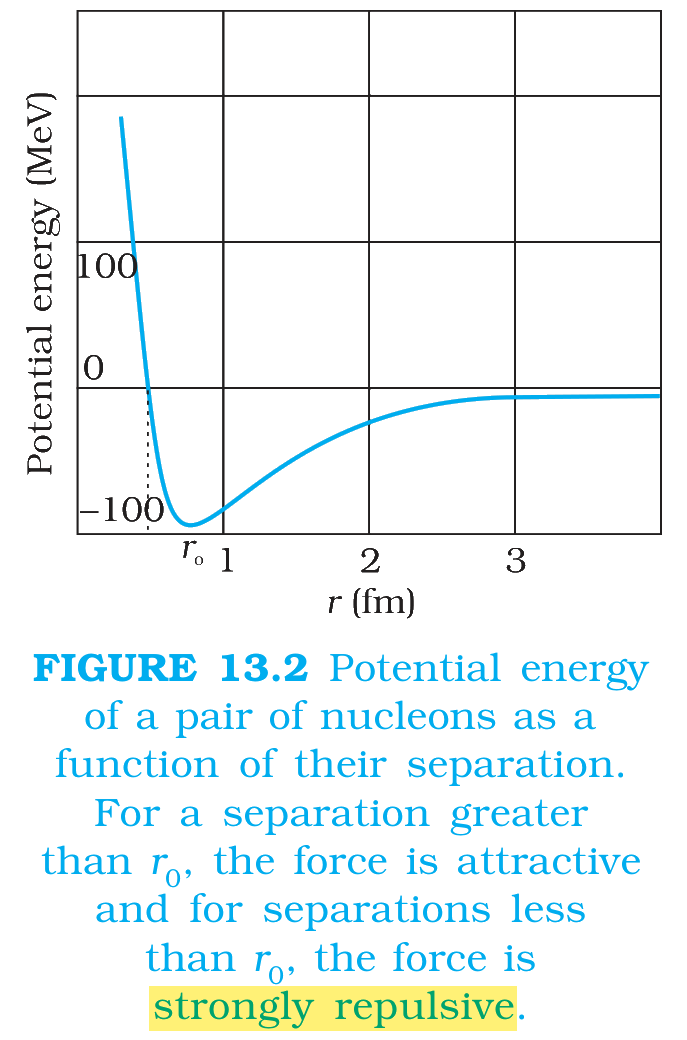
A nucleus is written as \({}^{A}_{Z}\mathrm{X}\), where X is the chemical symbol of the element. Here Z is the atomic number and A is the mass number. The nucleus contains Z protons and (A − Z) neutrons. Protons and neutrons are together called nucleons. For example, the aluminium nucleus \({}^{27}_{13}\mathrm{Al}\) has 13 protons and 14 neutrons. Experiments show that a nucleus of mass number A has a radius \(R=R_0A^{1/3}\), where \(R_0=1.2\ \mathrm{fm}\) and 1 fm = \(10^{-15}\ \mathrm{m}\). The protons in a nucleus are positively charged, so they repel each other. Still, the nucleus does not fly apart. The nucleons are held together by a force of a different kind, called the nuclear force. A rough graph of the potential energy of a pair of nucleons against their separation r has a minimum at a separation \(r_0\) of about 0.8 fm.
Two nucleons in the nucleus are pushed closer, to a separation of about 0.5 fm. The force between them is
Answer & explanation
Correct answer: option 1
The correct answer is Option (1) → strongly repulsive
The force between two nucleons can be read from the potential energy graph. If the potential energy rises as the nucleons move closer, the force pushes them apart. If it rises as they move apart, the force pulls them together. At \( r_0 \) the potential energy is the least, so the force there is zero.
Option (1) strongly repulsive — Correct. A separation of 0.5 fm is less than \( r_0 \). Here the curve rises very steeply as r becomes smaller. Pushing the nucleons closer needs a lot of work, so the force between them is strongly repulsive.
Option (2) attractive — Incorrect. The force is attractive only for separations greater than \( r_0 \). There the potential energy rises as the nucleons move apart.
Option (3) zero — Incorrect. The force is zero only at \( r_0 \) itself, the lowest point of the curve. At 0.5 fm, the curve is already rising steeply.
Option (4) negligible — Incorrect. The nuclear force becomes negligible only when two nucleons are more than a few femtometres apart. At 0.5 fm they are well within its range.
NCERT (2026-27):
Nuclear Force – “… The potential energy is a minimum at a distance r0 of about 0.8 fm. This means that the force is attractive for distances larger than 0.8 fm and repulsive if they are separated by distances less than 0.8 fm.”