In Etard reaction, benzaldehyde can be synthesized by using
Answer & explanation
Correct answer: option 2
The correct answer is Option (2) → Toluene + CrO2Cl2 , CS2, H3O+
Benzaldehyde can be prepared by several named methods. Each is recognised by its starting material and reagent:
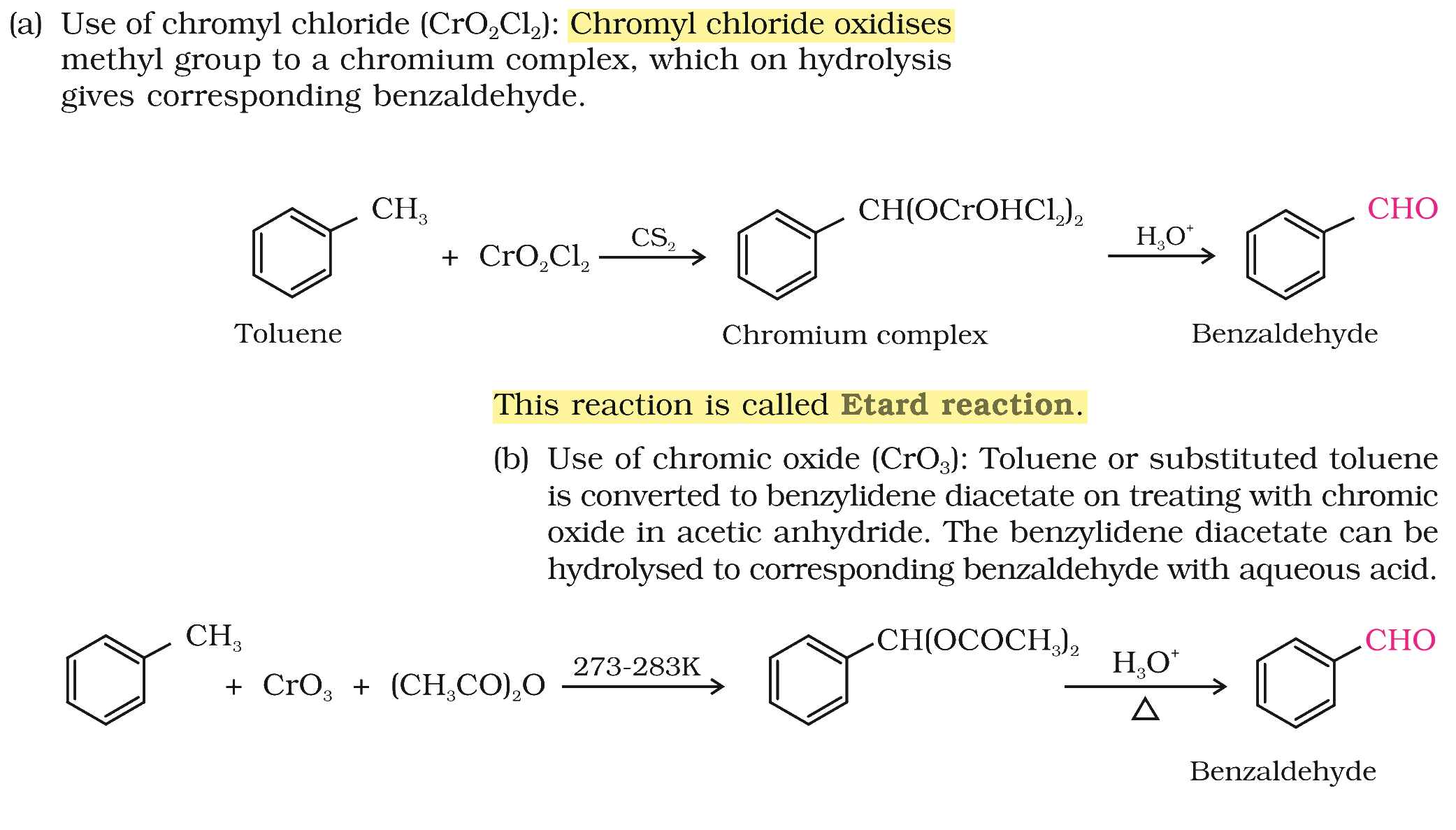
Etard reaction: toluene is oxidised by chromyl chloride (CrO2Cl2) in \( \ce{CS2} \). A brown chromium complex forms, which is hydrolysed to benzaldehyde.
\( \displaystyle \ce{C6H5CH3} \xrightarrow[\text{(ii) }\ce{H3O+}]{\text{(i) }\ce{CrO2Cl2}\text{, }\ce{CS2}} \ce{C6H5CHO} \)
Oxidation with chromic oxide in acetic anhydride: toluene with CrO3 in (CH3CO)2O gives benzylidene diacetate, which is hydrolysed to benzaldehyde. The anhydride traps the aldehyde and stops further oxidation.
\( \displaystyle \ce{C6H5CH3} \xrightarrow[\ce{(CH3CO)2O}]{\ce{CrO3}} \ce{C6H5CH(OCOCH3)2} \xrightarrow{\ce{H3O+}} \ce{C6H5CHO} \)
Gattermann–Koch reaction: benzene is treated with CO and HCl in the presence of anhydrous AlCl3 or CuCl.
\( \displaystyle \ce{C6H6 + CO} \xrightarrow{\ce{HCl}\text{, anhyd. }\ce{AlCl3}/\ce{CuCl}} \ce{C6H5CHO} \)
Reduction of a nitrile with DIBAL-H: benzonitrile is reduced by diisobutylaluminium hydride, AlH(i-Bu)2, to an imine, which is hydrolysed to benzaldehyde.
\( \displaystyle \ce{C6H5CN} \xrightarrow[\text{(ii) }\ce{H2O}]{\text{(i) DIBAL-H}} \ce{C6H5CHO} \)
So the Etard reaction uses toluene with CrO2Cl2 in CS2, followed by hydrolysis.
Why the other options are incorrect
Option (1) Benzonitrile + AlH(i-Bu)2 — Incorrect. This gives benzaldehyde by DIBAL-H reduction of a nitrile, not by the Etard reaction.
Option (3) Toluene + CrO3 — Incorrect. Chromic oxide needs acetic anhydride to stop at the aldehyde stage; it is a different method from the Etard reaction.
Option (4) Benzene + CO, HCl, Anhy AlCl3/CuCl — Incorrect. This is the Gattermann–Koch reaction.
NCERT (2026-27 edition):
Use of Chromyl Chloride