CUETMOCK
  • Pricing
  • Mentors
Log inStart freeStart free mocks→

First test, then trust

Try a free CUET mock test.

Join 5,00,000+ students who rehearsed exam day on the exact NTA screen before sitting CUET. On the web and on Android.

Start free mocks →Get the Android app
CUETMOCK

India's #1 CUET Mock Test Platform. Original NCERT-based questions on the exact NTA exam screen — trusted by 5,00,000+ students since CUET 2022.

Get it onGoogle PlayScan to download the CUETMOCK app

Mock tests

  • CUET mock test series
  • Browse all papers
  • Commerce mocks
  • Humanities (Arts) mocks
  • Science mocks
  • Languages & GAT mocks
  • Free practice questions
  • Pricing

Resources

  • CUET exam guide
  • CUET syllabus
  • Universities accepting CUET
  • Expert blogs
  • News & notifications
  • Webinars & counselling
  • CUET score calculator
  • How we estimate your rank
  • FAQs

Company

  • About us
  • Our leadership & team
  • Our toppers
  • Mentors
  • For schools
  • Contact us
  • Terms
  • Privacy
  • Refund policy

Talk to us

+91 7696 6630 56info@cuetmock.comWhatsApp us

Our other platforms

  • JEE Mock — For IIT-JEE aspirants
  • NEET Mock — For NEET aspirants

Newsletter

Exam updates, study material and offers — no spam.

© 2026 NYC Ventures Pvt. Ltd.

701-702, Royal Business Park, Zirakpur, Punjab - 140603

  • Terms of use
  • Privacy policy
  • Refund policy
  • Contact us

iCUETMOCK is an independent preparation platform, not affiliated with the National Testing Agency (NTA). Always check exam details on the official NTA website.

  • Home
  • Mock tests
  • CUET guide
  • Pricing
  • Log in
Home/Practice questions/History
HistoryModern India: Framing the Constitution

The above passage is related to:

Read the passage given below to answer the following questions:

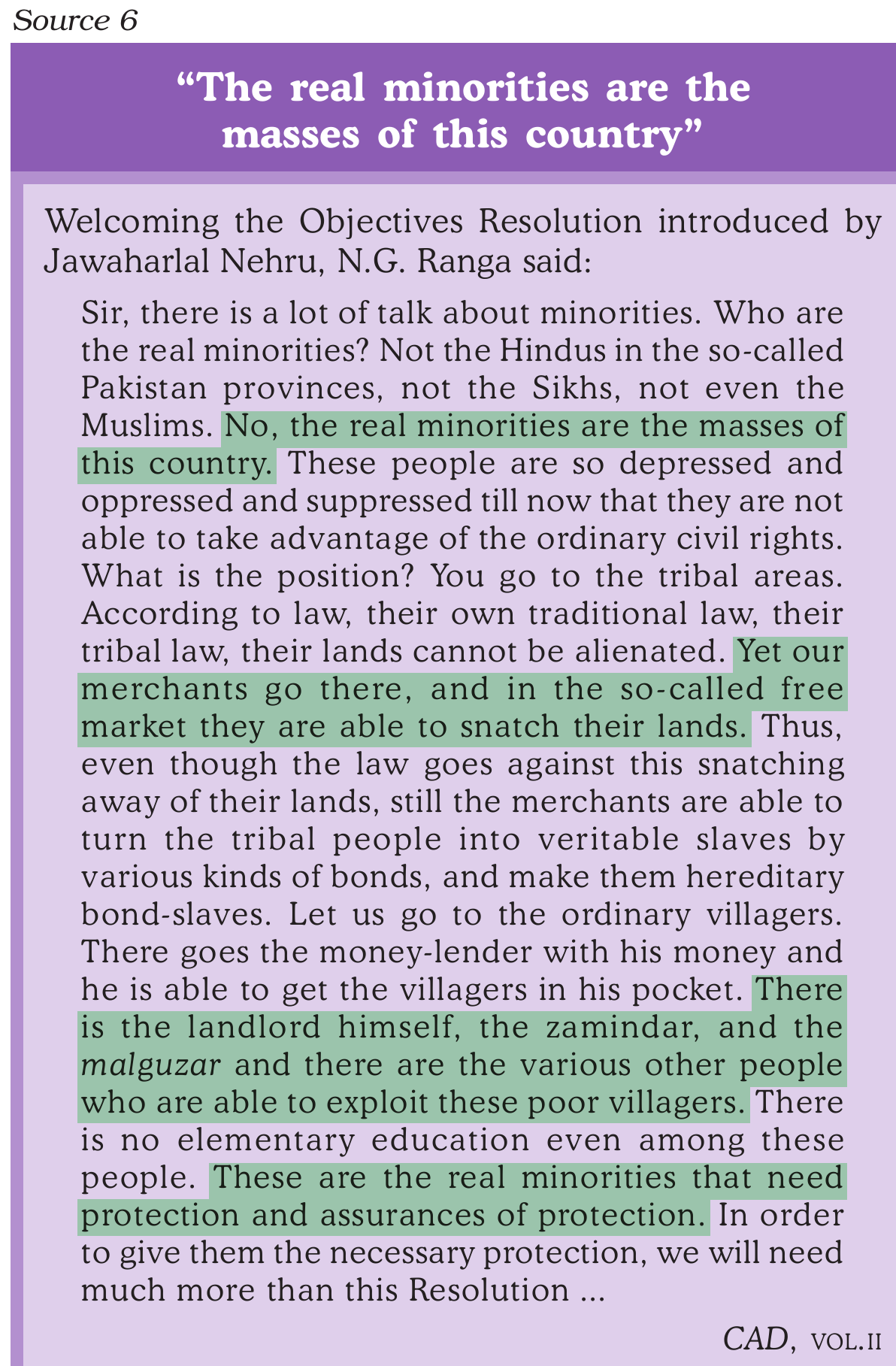
Welcoming the Objectives Resolution introduced by Jawaharlal Nehru, N.G. Ranga said:
Sir, there is a lot of talk about minorities. Who are the real minorities? Not the Hindus in the so-called Pakistan provinces, not the Sikhs, not even the Muslims. No, the real minorities are the masses of this country. These people are so depressed and oppressed and suppressed till now that they are not able to take advantage of the ordinary civil rights. What is the position? You go to the tribal areas. According to law, their own traditional law, their tribal law, their lands cannot be alienated. Yet our merchants go there, and in the so called free market they are able to snatch their lands. Thus, even though the law goes against this snatching away of their lands, still the merchants are able to turn the tribal people into veritable slaves by various kinds of bonds, and make them hereditary bond-slaves. Let us go to the ordinary villagers. There goes the money-lender with his money and he is able to get the villagers in his pocket. There is the landlord himself, the zamindar, and the malguzar and there are the various other people who are able to exploit these poor villagers. There is no elementary education even among these people. These are the real minorities that need protection and assurances of protection. In order to give them the necessary protection, we will need much more than this Resolution.

The above passage is related to:

Answer & explanation+

Correct answer: option 3

The correct answer is Option (3) → Exploitation of the villagers and the tribals

Ranga argues that the real minorities are the masses of the country, and to show why, he describes how the tribals lose their lands to merchants and how the villagers are exploited by the money-lender, the zamindar and the malguzar.

Option (1) The Muslim and Sikhs — Incorrect. Ranga names the Sikhs and the Muslims only to say that they are not the real minorities.

Option (2) Civil rights of all Indians — Incorrect. Civil rights come up in one line only: the oppressed masses are not able to take advantage of the ordinary civil rights. The passage is about why these people cannot use such rights, that is, about their exploitation, not about the rights of all Indians.

Option (3) Exploitation of the villagers and the tribals — Correct. Most of the speech describes this exploitation, and Ranga ends by calling these exploited people the real minorities that need protection.

Option (4) The Hindus in the Pakistan Provinces — Incorrect. Like the Sikhs and the Muslims, the Hindus in the so-called Pakistan provinces are mentioned only as a group that is not the real minority.


NCERT: Themes in Indian History Part III — Chapter 12: Framing the Constitution (2026-27)

NCERT extract

Advertisement

Practise more on Modern India: Framing the Constitution

Chapter-wise mocks on the real NTA exam screen, with solutions and your rank. Your first mocks are free.

Start free mocks →

Advertisement

Next questions

  1. Maths. Section B1 · Matrices
  2. Choose the appropriate adverb, from the options given below : You are quite wrong, I can ________ believe what you are saying.English · Fill Blanks
  3. Fill in the blank in the given sentence with the correct option:- The person who studies the structure and composition of the earth to know…English · One Word
  4. Which of the following mineral oil well was discovered in 1973 and production commenced in 1976?Geography · India-People and Economy: Mineral and Energy resources
  5. Physics · Ray Optics
  6. Study the following table and answer the question below. School name Total number of students enrolled Percentage of enrolled students, opt…General Aptitude Test · Quantitative Reasoning
  7. Rajan in a petition filed in 2019 said that he had faced humiliation and loss of reputation, as a transaction using a bank’s debit card at…Business Studies · Consumer Protection
  8. ∫(2x+1)e^2x dx is equal toMaths. Section B1 · Indefinite Integration
  9. Two circles having diameter 10 cm and 24 cm. The distance between their centres is 13 cm. What is the length of their common chord (in cm)?General Aptitude Test · Quantitative Reasoning
  10. Select the most appropriate option to fill in the blank. The weather was so ________ that she couldn’t step out of the house.English · Fill Blanks