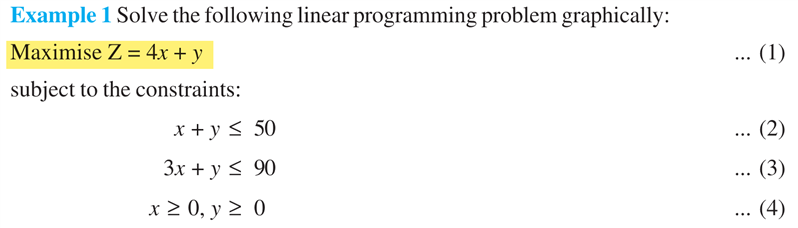
For the LPP:
Maximise z = 4x + y
subject to constraints
\(x + y \le 50\), \(3x + y \le 90\), \(x \ge 0\), \(y \ge 0\), the maximum value of z is:
Answer & explanation
Correct answer: option 2
The correct answer is Option (2) → 120
The feasible region is bounded, so the maximum of z is at a corner point.
The two lines meet where
\(x + y = 50\)
\(3x + y = 90\)
Subtracting, 2x = 40, so x = 20 and y = 30.
The line x + y = 50 meets the y-axis at (0, 50); the line 3x + y = 90 meets the x-axis at (30, 0). Both these points satisfy the other constraint, so the corner points are (0, 0), (30, 0), (20, 30) and (0, 50).
Values of z = 4x + y:
\(z(0, 0) = 0\)
\(z(30, 0) = 120\)
\(z(20, 30) = 80 + 30 = 110\)
\(z(0, 50) = 50\)
The maximum value is 120, at (30, 0).
Why the other options are incorrect
Option (1) 110 — Incorrect. 110 is the value at the intersection point (20, 30); the corner (30, 0) gives more.
Option (3) 50 — Incorrect. 50 is the value at (0, 50), the smallest of the non-zero corner values.
Option (4) 100 — Incorrect. No corner point gives 100; the corner values are 0, 120, 110 and 50.
NCERT (2026-27 edition):
Graphical Method of Solving Linear Programming Problems