
Seven people, A, B, C, D, E, F and G are sitting in a circle facing the center and playing cards. E is neighbour of A and D. G is not between F and C. B is not neighbour of G and D. F is the immediate right of A.
Which of the following statements is/are correct:
(A) A and B are sitting adjacent to each other.
(B) A is sitting immediately right of E.
(C) F is second to the left of C.
(D) F and C are neighbours of B
Choose the correct answer from the options given below:
Answer & explanation
Correct answer: option 2
The correct answer is Option (2) → (B), (C) and (D) only
All seven face the centre, so a person’s right is the anticlockwise direction round the table. The arrangement is fixed clue by clue:
F is immediately right of A, and E is a neighbour of A. A has only two neighbours, so E sits on A’s left.
E is also a neighbour of D, so D sits on E’s other side. This fixes D, E, A, F in four seats in a row.
B, C and G fill the three seats between F and D. B is not a neighbour of D, so B is not in the seat next to D; B is not a neighbour of G, so B cannot take the middle seat either, because G would then sit next to it. So B sits next to F.
G cannot take the middle seat, as it would be next to B. So G sits next to D and C takes the middle seat. G then sits between C and D, which agrees with “G is not between F and C”.
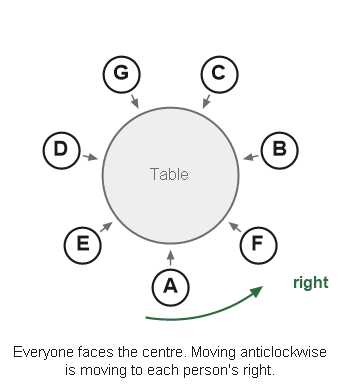
(A) A and B are sitting adjacent to each other. Incorrect. A’s neighbours are E and F; F sits between A and B.
(B) A is sitting immediately right of E. Correct. E is on A’s left, so the next seat to E’s right is A.
(C) F is second to the left of C. Correct. Moving clockwise (to the left) from C, the first seat is B and the second is F.
(D) F and C are neighbours of B Correct. B sits between F and C.