
CUETMOCK
  • Pricing
  • Mentors
Log inStart freeStart free mocks→

First test, then trust

Try a free CUET mock test.

Join 5,00,000+ students who rehearsed exam day on the exact NTA screen before sitting CUET. On the web and on Android.

Start free mocks →Get the Android app
CUETMOCK

India's #1 CUET Mock Test Platform. Original NCERT-based questions on the exact NTA exam screen — trusted by 5,00,000+ students since CUET 2022.

Get it onGoogle PlayScan to download the CUETMOCK app

Mock tests

  • CUET mock test series
  • Commerce mocks
  • Humanities (Arts) mocks
  • Science mocks
  • Languages & GAT mocks
  • Free practice questions
  • Pricing

Resources

  • CUET exam guide
  • CUET syllabus
  • Universities accepting CUET
  • Expert blogs
  • News & notifications
  • Webinars & counselling
  • CUET score calculator
  • How we estimate your rank
  • FAQs

Company

  • About us
  • Our leadership & team
  • Our toppers
  • Mentors
  • For schools
  • Contact us
  • Terms
  • Privacy
  • Refund policy

Talk to us

+91 7696 6630 56info@cuetmock.comWhatsApp us

Our other platforms

  • JEE Mock — For IIT-JEE aspirants
  • NEET Mock — For NEET aspirants

Newsletter

Exam updates, study material and offers — no spam.

© 2026 NYC Ventures Pvt. Ltd.

701-702, Royal Business Park, Zirakpur, Punjab - 140603

  • Terms of use
  • Privacy policy
  • Refund policy
  • Contact us

iCUETMOCK is an independent preparation platform, not affiliated with the National Testing Agency (NTA). Always check exam details on the official NTA website.

  • Home
  • Mock tests
  • CUET guide
  • Pricing
  • Log in
Home/Practice questions/Chemistry
ChemistryInorganic: Coordination Compounds

How many unpaired electrons are present in [Fe(H2O)6]2+?

A critical study of the magnetic data of coordination compounds of metals of the first transition series reveals some complications. For metal ions with up to three electrons in the d orbitals, like Ti3+(d1); V3+(d2); Cr3+(d3); two vacant d orbitals are available for octahedral hybridization with 4s and 4p orbitals. The magnetic behaviour of these free ions and their coordination entities is similar. When more than three 3d electrons are present, the required pair of 3d orbitals for octahedral hybridization is not directly available (as a consequence of Hund’s rule). Thus, for d4 (Cr2+, Mn3+), d5 (Mn2+, Fe3+), d6 (Fe2+, Co3+) cases, a vacant pair of d orbitals results only by pairing of 3d electrons which leaves two, one and zero unpaired electrons, respectively. The magnetic data agree with maximum spin pairing in many cases, especially with coordination compounds containing d6 ions. However, with species containing d4 and d5 ions there are complications.

How many unpaired electrons are present in [Fe(H2O)6]2+?

Answer & explanation+

Correct answer: option 2

The correct answer is Option (2) → 4

  • Oxidation state of Fe: in \( \ce{[Fe(H2O)6]^2+} \) water is neutral, so x + 6(0) = +2 and x = +2.

  • Configuration: Fe (Z = 26) is [Ar]3d64s2; losing the two 4s electrons gives \( \ce{Fe^2+} \): 3d6.

  • Type of ligand: towards \( \ce{Fe^2+} \), water acts as a weak field ligand (Δo < P), so the 3d electrons are not forced to pair and the complex is high spin. The full spin pairing of d6 ions described in the passage needs strong field ligands.

  • Filling the d orbitals: t2g4eg2.

  • Paired orbitals: one t2g orbital holds a pair.

  • Unpaired electrons: two t2g and both eg orbitals hold single electrons, so there are 4 unpaired electrons.

  • Check: Table 4.7 lists 4 unpaired electrons for \( \ce{Fe^2+} \); its data are mainly for hydrated ions.

NCERT (2026-27 edition):
5.5.4 Crystal Field Theory – “(i) If Δo < P, the fourth electron enters one of the eg orbitals giving the configuration t2g3eg1. Ligands for which Δo < P are known as weak field ligands and form high spin complexes.”

4.3.9 Magnetic Properties – “… The magnetic moments calculated from the ‘spin-only’ formula and those derived experimentally for some ions of the first row transition elements are given in Table 4.7. The experimental data are mainly for hydrated ions in solution or in the solid state.”

Table 4.7: Calculated and Observed Magnetic Moments (BM)
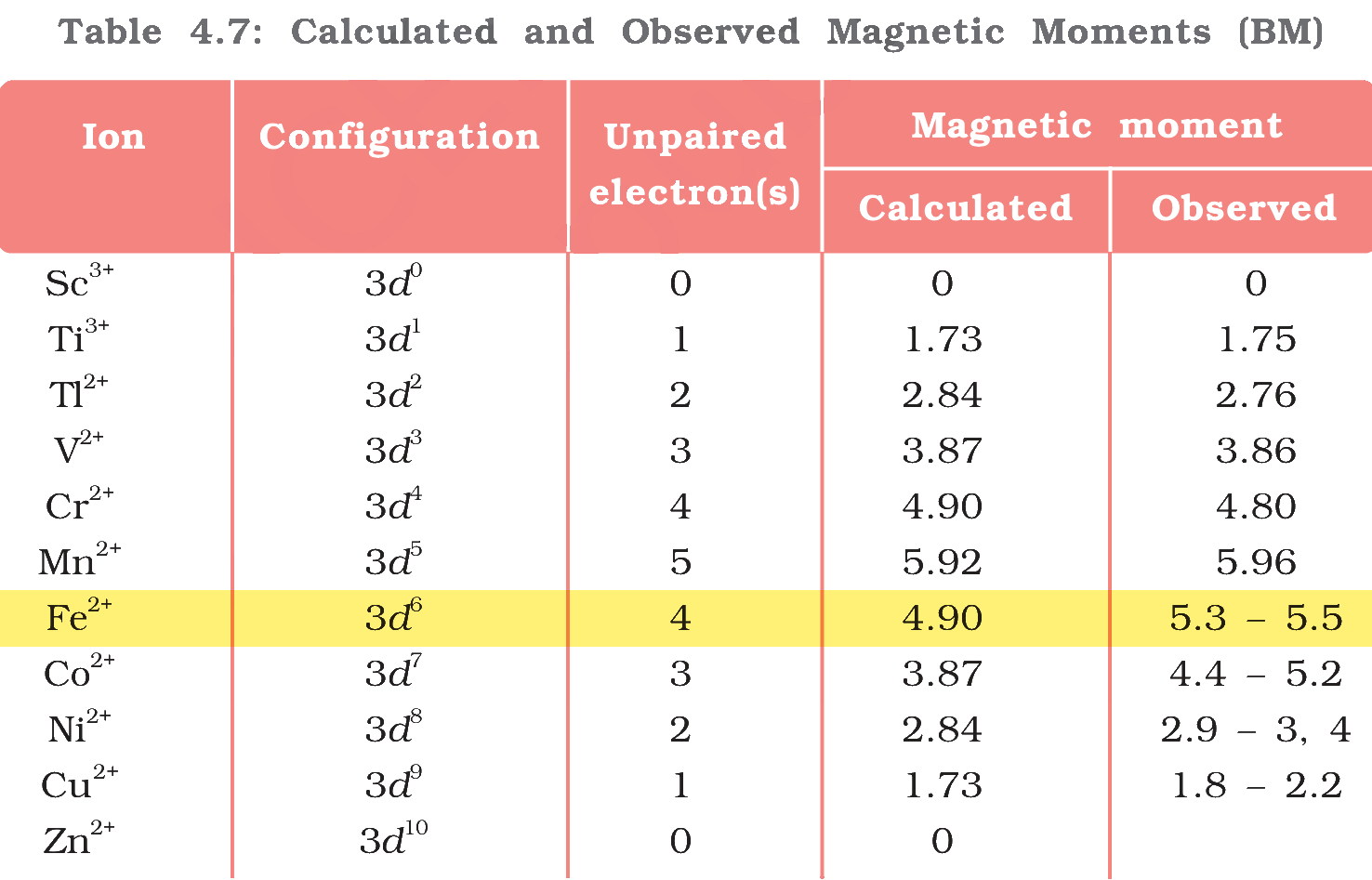
Table 4.7

Advertisement

Practise more on Inorganic: Coordination Compounds

Chapter-wise mocks on the real NTA exam screen, with solutions and your rank. Your first mocks are free.

Start free mocks →

Advertisement

Next questions

  1. Three of the following four letter-clusters are alike in a certain way and one is different. Pick the odd one out.General Aptitude Test · General Ability
  2. A man can row 90 km downstream and return in a total of 8 hours. If the speed of the boat in still water is four times the speed of the cur…General Aptitude Test · Numerical Ability
  3. The order of √(1 + ≤ft(displaystyledy/dx)^2) = ≤ft[a(d^2y)/(dx^2)]^1/3 isMaths. Section A · Differential Equations
  4. Consider the following statements about Maslow’s Need Hierarchy Theory:(A) People’s behaviour is based on their needs, and satisfaction of…Business Studies · Directing
  5. Match List-I with List-II.List-IList-II(A) Bazaars(I) Were in great demand in West Asia and Southeast Asia(B) Agriculture(II) Were hubs of…History · Medieval India: Through the Eyes of Travellers
  6. Find at what time between 7 to 8 o'clock will the hands of a clock be in the same straight line but not together.General Aptitude Test · Verbal Reasoning
  7. Which of the following is NOT done at the step ‘Identifying alternative courses of action’?Business Studies · Planning
  8. Which one is responsible to cause inbreeding depression?Biology · Sexual Reproduction in Flowering Plants
  9. A 10.0 mF capacitor that is initially uncharged is connected in series with a 10.0 MΩ resistor and an emf source with E = 100 V. Just after…Physics · Current Electricity
  10. What significant measures did Sheikh Abdullah undertake after becoming Prime Minister?Political Science · Politics in India Since Independence: Regional Aspirations