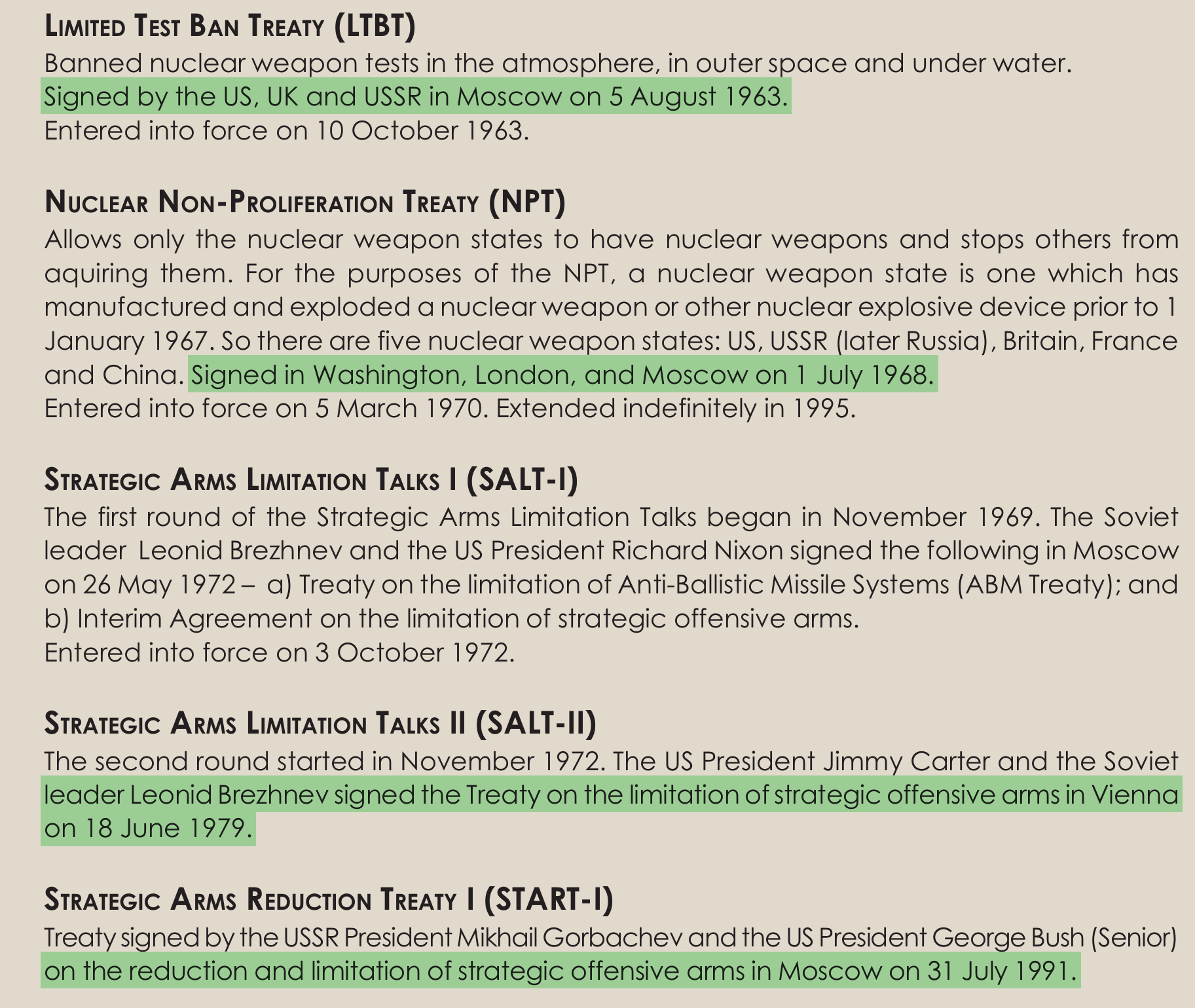
Match List-I with List-II
| List-I | List-II | ||
| (A) | Limited Test Ban Treaty | (I) | 1991 |
| (B) | Strategic Arms Limitation Talks-II | (II) | 1968 |
| (C) | Nuclear Non-Proliferation Treaty | (III) | 1963 |
| (D) | Strategic Arms Reduction Treaty-I | (IV) | 1979 |
Choose the correct answer from the options given below:
Answer & explanation
Correct answer: option 4
The correct answer is Option (4) → (A)-(III), (B)-(IV), (C)-(II), (D)-(I)
(A) Limited Test Ban Treaty — this matches (III) 1963.
(B) Strategic Arms Limitation Talks-II — this matches (IV) 1979.
(C) Nuclear Non-Proliferation Treaty — this matches (II) 1968.
(D) Strategic Arms Reduction Treaty-I — this matches (I) 1991.
Note: This question is taken from the chapter ‘The Cold War Era’, which was there in the pre-rationalised NCERT and has been dropped from later editions. Since a question cannot be tagged to a deleted chapter, it has been mapped here to the chapter ‘Security in the Contemporary World’ of the NCERT book (2026-27). The later NCERT books (2023-24, 2025-26 and 2026-27) still name SALT II, START and the NPT of 1968 in that chapter, but give no year for SALT II or START and do not name the Limited Test Ban Treaty; the years are in the pre-rationalised book’s box ‘Arms Control Treaties’.
NCERT (2026-27): “Traditional Security and Cooperation … The US and Soviet Union signed a number of other arms control treaties including the Strategic Arms Limitations Treaty II or SALT II and the Strategic Arms Reduction Treaty (START). The Nuclear Non-Proliferation Treaty (NPT) of 1968 was an arms control treaty in the sense that it regulated the acquisition of nuclear weapons: those countries that had tested and manufactured nuclear weapons before 1967 were allowed to keep their weapons; and those that had not done so were to give up the right to acquire them.…” NCERT (Pre-rationalised): Contemporary World Politics — Chapter 1: The Cold War Era, box ‘Arms Control Treaties’
|