
CUETMOCK
  • Pricing
  • Mentors
Log inStart freeStart free mocks→

First test, then trust

Try a free CUET mock test.

Join 5,00,000+ students who rehearsed exam day on the exact NTA screen before sitting CUET. On the web and on Android.

Start free mocks →Get the Android app
CUETMOCK

India's #1 CUET Mock Test Platform. Original NCERT-based questions on the exact NTA exam screen — trusted by 5,00,000+ students since CUET 2022.

Get it onGoogle PlayScan to download the CUETMOCK app

Mock tests

  • CUET mock test series
  • Browse all papers
  • Commerce mocks
  • Humanities (Arts) mocks
  • Science mocks
  • Languages & GAT mocks
  • Free practice questions
  • Pricing

Resources

  • CUET exam guide
  • CUET syllabus
  • Universities accepting CUET
  • Expert blogs
  • News & notifications
  • Webinars & counselling
  • CUET score calculator
  • How we estimate your rank
  • FAQs

Company

  • About us
  • Our leadership & team
  • Our toppers
  • Mentors
  • For schools
  • Contact us
  • Terms
  • Privacy
  • Refund policy

Talk to us

+91 7696 6630 56info@cuetmock.comWhatsApp us

Our other platforms

  • JEE Mock — For IIT-JEE aspirants
  • NEET Mock — For NEET aspirants

Newsletter

Exam updates, study material and offers — no spam.

© 2026 NYC Ventures Pvt. Ltd.

701-702, Royal Business Park, Zirakpur, Punjab - 140603

  • Terms of use
  • Privacy policy
  • Refund policy
  • Contact us

iCUETMOCK is an independent preparation platform, not affiliated with the National Testing Agency (NTA). Always check exam details on the official NTA website.

  • Home
  • Mock tests
  • CUET guide
  • Pricing
  • Log in
Home/Practice questions/General Aptitude Test
General Aptitude TestVerbal ReasoningDice

Three different positions of the same dice are shown, the faces of wh…

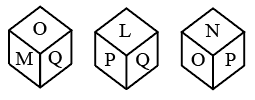
Three different positions of the same dice are shown, the faces of which are marked with the letters L, M, N, O, P and Q. Select the letter that will be on the face opposite to the face having the letter 'M'.
Answer & explanation+

Correct answer: option 1

Step 1) In figure 1 and 2, (Q) is common

Step 2) The number ‘Q’ is common in both the dice. In order to find out, the number appearing on the opposite face, rotate the dice in a clockwise direction with the common number as the reference.

Step 3) Q     M      O

             Q      P       L

Step 4)  

M will be opposite  to P

Advertisement

Practise more on Verbal Reasoning

Chapter-wise mocks on the real NTA exam screen, with solutions and your rank. Your first mocks are free.

Start free mocks →

Advertisement

Next questions

  1. A peacock eats a snake, the snake eats a frog and the frog eats insects, while insects eat green plants. The position of the peacock is:Biology · Ecosystem
  2. Select the option in which the numbers shares the same relationship in set as that shared by the numbers in the given set. (NOTE: Operation…General Aptitude Test · Verbal Reasoning
  3. Which among the following statements are correct about the first general elections of India? (A) The first general elections spanned from O…Political Science · Politics in India Since Independence: Era of one Party Dominance
  4. Who proposed that the long neck of giraffes evolved due to their attempt to forage leaves on tall trees?Biology · Evolution
  5. With which country India signed a landmark Free Trade Agreement (FTA) during July 2025?General Aptitude Test · Current Affairs
  6. Which of the following is an indicator used by experts to gauge the number of people dying prematurely due to a particular disease, as well…Economics · Indian Economic Development: Infrastructure
  7. A capacitor is filled with an insulator and a potential difference is applied to its plates. The energy stored in the capacitor is U. The c…Physics · Electrostatic Potential and Capacitance
  8. The chromosomal theory of inheritance was given by:Biology · Principles of Inheritance and Variation
  9. The equation √(x + 3-4√(x-1))+ √(x+8-6√(x-1))=1 hasMaths. Section B1 · Relations and Functions
  10. Identify the year of Champaran Movement:History · Modern India: Mahatma Gandhi and the Nationalist movement