Read the passage and answer the questions:
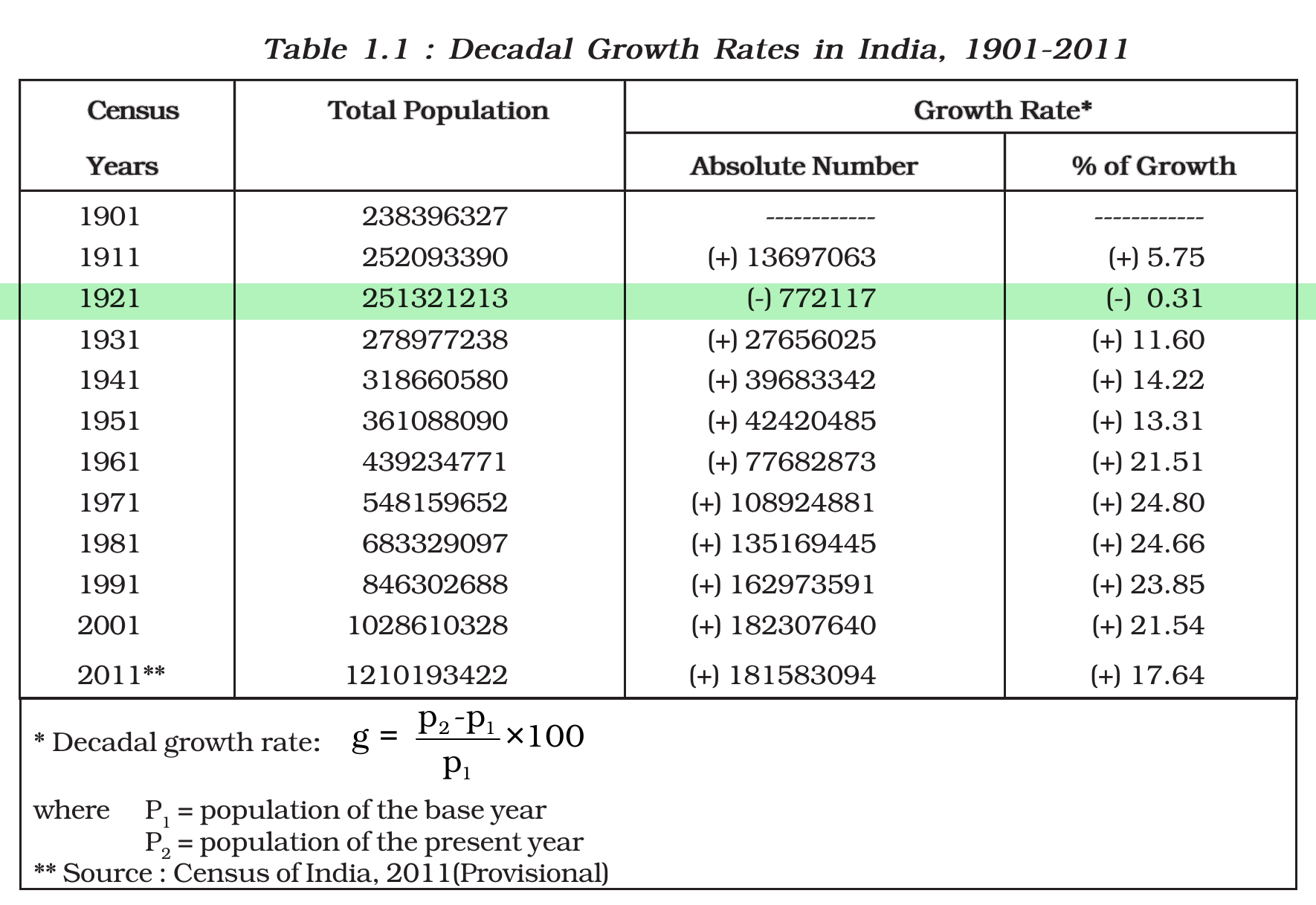
Decadal Growth Rates in India, 1901-2011
| Census Years | Total Population | Absolute Number | % of Growth |
| 1901 | 238396327 | — | — |
| 1911 | 252093390 | (+) 13697063 | (+) 5.75 |
| 1921 | 251321213 | (-) 772117 | (-) 0.31 |
| 1931 | 278977238 | (+) 27656025 | (+) 11.60 |
| 1941 | 318660580 | (+) 39683342 | (+) 14.22 |
| 1951 | 361088090 | (+) 42420485 | (+) 13.31 |
| 1961 | 439234771 | (+) 77682873 | (+) 21.51 |
| 1971 | 548159652 | (+) 108924881 | (+) 24.80 |
| 1981 | 683329097 | (+) 135169445 | (+) 24.66 |
| 1991 | 846302688 | (+) 162973591 | (+) 23.85 |
| 2001 | 1028610328 | (+) 182307640 | (+) 21.54 |
| 2011** | 1210193422 | (+) 181583094 | (+) 17.64 |
* Decadal growth rate: \( g = \displaystyle\frac{P_2 - P_1}{P_1} \times 100 \)
where
\( P_1 = \text{population of the base year} \)
\( P_2 = \text{population of the present year} \)
Source: Census of India, 2011 (Provisional)
Which of the following decades experienced negative growth of population in India?
Answer & explanation
Correct answer: option 2
The correct answer is Option (2) → 1911-1921
The table shows a minus sign only once: in 1921 the population was 772,117 less than in 1911, a growth of (-) 0.31 per cent. High birth and death rates kept growth very low in this period, and in 1911-1921 it even turned negative.
Note: This passage is NCERT’s Table 1.1 ‘Decadal Growth Rates in India, 1901-2011’ from the chapter ‘Population: Distribution, Density, Growth and Composition’ (India – People and Economy). NTA built five questions on a single table, so read the book’s tables as closely as its text.
Note: A similar question was also asked in CUET (UG) 2026 on 14-05-2026 (Slot 1), and in CUET (UG) 2022 on 15-07-2022 (Slot 2).
NCERT (2025-26): “Growth of Population … Phase I : The period from 1901-1921 is referred to as a period of stagnant or stationary phase of growth of India’s population, since in this period growth rate was very low, even recording a negative growth rate during 1911-1921. Both the birth rate and death rate were high keeping the rate of increase low (Appendix–iii). Poor health and medical services, illiteracy of people at large and inefficient distribution system of food and other basic necessities were largely responsible for a high birth and death rates in this period.…”
|