What is the reason for lanthanoid contraction?
Answer & explanation
Correct answer: option 4
The correct answer is Option (4) → Imperfect shielding of 4f electrons
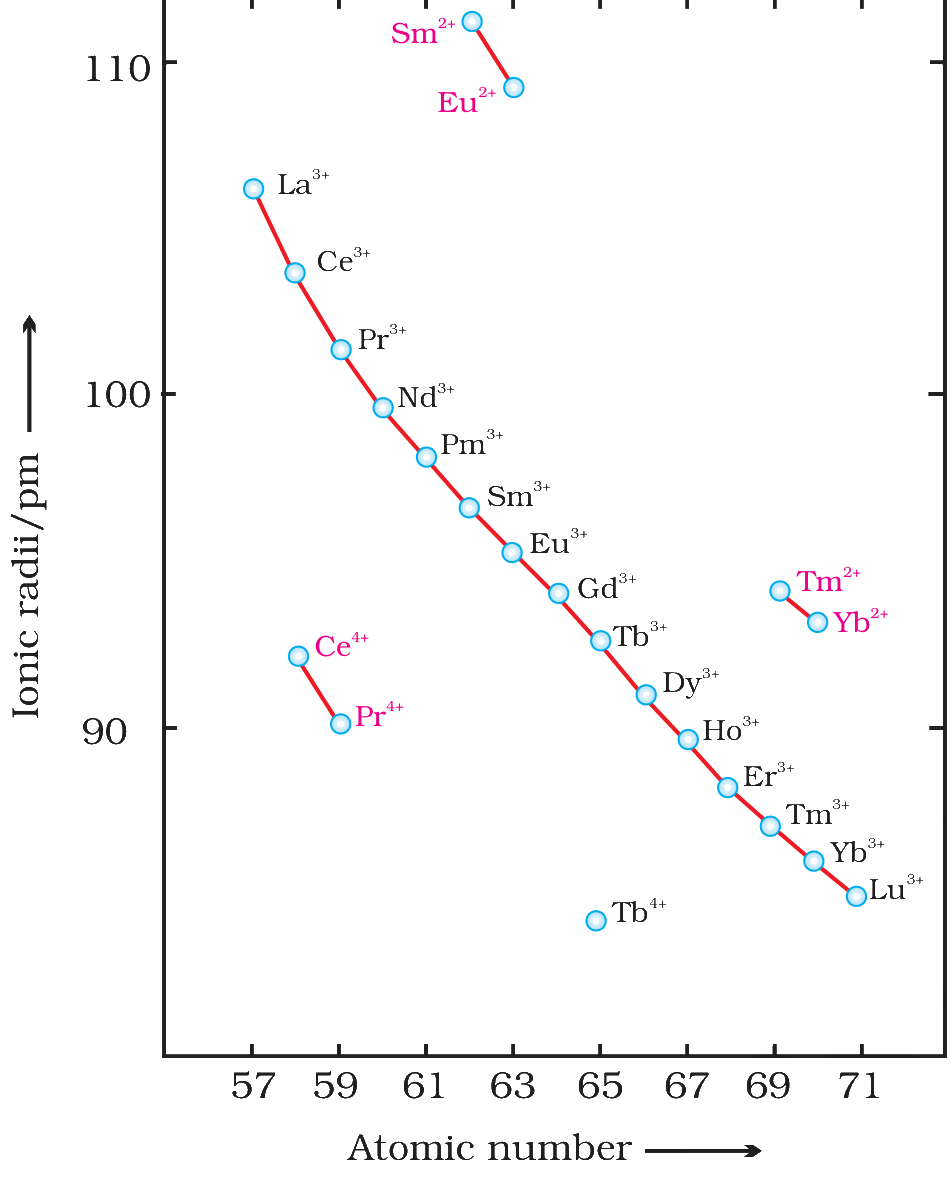
The lanthanoid contraction is the steady decrease in atomic and ionic radii from lanthanum to lutetium. Each step adds one proton to the nucleus and one electron to the 4f subshell, and one 4f electron shields another imperfectly. The effective nuclear charge felt by the outer electrons therefore rises at every step, and the size shrinks.
So lanthanoid contraction is caused by the imperfect shielding of 4f electrons.
Why the other options are incorrect
Option (1) Imperfect shielding of 4s and 4p electrons — Incorrect. 4s and 4p are completely filled inner subshells long before the lanthanoids; they do not change across the series.
Option (2) Imperfect shielding of 4p and 4d electrons — Incorrect. These subshells are also already full and the same for every lanthanoid, so they cannot cause a steady change.
Option (3) Imperfect shielding of 4d electrons — Incorrect. The 4d subshell is filled in the second transition series; the electrons added in the lanthanoids go into 4f.
NCERT (2026-27 edition):
Atomic and Ionic Sizes – “The overall decrease in atomic and ionic radii from lanthanum to lutetium (the lanthanoid contraction) is a unique feature in the chemistry of the lanthanoids. … This contraction is, of course, similar to that observed in an ordinary transition series and is attributed to the same cause, the imperfect shielding of one electron by another in the same sub-shell. However, the shielding of one 4f electron by another is less than one d electron by another with the increase in nuclear charge along the series. There is fairly regular decrease in the sizes with increasing atomic number.”