
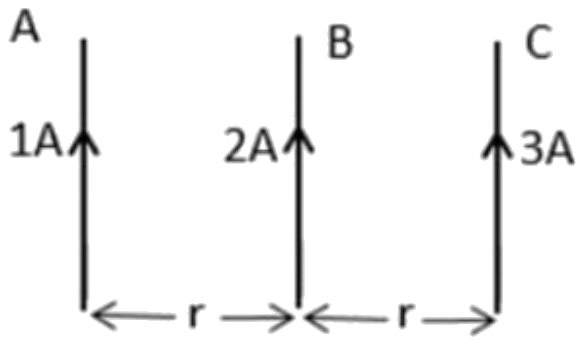
In the figure given below, A, B and C are current carrying wires. The direction of the resultant force on wire B is
Answer & explanation
Correct answer: option 1
The correct answer is Option (1) → in the plane of the paper towards right
Parallel currents attract each other, and the force per unit length between two long parallel wires is \( F/l = \mu_0I_1I_2/(2\pi d) \). A and C are both at the same distance r from B, so the two forces on B compare as the products of the currents.
\( \displaystyle \frac{F_{\mathrm{BA}}}{l} = \frac{\mu_0 \times 1 \times 2}{2\pi r} \ \text{(towards A, to the left)} \)
\( \displaystyle \frac{F_{\mathrm{BC}}}{l} = \frac{\mu_0 \times 3 \times 2}{2\pi r} \ \text{(towards C, to the right)} \)
The pull of C on B is three times the pull of A, so the resultant force on B points towards C, in the plane of the paper towards the right.
Why the other options are incorrect
Option (2) perpendicular to the plane of the paper and outward — Incorrect. The force between parallel wires acts along the line joining them, in the plane of the paper, never perpendicular to it.
Option (3) in the plane of the paper towards left — Incorrect. A resultant towards the left would need the larger pull from A, but A carries the smaller current.
Option (4) perpendicular to the plane of the paper and inward — Incorrect. The force between parallel wires acts along the line joining them, in the plane of the paper, never perpendicular to it.
NCERT (2026-27):
Force Between Two Parallel Currents, the Ampere – “… We have seen from above that currents flowing in the same direction attract each other. One can show that oppositely directed currents repel each other. Thus, Parallel currents attract, and antiparallel currents repel.”