
Read the following passage and answer the questions.
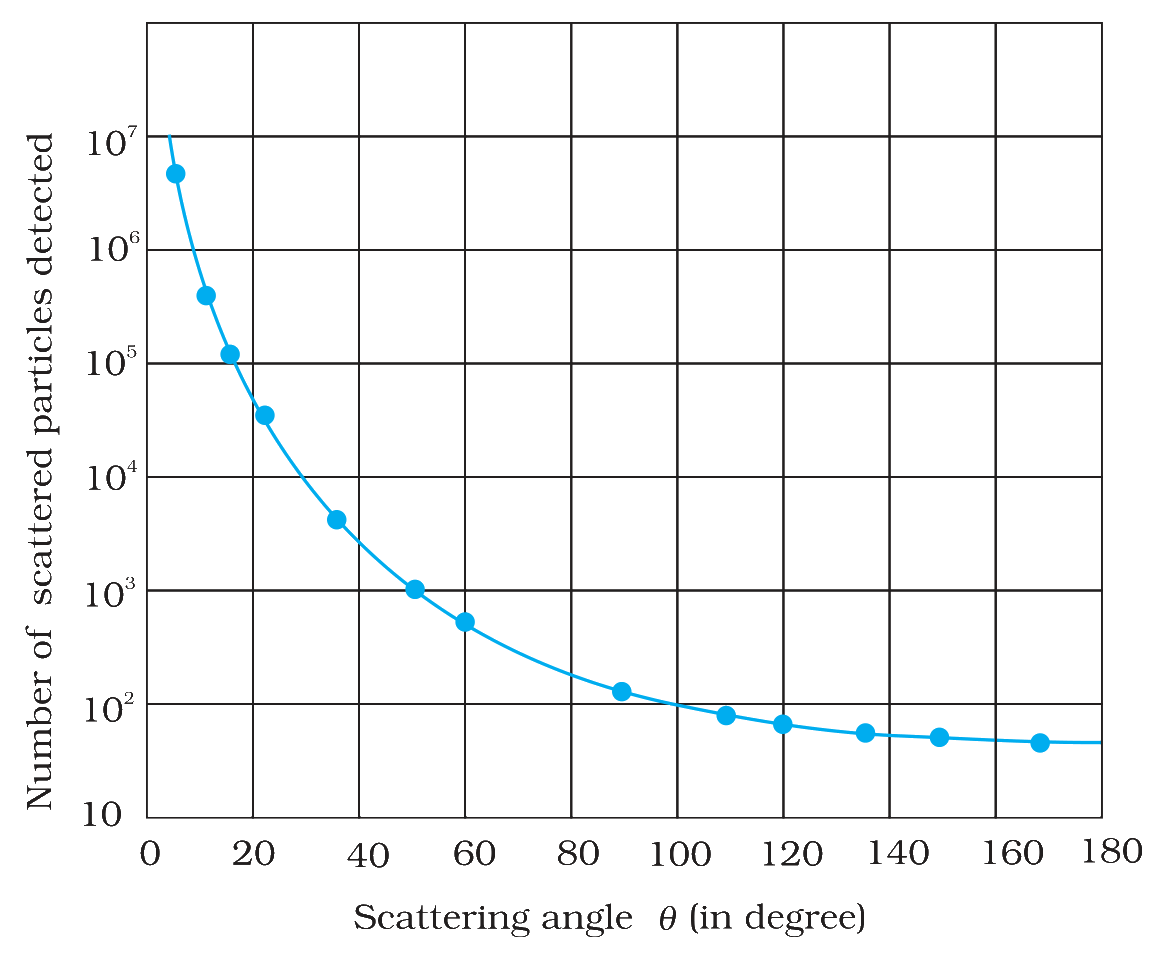
In 1911, H. Geiger and E. Marsden did a scattering experiment suggested by Rutherford. A radioactive source of \({}^{214}_{83}\mathrm{Bi}\) gave out alpha-particles of energy 5.5 MeV. The alpha-particles passed through lead bricks and then fell on a gold foil. The foil was only \(2.1\times10^{-7}\ \mathrm{m}\) thick. A detector made of a zinc sulphide screen and a microscope was placed near the foil. The detector could be turned around the foil. The whole apparatus was kept in a vacuum chamber. An alpha-particle carries a positive charge \(2e\). A gold nucleus carries a positive charge \(Ze\), with \(Z = 79\) for gold. The graph below shows the number of scattered alpha-particles detected at different scattering angles.
While working out the path of an alpha-particle in this experiment, the gold nucleus is taken to stay at rest. This is reasonable because the gold nucleus
Answer & explanation
Correct answer: option 1
The correct answer is Option (1) → is about 50 times heavier than the alpha-particle
Option (1) is about 50 times heavier than the alpha-particle — Correct. The nucleus and the alpha-particle push each other with forces of the same size. The nucleus is much heavier, so its acceleration is far smaller. It hardly moves while the alpha-particle passes.
Option (2) carries a much larger charge than the alpha-particle — Incorrect. The Coulomb force depends on the product of both charges. So the force on the nucleus has the same size as the force on the alpha-particle. A larger charge does not keep the nucleus still.
Option (3) feels a much smaller force than the alpha-particle — Incorrect. The two forces are an action-reaction pair. They are equal in size and opposite in direction.
Option (4) is shielded by the electrons of the gold atom — Incorrect. The atomic electrons are very light and do not appreciably affect the alpha-particles. They play no part in keeping the nucleus at rest.
NCERT (2026-27):
Alpha-particle Scattering and Rutherford’s Nuclear Model of Atom – “… Since the nucleus of gold is about 50 times heavier than an α-particle, it is reasonable to assume that it remains stationary throughout the scattering process. …”