
Given below are two statements:
Statement I: In a DNA double helix, the backbone is constituted by sugar-phosphate, and the bases project outside.
Statement II: In a DNA double helix, the plane of one base pair stacks over the other, and this, in addition to H-bonds, confers stability on the helical structure.
In the light of the above statements, choose the most appropriate answer from the options given below:
Answer & explanation
Correct answer: option 4
The correct answer is Option (4) → Statement I is incorrect but Statement II is correct.
In the Watson-Crick double helix, two polynucleotide chains run side by side in opposite directions. Each chain has a sugar-phosphate backbone, and the nitrogenous bases of the two chains pair with each other by hydrogen bonds. The helix is held together by these H-bonds and by the stacking of base pairs one over the other.
Statement I: In a DNA double helix, the backbone is constituted by sugar-phosphate, and the bases project outside. — False. The backbone is sugar-phosphate, but the bases project inside, towards the axis of the helix. Only then can a base of one strand pair with a base of the other strand.
Statement II: In a DNA double helix, the plane of one base pair stacks over the other, and this, in addition to H-bonds, confers stability on the helical structure. — True. The flat base pairs lie one above the other like the steps of a spiral staircase. This stacking adds to the stability given by the hydrogen bonds.
NCERT Extract:
Structure of Polynucleotide Chain – “The salient features of the Double-helix structure of DNA are as follows:
(i) It is made of two polynucleotide chains, where the backbone is constituted by sugar-phosphate, and the bases project inside.
(ii) The two chains have anti-parallel polarity. It means, if one chain has the polarity 5′→3′, the other has 3′→5′.
…
(v) The plane of one base pair stacks over the other in double helix. This, in addition to H-bonds, confers stability of the helical structure (Figure 5.3).”
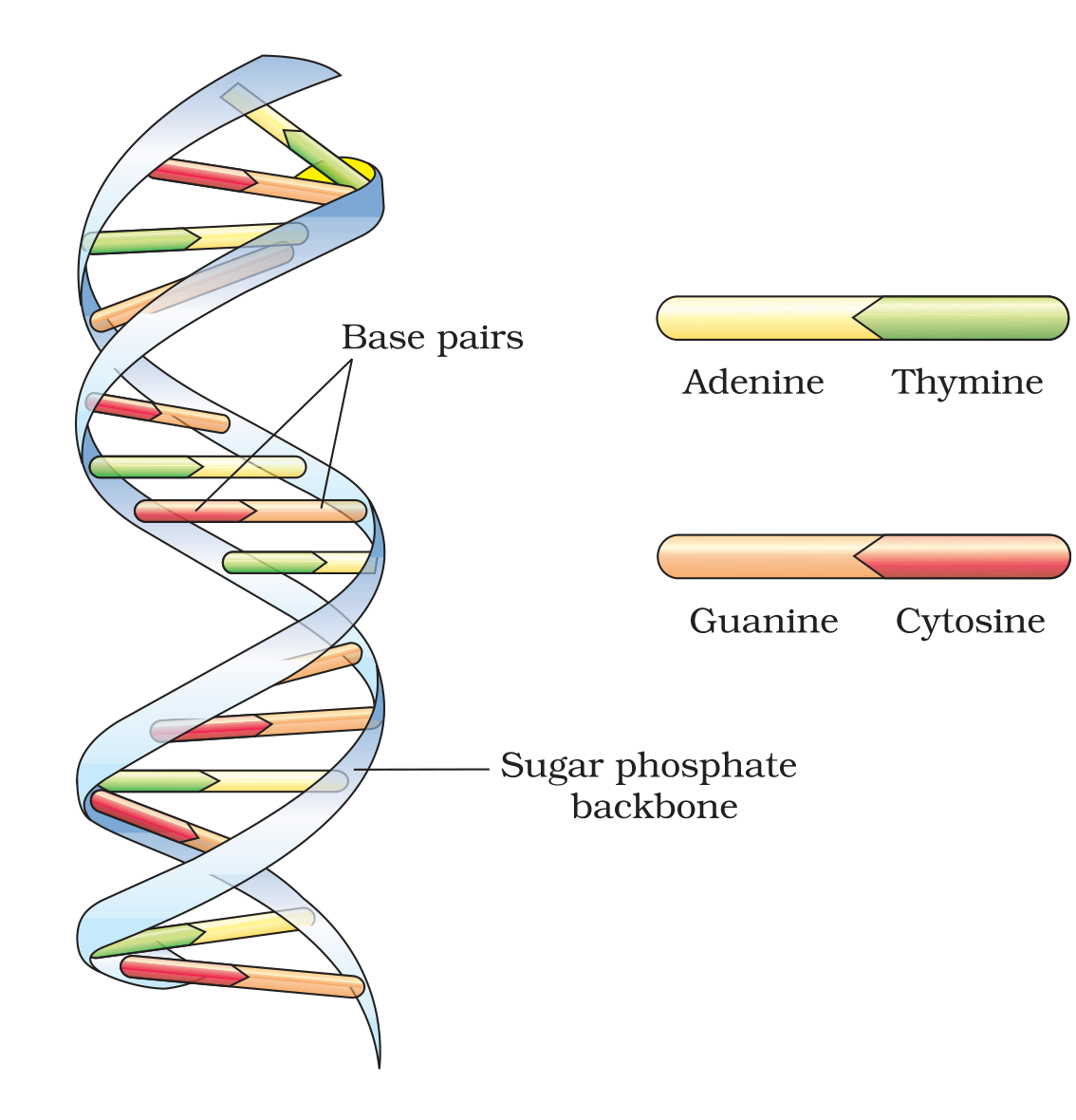
Figure 5.3 DNA double helix