
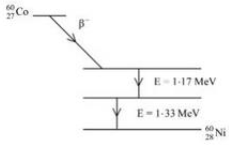
The energy level diagram of \( \beta^- \) emission from Cobalt is as shown. This diagram depicts the
Answer & explanation
Correct answer: option 3
The correct answer is Option (3) → emission of one \( \beta^- \) particle and two gamma photons of different frequencies
The diagram shows three steps. First, \( {}^{60}_{27}\mathrm{Co} \) emits one \( \beta^- \) particle (the slanting arrow) and becomes \( {}^{60}_{28}\mathrm{Ni} \) in an excited state. The excited nucleus then drops to its ground state in two steps, each marked by a vertical arrow, and each step emits a gamma photon carrying the energy difference of the two levels.
The two energies are different, 1.17 MeV and 1.33 MeV. Since a photon’s energy is \( E = h\nu \), different energies mean different frequencies. Gamma emission changes neither the mass number nor the charge number, so the nucleus stays \( {}^{60}_{28}\mathrm{Ni} \).
Note: This question is from the pre-rationalised NCERT book (2022-23). The topic was removed from the latest NCERT book (2026-27), and it also appears to be out of the CUET 2026 syllabus.
NCERT (Pre-rationalised edition, 2022-23):
Gamma Decay – “… A well-known example of such a process is that of \( {}^{60}_{27}\mathrm{Co} \). By beta emission, the \( {}^{60}_{27}\mathrm{Co} \) nucleus transforms into \( {}^{60}_{28}\mathrm{Ni} \) nucleus in its excited state. The excited \( {}^{60}_{28}\mathrm{Ni} \) nucleus so formed then de-excites to its ground state by successive emission of 1.17 MeV and 1.33 MeV gamma rays. This process is depicted in Fig.13.4 through an energy level diagram.”