What is the final product when Isopropylmagnesium bromide reacts with carbon dioxide (CO2) followed by acid hydrolysis?
Answer & explanation
Correct answer: option 3
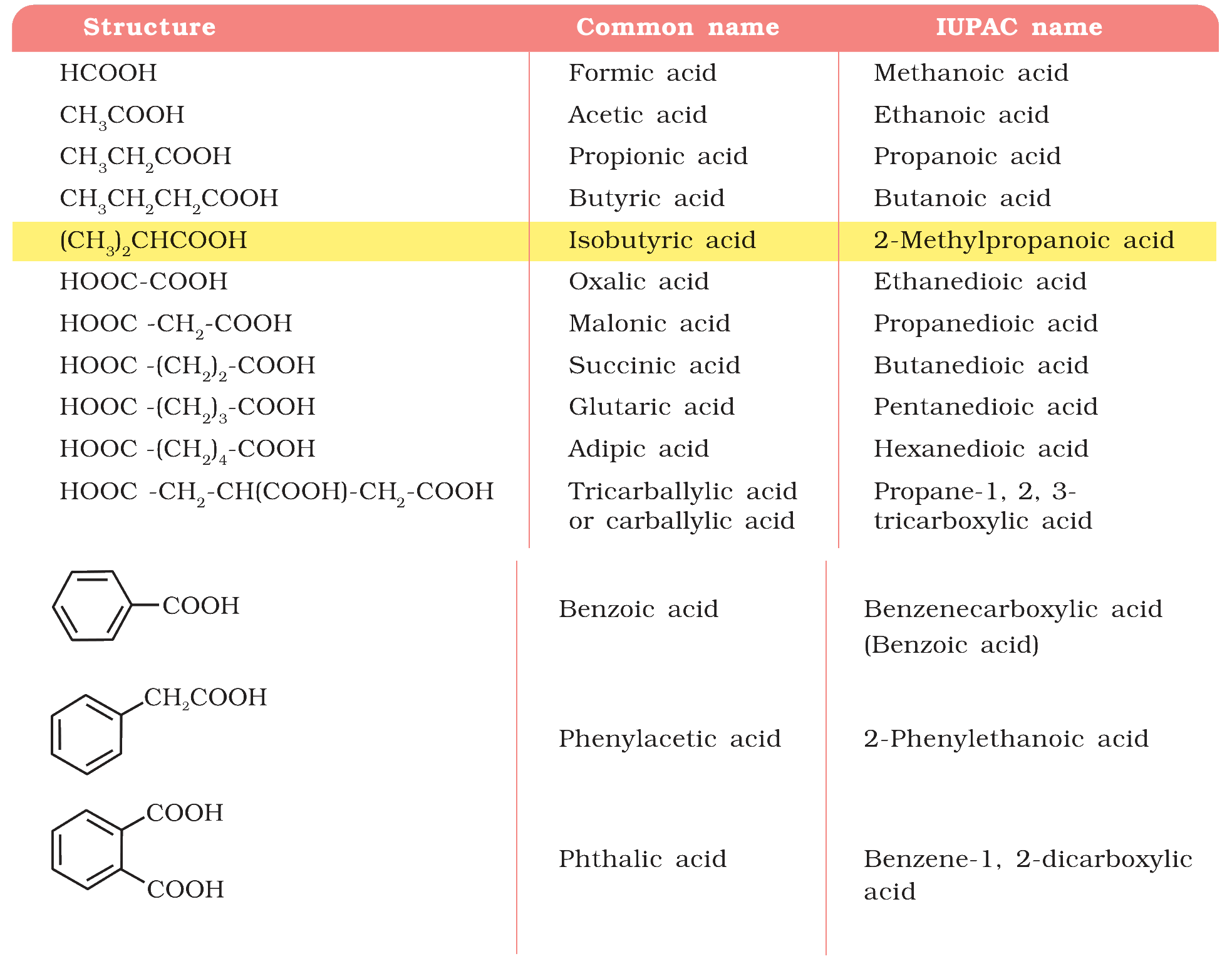
The correct answer is Option (3) → Isobutyric acid
A Grignard reagent adds to carbon dioxide to give a magnesium salt of a carboxylic acid, and acid hydrolysis frees the acid. The \( \ce{CO2} \) carbon becomes the –COOH carbon, so the acid has one carbon more than the alkyl group, and the alkyl group keeps its shape.
Isopropylmagnesium bromide, \( \ce{(CH3)2CHMgBr} \), has a three-carbon branched alkyl group:
\( \displaystyle \ce{(CH3)2CHMgBr + CO2} \xrightarrow{\text{dry ether}} \ce{(CH3)2CHCOOMgBr} \)
\( \displaystyle \ce{(CH3)2CHCOOMgBr + H2O} \xrightarrow{\ce{H^+}} \ce{(CH3)2CHCOOH + Mg(OH)Br} \)
The product, \( \ce{(CH3)2CHCOOH} \), is 2-methylpropanoic acid, whose common name is isobutyric acid.
Why the other options are incorrect
Option (1) Pentanoic acid — Incorrect. Pentanoic acid has five carbons; it would need a four-carbon Grignard reagent (butylmagnesium bromide). Three carbons plus one from \( \ce{CO2} \) give four.
Option (2) Butanoic acid — Incorrect. Butanoic acid, \( \ce{CH3CH2CH2COOH} \), has four carbons but a straight chain. It comes from propylmagnesium bromide, \( \ce{CH3CH2CH2MgBr} \); the branched isopropyl group gives the branched acid.
Option (4) Propanoic acid — Incorrect. Propanoic acid, \( \ce{CH3CH2COOH} \), has three carbons and comes from ethylmagnesium bromide. The isopropyl group already has three carbons before \( \ce{CO2} \) adds one.
NCERT (2026-27 edition):
8.7 Methods of Preparation of Carboxylic Acids
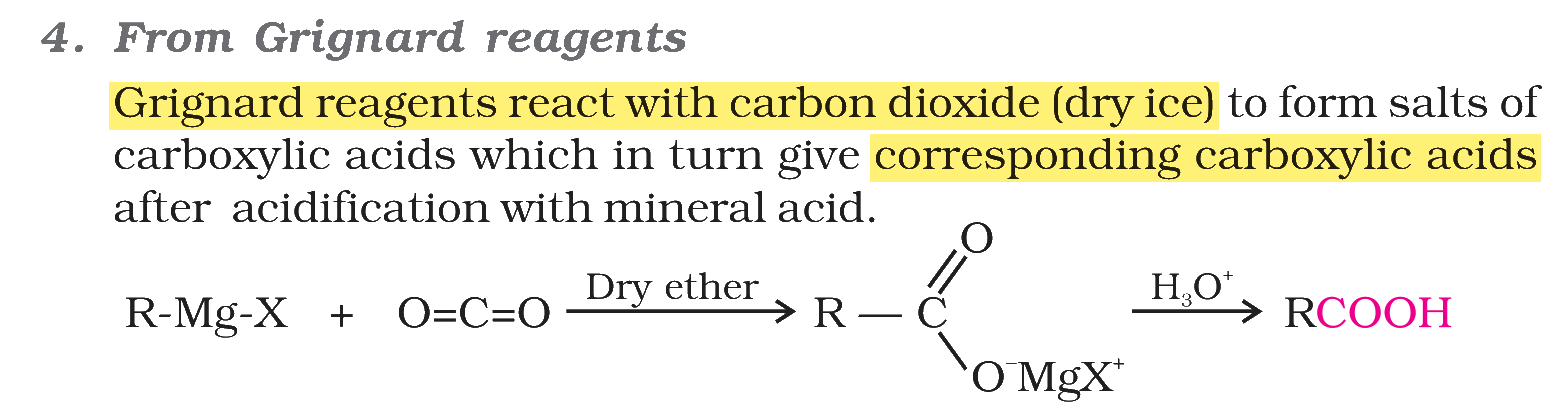
“As we know, the Grignard reagents and nitriles can be prepared from alkyl halides (refer Unit 6, Class XII). The above methods (3 and 4) are useful for converting alkyl halides into corresponding carboxylic acids having one carbon atom more than that present in alkyl halides (ascending the series).”
Table 8.3 Names and Structures of Some Carboxylic Acids