
Read the given passage and answer the following questions.
Determining the biochemical nature of genetic material and the structure of DNA was very exciting, the proposition and deciphering of genetic code were most challenging. In a very true sense, it required involvement of scientists from several disciplines – physicists, organic chemists, biochemists and geneticists. It was George Gamow, a physicist, who argued that since there are only 4 bases and if they have to code for 20 amino acids, the code should constitute a combination of bases. He suggested that in order to code for all the 20 amino acids, the code should be made up of three nucleotides. This was a very bold proposition, because a permutation combination of 43 (4 × 4 × 4) would generate 64 codons; generating many more codons than required. The codon is triplet. 61 codons code for amino acids and 3 codons do not code for any amino acids, hence they function as stop codons. Some amino acids are coded by more than one codon, hence the code is degenerate. The codon is read in mRNA in a contiguous fashion. There are no punctuations. The code is nearly universal: for example, from bacteria to human UUU would code for Phenylalanine (phe). Some exceptions to this rule have been found in mitochondrial codons, and in some protozoans. AUG has dual functions. It codes for Methionine (met) , and it also act as initiator codon. UAA, UAG, UGA are stop terminator codons.
Francis Crick postulated an adapter molecule that would, on one hand, read the code and, on the other hand, bind to specific amino acids. Which molecule plays this role?
Answer & explanation
Correct answer: option 3
The correct answer is Option (3) → tRNA
Amino acids have no structure that can read the bases of a codon. So Francis Crick argued that some molecule must stand between the two. It would read the codon on one side and carry a specific amino acid on the other. This adapter turned out to be tRNA. Its anticodon loop pairs with the codon on the mRNA, and its acceptor end carries the amino acid (Figure 5.12).
Option (1) mRNA — Incorrect. mRNA carries the codons. It is the molecule that is read during translation, so it cannot be the adapter that reads it.
Option (2) rRNA — Incorrect. rRNA is part of the ribosome. It plays structural and catalytic roles; for example, 23S rRNA in bacteria acts as the enzyme that forms the peptide bond. It does not carry amino acids to the codons.
Option (3) tRNA — Correct. tRNA has an anticodon loop that pairs with the codon and an amino acid acceptor end that binds the amino acid. It links the code to the amino acids, which is the adapter role.
Option (4) hnRNA — Incorrect. hnRNA (heterogeneous nuclear RNA) is the primary transcript in eukaryotes. It holds both exons and introns and is processed into mRNA by splicing, capping and tailing. It is not the adapter.
NCERT Extract:
tRNA – the Adapter Molecule – “From the very beginning of the proposition of code, it was clear to Francis Crick that there has to be a mechanism to read the code and also to link it to the amino acids, because amino acids have no structural specialities to read the code uniquely. He postulated the presence of an adapter molecule that would on one hand read the code and on other hand would bind to specific amino acids. The tRNA, then called sRNA (soluble RNA), was known before the genetic code was postulated. However, its role as an adapter molecule was assigned much later. tRNA has an anticodon loop that has bases complementary to the code, and it also has an amino acid acceptor end to which it binds to amino acids.”
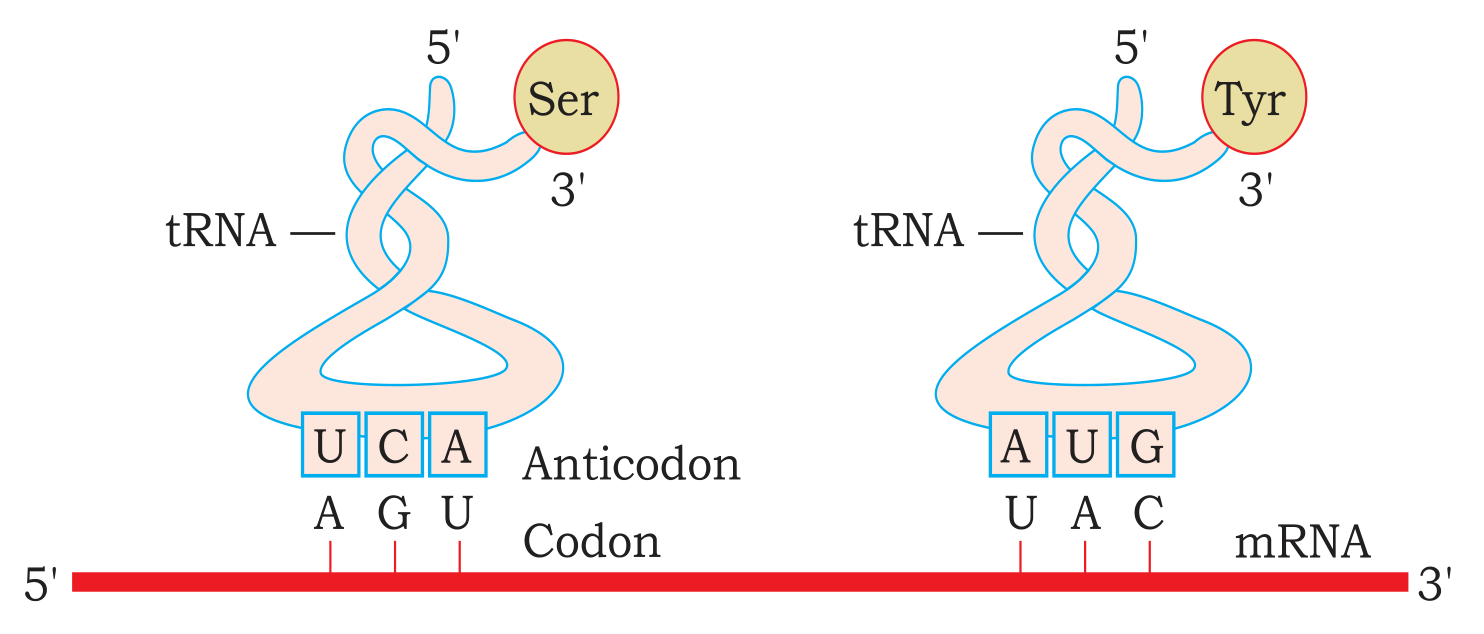
Figure 5.12 tRNA - the adapter molecule