
Answer & explanation
Correct answer: option 3
The correct answer is Option (3) → 3,3-Dimethylbut-1-ene with B2H6, then H2O2/OH−
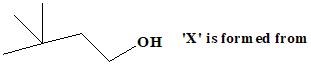
X is 3,3-dimethylbutan-1-ol, \( \ce{(CH3)3CCH2CH2OH} \): the –OH is on the terminal carbon. Of the alkenes given, only 3,3-dimethylbut-1-ene has the right carbon skeleton, and the –OH must be added against Markovnikov’s rule.
Hydroboration–oxidation does this. Diborane adds to the double bond with boron going to the less substituted carbon; oxidation of the trialkylborane by alkaline \( \ce{H2O2} \) replaces B by OH. The net result is addition of water in an anti-Markovnikov way, with no carbocation (and so no rearrangement):
\( \ce{(CH3)3C-CH=CH2} \xrightarrow[\ce{(ii) H2O2/OH^-}]{\ce{(i) B2H6}} \ce{(CH3)3C-CH2-CH2OH} \)
Why the other options are incorrect
Option (1) 3,3-dimethylbut-1-ene, H2O2/H+ — Incorrect. Acid-catalysed hydration goes through a carbocation; it would put the –OH on C-2 (Markovnikov), and the 2° cation rearranges to the 3° one, giving 2,3-dimethylbutan-2-ol.
Option (2) 2,3-dimethylbut-2-ene, H2O2/H+ — Incorrect. The skeleton is wrong (two \( \ce{CH3} \) groups on different carbons); it gives 2,3-dimethylbutan-2-ol.
Option (4) 2,3-dimethylbut-1-ene, H2O2/H+ — Incorrect. Again the wrong skeleton, and Markovnikov addition gives the tertiary alcohol 2,3-dimethylbutan-2-ol.
NCERT (2026-27 edition):
By Hydroboration–Oxidation – “Diborane (BH3)2 reacts with alkenes to give trialkyl boranes as addition product. This is oxidised to alcohol by hydrogen peroxide in the presence of aqueous sodium hydroxide. The addition of borane to the double bond takes place in such a manner that the boron atom gets attached to the sp2 carbon carrying greater number of hydrogen atoms. The alcohol so formed looks as if it has been formed by the addition of water to the alkene in a way opposite to the Markovnikov’s rule. In this reaction, alcohol is obtained in excellent yield.”