
Identify product ‘A’ in the reaction shown below:
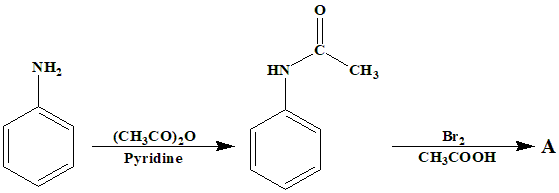
Answer & explanation
Correct answer: option 2
The correct answer is Option (2) → p-Bromoacetanilide
The –\( \ce{NH2} \) group makes the ring so reactive that aniline with bromine water gives 2,4,6-tribromoaniline. To get a monosubstituted product, the –\( \ce{NH2} \) group is first protected by acetylation:
\( \displaystyle \ce{C6H5NH2 + (CH3CO)2O} \xrightarrow{\text{pyridine}} \ce{C6H5NHCOCH3 + CH3COOH} \)
In acetanilide the nitrogen lone pair is partly drawn towards the C=O group by resonance, so –\( \ce{NHCOCH3} \) activates the ring less than –NH2 and bromination stops at one bromine. The group is still ortho, para directing, and its bulk hinders the ortho positions, so bromine enters mainly at the para position:
\( \displaystyle \ce{C6H5NHCOCH3 + Br2} \xrightarrow{\ce{CH3COOH}} p\text{-}\ce{BrC6H4NHCOCH3 + HBr} \)
Why the other options are incorrect
Option (1) p-Bromoaniline — Incorrect. It has a free –\( \ce{NH2} \); the acetyl group is removed only by a separate hydrolysis step, which is not part of this reaction.
Option (3) o-Bromoacetanilide — Incorrect. It is at most a minor product; the bulky –\( \ce{NHCOCH3} \) group makes para substitution the main path.
Option (4) 2-Aminoacetophenone — Incorrect. It has an acetyl group on the ring and a free –\( \ce{NH2} \); \( \ce{Br2} \) in acetic acid neither moves the acetyl group to the ring nor brings in any bromine in this structure.
NCERT (2026-27 edition):
Bromination – “… The main problem encountered during electrophilic substitution reactions of aromatic amines is that of their very high reactivity. Substitution tends to occur at ortho- and para-positions. If we have to prepare monosubstituted aniline derivative, how can the activating effect of –NH2 group be controlled ? This can be done by protecting the -NH2 group by acetylation with acetic anhydride, then carrying out the desired substitution followed by hydrolysis of the substituted amide to the substituted amine.”