
Read the passage and answer the following questions:
Organisms evolve in their respective habitats to maximise their reproductive fitness, also known as Darwinian fitness, which is often measured by a high "r" value. They adapt to the specific selection pressures present in their environment by developing the most efficient reproductive strategies. This includes variations in breeding frequency and the number and size of offspring produced. Some organisms, such as Pacific salmon fish and bamboo, exhibit a strategy known as semelparity, where they breed only once in their lifetime. In contrast, most birds and mammals follow an iteroparous strategy, breeding multiple times throughout their lives. Additionally, some species, like oysters and pelagic fishes, produce a large number of small-sized offspring, while others, such as birds and mammals, produce a small number of large-sized offspring. The desirable reproductive strategy for maximising fitness depends on the specific conditions and selection pressures within the habitat. Ecologists emphasise that the evolution of life history traits is influenced by the constraints imposed by the abiotic and biotic components of the environment. Factors such as resource availability, competition, predation, and other ecological interactions shape the evolution of these traits. Thus, populations evolve to maximise reproductive fitness in their habitats, and the specific reproductive strategies and traits they adopt depend on the selection pressures and constraints present in their environment. Ecologists investigate these relationships to uncover the mechanisms behind the evolution of life history traits and their ecological significance.
When resources become progressively limiting, a plot of population density (N) against time (t) gives:
Answer & explanation
Correct answer: option 2
The correct answer is Option (2) → a sigmoid curve of Verhulst-Pearl logistic growth
Populations grow in two ways. When resources are unlimited, growth is exponential: the population keeps multiplying faster. When resources are limited, the habitat can hold only a maximum number, the carrying capacity (K), and growth becomes logistic.
Option (1) a J-shaped curve of exponential growth — Incorrect. A J-shaped curve is the plot of exponential growth (dN/dt = rN), which happens only when resources are unlimited.
Option (2) a sigmoid curve of Verhulst-Pearl logistic growth — Correct. With limited resources, there is a lag phase, then acceleration, then deceleration, and finally the population levels off at K. This gives a sigmoid (S-shaped) curve, called Verhulst-Pearl logistic growth.
Option (3) a straight line rising without limit — Incorrect. A straight line rising without limit would mean the population never stops growing. Limited resources always stop growth at the carrying capacity.
Option (4) an age pyramid with a broad base — Incorrect. An age pyramid shows the age distribution (pre-reproductive, reproductive and post-reproductive groups) of a population at one time. It is not a plot of N against time.
NCERT Extract:
Population Growth – “… In nature, a given habitat has enough resources to support a maximum possible number, beyond which no further growth is possible. Let us call this limit as nature’s carrying capacity (K) for that species in that habitat. A population growing in a habitat with limited resources show initially a lag phase, followed by phases of acceleration and deceleration and finally an asymptote, when the population density reaches the carrying capacity. A plot of N in relation to time (t) results in a sigmoid curve. This type of population growth is called Verhulst-Pearl Logistic Growth (Figure 11.3).”
Population Growth – “… The above equation describes the exponential or geometric growth pattern of a population (Figure 11.3) and results in a J-shaped curve when we plot N in relation to time.”
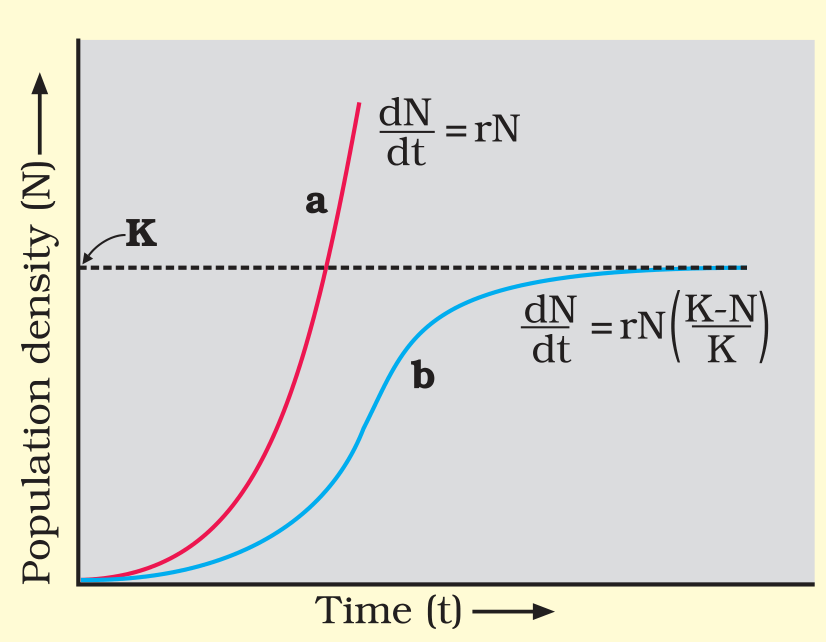
Figure 11.3 Population growth curve a when responses are not limiting the growth, plot is exponential, b when responses are limiting the growth, plot is logistic, K is carrying capacity