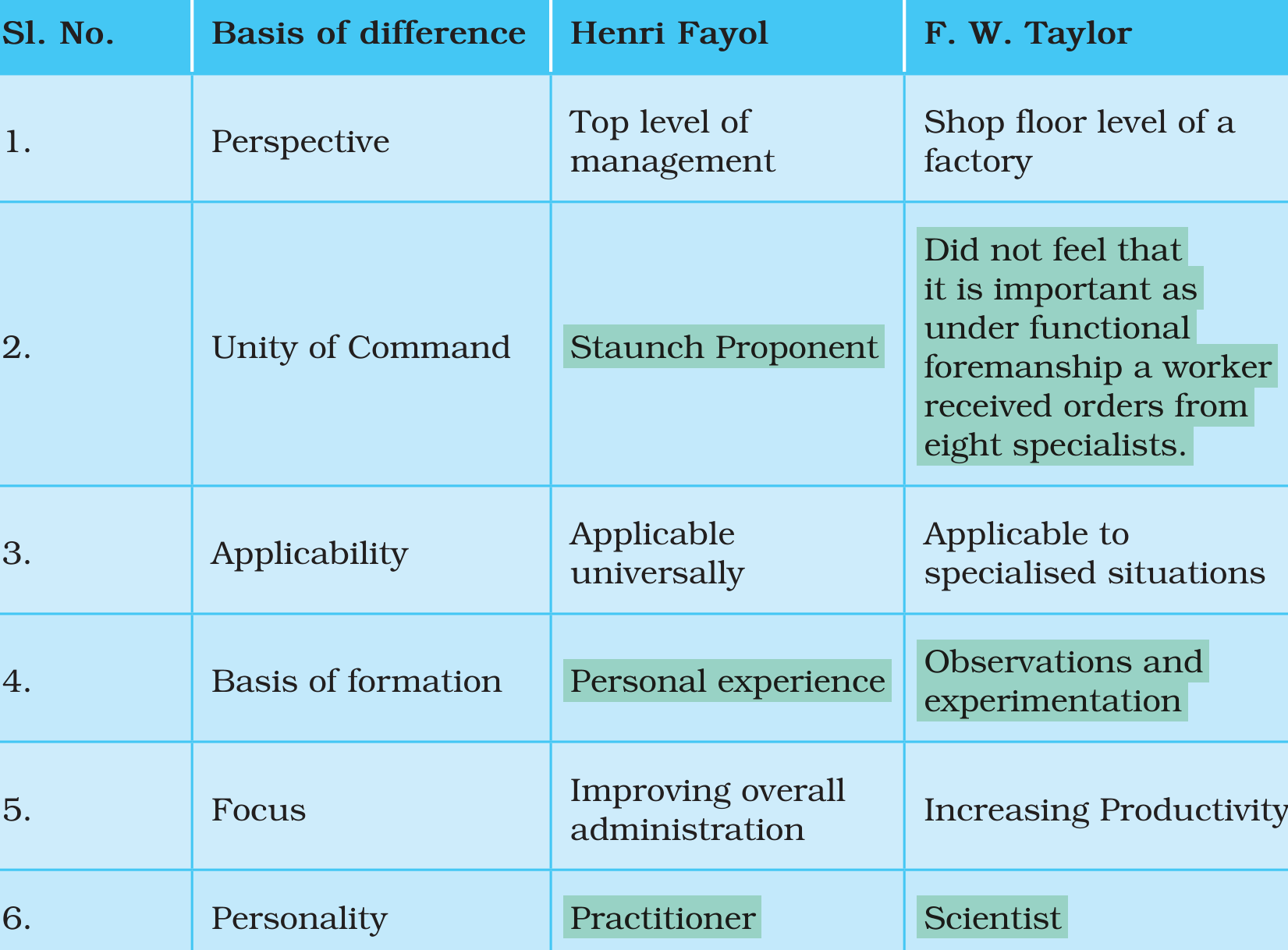
Consider the following statements comparing Henri Fayol and F.W. Taylor:
(A) Fayol’s principles were formed by personal experience, whereas Taylor’s principles were formed by observations and experimentation.
(B) Taylor did not feel that unity of command was important, as under functional foremanship a worker received orders from eight specialists.
(C) Fayol’s focus was on increasing productivity, whereas Taylor’s focus was on improving overall administration.
(D) By personality, Fayol was a practitioner, whereas Taylor was a scientist.
(E) Fayol’s principles were applicable to specialised situations, whereas Taylor’s principles were applicable universally.
Which of the statements given above are correct?
Choose the correct answer from the options given below:
Answer & explanation
Correct answer: option 4
The correct answer is Option (4) → (A), (B) and (D) only
(A) Fayol's principles were formed by personal experience, whereas Taylor's principles were formed by observations and experimentation. — Correct. Fayol drew on his personal experience. Taylor worked from observations and experimentation.
(B) Taylor did not feel that unity of command was important, as under functional foremanship a worker received orders from eight specialists. — Correct. Fayol was a staunch supporter of unity of command. Taylor’s functional foremanship gave each worker eight bosses, so he did not hold it important.
(C) Fayol's focus was on increasing productivity, whereas Taylor's focus was on improving overall administration. — Incorrect. The two are reversed. Fayol focused on improving overall administration; Taylor focused on increasing productivity.
(D) By personality, Fayol was a practitioner, whereas Taylor was a scientist. — Correct. Fayol was a practitioner who ran a company. Taylor was a scientist who tested methods.
(E) Fayol's principles were applicable to specialised situations, whereas Taylor's principles were applicable universally. — Incorrect. This is also reversed. Fayol’s principles apply universally; Taylor’s apply to specialised situations.
NCERT (2026-27 Edition):
|