CUETMOCK
  • Pricing
  • Mentors
Log inStart freeStart free mocks→

First test, then trust

Try a free CUET mock test.

Join 5,00,000+ students who rehearsed exam day on the exact NTA screen before sitting CUET. On the web and on Android.

Start free mocks →Get the Android app
CUETMOCK

India's #1 CUET Mock Test Platform. Original NCERT-based questions on the exact NTA exam screen — trusted by 5,00,000+ students since CUET 2022.

Get it onGoogle PlayScan to download the CUETMOCK app

Mock tests

  • CUET mock test series
  • Browse all papers
  • Commerce mocks
  • Humanities (Arts) mocks
  • Science mocks
  • Languages & GAT mocks
  • Free practice questions
  • Pricing

Resources

  • CUET exam guide
  • CUET syllabus
  • Universities accepting CUET
  • Expert blogs
  • News & notifications
  • Webinars & counselling
  • CUET score calculator
  • How we estimate your rank
  • FAQs

Company

  • About us
  • Our leadership & team
  • Our toppers
  • Mentors
  • For schools
  • Contact us
  • Terms
  • Privacy
  • Refund policy

Talk to us

+91 7696 6630 56info@cuetmock.comWhatsApp us

Our other platforms

  • JEE Mock — For IIT-JEE aspirants
  • NEET Mock — For NEET aspirants

Newsletter

Exam updates, study material and offers — no spam.

© 2026 NYC Ventures Pvt. Ltd.

701-702, Royal Business Park, Zirakpur, Punjab - 140603

  • Terms of use
  • Privacy policy
  • Refund policy
  • Contact us

iCUETMOCK is an independent preparation platform, not affiliated with the National Testing Agency (NTA). Always check exam details on the official NTA website.

  • Home
  • Mock tests
  • CUET guide
  • Pricing
  • Log in
Home/Practice questions/Sociology
SociologyIndian Society: Demographic Structure of Indian Society

Arrange the following five census years (1941 - 1981) in terms of urb…

Arrange the following five census years (1941 - 1981) in terms of urban population share from lowest to highest.

(A) 1941

(B) 1951

(C) 1961

(D) 1971

(E) 1981

Choose the correct answer from the options given below:

Answer & explanation+

Correct answer: option 2

The correct answer is Option (2) → (A), (B), (C), (D), (E)

The urban population has been increasing its share steadily through the twentieth century, so the census years fall in the same order as time:

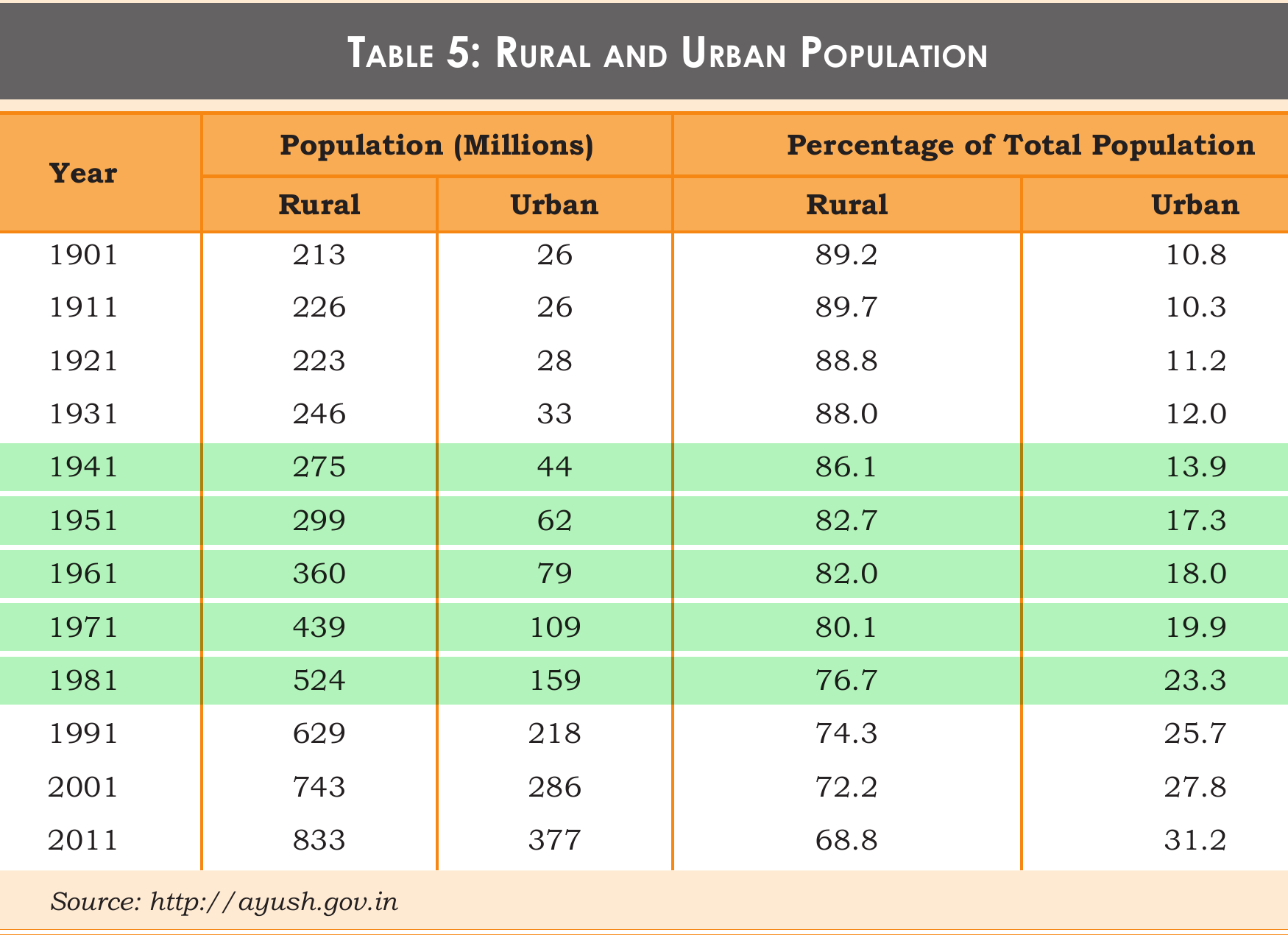
  • (A) 1941 — 13.9 per cent urban.

  • (B) 1951 — 17.3 per cent urban.

  • (C) 1961 — 18.0 per cent urban.

  • (D) 1971 — 19.9 per cent urban.

  • (E) 1981 — 23.3 per cent urban.


NCERT (2025-26): “2.6 Rural-Urban Differences … The vast majority of the population of India has always lived in the rural areas, and that continues to be true. According to Census of India 2011 still more people are living in rural areas but the population of urban areas has increased. Now 68.8% population lives in rural areas while 31.2% people live in urban areas. However, as Table 5 shows, the urban population has been increasing its share steadily, from about 11% at the beginning of the twentieth century to about 28% at the beginning of the twenty-first century, an increase of about two-and-a-half times. It is not a question of numbers alone; processes of modern development ensure that the economic and social significance of the agrarian-rural way of life declines relative to the significance of the industrial-urban way of life. This has been broadly true all over the world, and it is true in India as well.”

NCERT extract

Table 5: Rural and Urban Population

Advertisement

Practise more on Indian Society: Demographic Structure of Indian Society

Chapter-wise mocks on the real NTA exam screen, with solutions and your rank. Your first mocks are free.

Start free mocks →

Advertisement

Next questions

  1. Which of the following is the main reason for the development of a dense air network in the Eastern U.S.A.?Geography · Fundamentals of Human Geography: Transport and Communication
  2. A delusion is defined as _______.Psychology · Psychological Disorders
  3. Which one of the following is not related to the beginning of an era of coalition government?Political Science · Politics in India Since Independence: Recent Developments in Indian Politics
  4. A sum of ₹25600 is lent out in two parts in such a way that the interest on one part at 7% for 5 years is equal to that on another part at…General Aptitude Test · Numerical Ability
  5. This question consists of a paragraph followed by four statements. You are required to read the paragraph carefully and select one statemen…General Aptitude Test · Verbal Reasoning
  6. The Suez Canal connects which two ports ?Geography · Fundamentals of Human Geography: Transport and Communication
  7. Select the default extension of MS Access (2007) file:Accountancy Part A · Database Management System for Accounting
  8. Why is the worker-population ratio lower in urban areas than in rural areas in India?Economics · Indian Economic Development: Employment - Growth, Informalisation and Other Issues
  9. Which among the following cells synthesize and secrete testicular hormones called androgens ?Biology · Human Reproduction
  10. Area of ΔAFC isGeneral Aptitude Test · Quantitative Reasoning